Market View
J200 110,096.00 -1.10% J203 117,889.00 -1.06% J210 136,255.00 -0.76% J211 129,762.00 -1.31% J212 25,150.00 -1.30% J213 140,469.00 -1.31%
Winning Shares (Top 5)
Code Name Added Price Latest % Gain % Gain/Year
FFB FORTRESSB 2024-06-19 1664 2455 +47.54% +25.22%
CHP CHOPPIES 2025-03-06 85 175 +105.88% +90.30%
SSK STEFSTOCK 2024-06-22 146 654 +347.95% +185.40%
KAP KAP 2026-04-30 240 259 +7.92% +361.20%
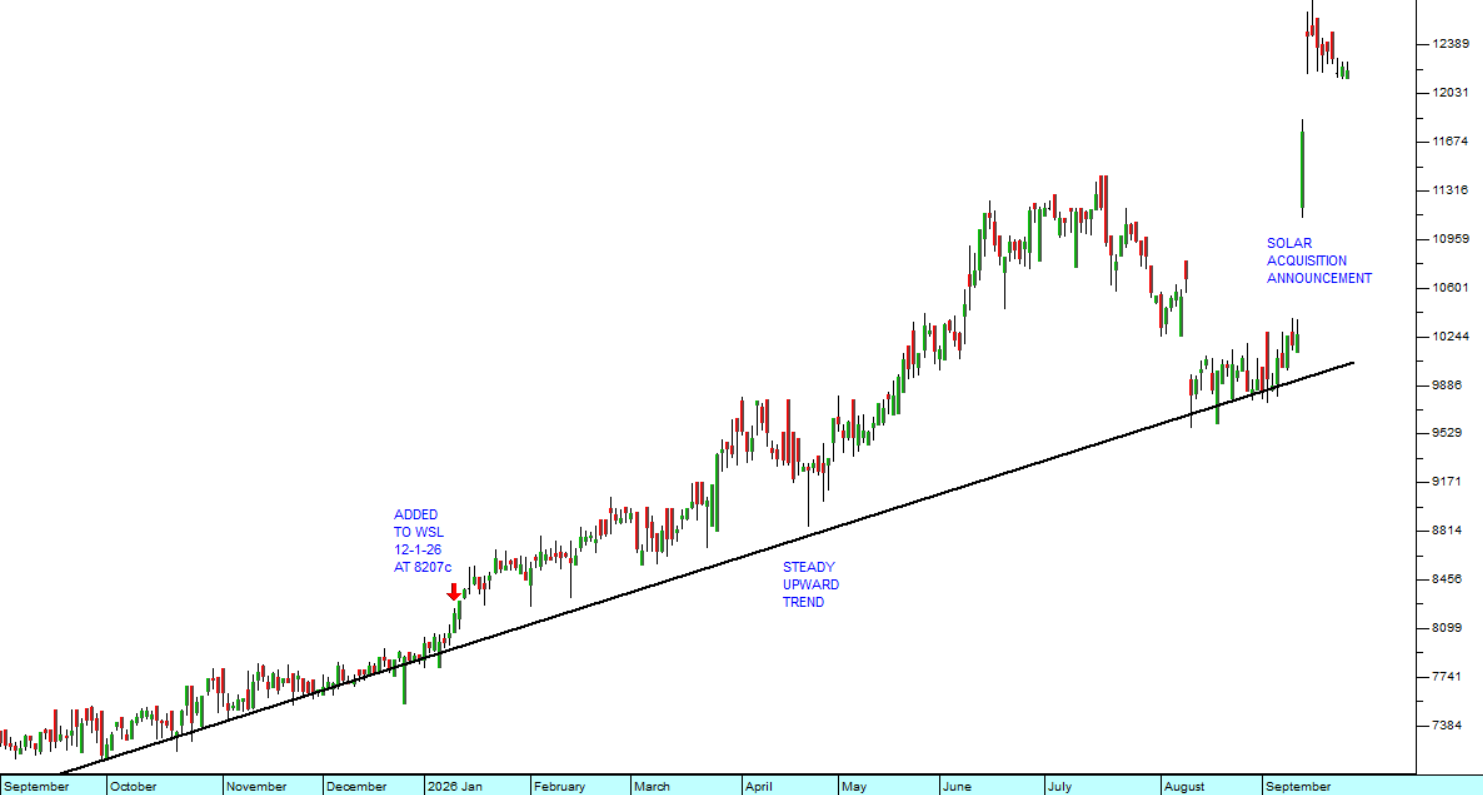
OMN OMNIA 2026-01-13 8207 9607 +17.06% +54.14%
Opinions (Top 5)
Code Name Date Action
NRL NEWPARK 2026-05-10 View

Newpark is a South African real estate investment trust (REIT) which has commercial and industrial properties worth R1,37bn and with a gross lettable area (GLA) of 57249 square meters. It owns four properties - two in Sandton CBD and one in Linbro Business Park and one in Crown City.

In its results for the six months to 31st August 2025 the company reported headline earnings per share down 0,6% and net asset value (NAV) down 3,8% to 562c per share. The company said, "Revenue for the six months ended 31 August 2025 was R63,8 million, a decrease of 7,3% compared to the same period in H1 FY2025, and operating profit before fair value adjustments was R44,5 million (down 3,2%).

The decrease in revenue and operating profit was predominantly as a result of the reversion in the JSE rental in accordance with the terms of their new lease." In a trading statement for the year to 28th February 2026 the company estimated that its dividend per share (DPS) would decrease by 36,1%. The enduring problem has always been that its shares were extremely thinly traded and therefore not suitable for the private investor.

However, from April 2026 the volumes traded have picked up and are now averaging R2300 per day. If they continue increasing perhaps the share could become more interesting.

TFG TFG 2026-05-10 View

The Foschini Group (TFG) is an international retailer of 28 fashion brands. It has 4083 trading outlets in 32 countries around the world. It has a division in London and one in Australia, aside from its extensive presence in the South African market. One of the notable achievements of TFG is that it has managed to establish a successful business in Australia where many other retailers (like Woolworths) have failed.

TFG bought the Retail Apparel Group (RAG) in Australia for just over $300m in 2017. TFG has allowed the Australian management team virtual autonomy in the management of the business and has not attempted to manage it from South Africa. Over the long term, TFG has been a consistent performer in one of the most difficult industries in South Africa, with stiff competition from overseas brands and local clothing retailers.

We regard TFG as the best of the retail clothing companies and it is well diversified overseas which gives it a rand hedge element. Retail is normally very much impacted by the business cycle, but the TFG board has shown its ability to manage the business profitably in many difficult environments where others have failed.

In its results for the six months to 30th September 2025 the company reported revenue up 12,2% and headline earnings per share (HEPS) down 21,3%. The company said, "Trading conditions remain challenging across Africa, the UK, and Australia with sales growth of 12,7% supported mainly by the acquisition of White Stuff.

In Africa, market sales declined sharply in June and September, with gross margins pressured by clearance activities to liquidate remaining winter stock after slower sales. In the UK and Australia, continued cost-of-living pressures contributed to subdued sales." In a trading statement for the year to 31st March 2026 the company estimated that HEPS would be between 30% and 40% lower.

From December 2024 TFG has been in a downward trend. We believe that this remains a very well-managed company which should be accumulated on weakness. Wait for a break up through the 200-day moving average before investigating further. 

DTC DATATEC 2026-05-10 View

Datatec (DTC) is an international IT and telecommunications company operating in more than fifty countries. It operates in the United States, South America, Europe, Africa, the Middle East, and Asia. Its business is divided into three main divisions - technology distribution through Westcon International, integration and managed services through Logicalis, and consulting and financial services through Datatec Financial Services and Analysys Mason.

The CEO, Jens Montanana, is a 10% shareholder. In its results for the six months to 31st August 2025 the company reported revenue up 2,9% and headline earnings per share (HEPS) up 109,5%. The company pointed to, "Continued margin expansion and strong profit growth trajectory in Westcon with growing recurring software and services mix.

Strong operating leverage in Logicalis International driving excellent performance. Considerably improved financial performance in Latin America." In a trading update for the year to 28th February 2026 the company reported gross profit up 10% to $998m. The company said, "...an increasing proportion of software and services is accounted for on a net* basis, which affects comparability of reported revenues with prior periods".

In a trading statement for the year to 28th February 2026 the company estimated that HEPS would increase by between 51% and 58,8%. Technically, the share although volatile, has been recovering since September 2024. It was added to the Winning Shares List (WSL) on 26th October 2024 at 3950c and it has subsequently risen to 7801c (7-5-26).

We believe it will continue to perform, especially as the use of artificial intelligence (AI) becomes more widespread. 

FGL FINBOND 2026-05-10 View

Finbond (FGL) is a micro-lending and insurance operation which operates in South Africa and America. This company wants to expand in the US to the point where 70% to 80% of its income is derived from that country within 3 to 5 years. It already has 66% of its income coming from the US and believes that the US offers significant growth opportunities.

Including South Africa, Finbond has a total of 694 branches. In its results for the six months to 31st August 2025 the company reported revenue up 13,4% and headline earnings per share (HEPS) of 11c compared with a loss of 2,3c in the previous period. The company reported, "Profit after tax attributable to owners increased 598.9% to R52.8 million (August 2024: Loss of R10.6 million).

Net asset value per share improved 7.2% to 148.9 cents (August 2024: 138.8 cents)". In a trading statement for the year to 28th February 2026 the company estimated that HEPS would be at least 2,9c per share compared with a loss in the previous period of 1,9c. Technically, the share was in a long-term a downward trend and has been moving upwards since March 2022.

It trades about R79 000 worth of shares each day on average which makes it viable for a small investment. We believe that there may be better options than this penny stock, but it has begun to move up.

GFI GFIELDS 2026-05-10 View

Gold Fields (GFI) is a relatively high-cost international gold mining house with a single mine in South Africa - South Deep. South Deep was bought by Gold Fields in 2006 and it has struggled to make the mine profitable, pouring in a total of R32bn (R22bn purchase price plus R10bn in development costs) into it over the past 14 years.

Brett Kebble once described South Deep as, "The world's most expensive long drop...". South Deep is 3 kilometres deep and a very difficult mine with many technical complications, but it is the second largest unmined gold resource in the world - hence Gold Field's persistence. Gold Fields is working with an independent power producer (IPP) to build a 50MW project in SA.

The company has spent a total of $502m over the past two years to ensure that Damang and Gruyere (international operations) would produce 2 million ounces a year for the next ten years. South Deep now has R800m less in costs and R400m less in capital expenditure. The company is focusing on bringing the new Salares Norte gold mine in Chile into production.

On 11th July 2022 the company said that it would list on the Toronto Stock Exchange and that it would adopt a dividend policy of paying between 30% and 45% of profits out.  Its protracted investment in South Deep is definitely beginning to pay off with output expected to rise by about 25% over the next 4 years. On 12th August 2024 the company announced that it had acquired the remaining 50% of Osisko Mining for $1,57bn (R29bn).

In its results for the year to 31st December 2025 the company reported attributable profit of $3.99 per share compared with $1.39 in the previous year. Headline earnings per share (HEPS) increased to 288c from 133c. The company said, "Gold produced and sold throughout this report includes copper gold equivalents of approximately 3% and silver gold equivalents of approximately 1% of Group production, respectively".

In an update on the 3 months to 31st March 2026 the company reported gold-equivalent production up 15% and all-in sustaing costs (AISC) up 13%. The company said, "...we delivered strong cash flow generation in the quarter, driven by increased sales volumes and higher gold prices.

Net debt decreased by 34% YoY to US$1,304m as at 31 March 2026 (Q1 2025:US$1,981m)". Technically, the share is volatile and subject to shifts in the international price of gold, but it has been in a strong upward trend over the past five years. It remains a volatile commodity play and hence volatile.

Its was added to the Winning Shares List (WSL) on 4th February 2025 at a price of 32915c. It has subsequently risen to 76150 (7-5-26).

Winning Share: KAP
Opinion: GFI
Record Highs  (2026-04-28)

Wall Street’s relationship with Trump is evolving. At the start of his current term, when he was playing with the US tariff system, everything he said moved the markets. Today, tariffs have completely lost their force in the market and Trump has moved on to being a warmonger instead. His attack on…

Wall Street’s relationship with Trump is evolving. At the start of his current term, when he was playing with the US tariff system, everything he said moved the markets. Today, tariffs have completely lost their force in the market and Trump has moved on to being a warmonger instead.

His attack on Venezuela did not move the markets, but it boosted his confidence and made him easy prey for Israel’s Netanyahu, allowing him to embroil the US in a war which does absolutely nothing for America and has certainly damaged Trump’s mid-term election prospects beyond repair.

The US/Iran war has reached a stalemate with both sides closing the Strait of Hormuz and both sides seizing commercial ships in the vicinity. What is interesting is that while the price of North Sea Brent oil has now climbed back above $105 per barrel, the S&P500 index has made yet another new all-time record high.

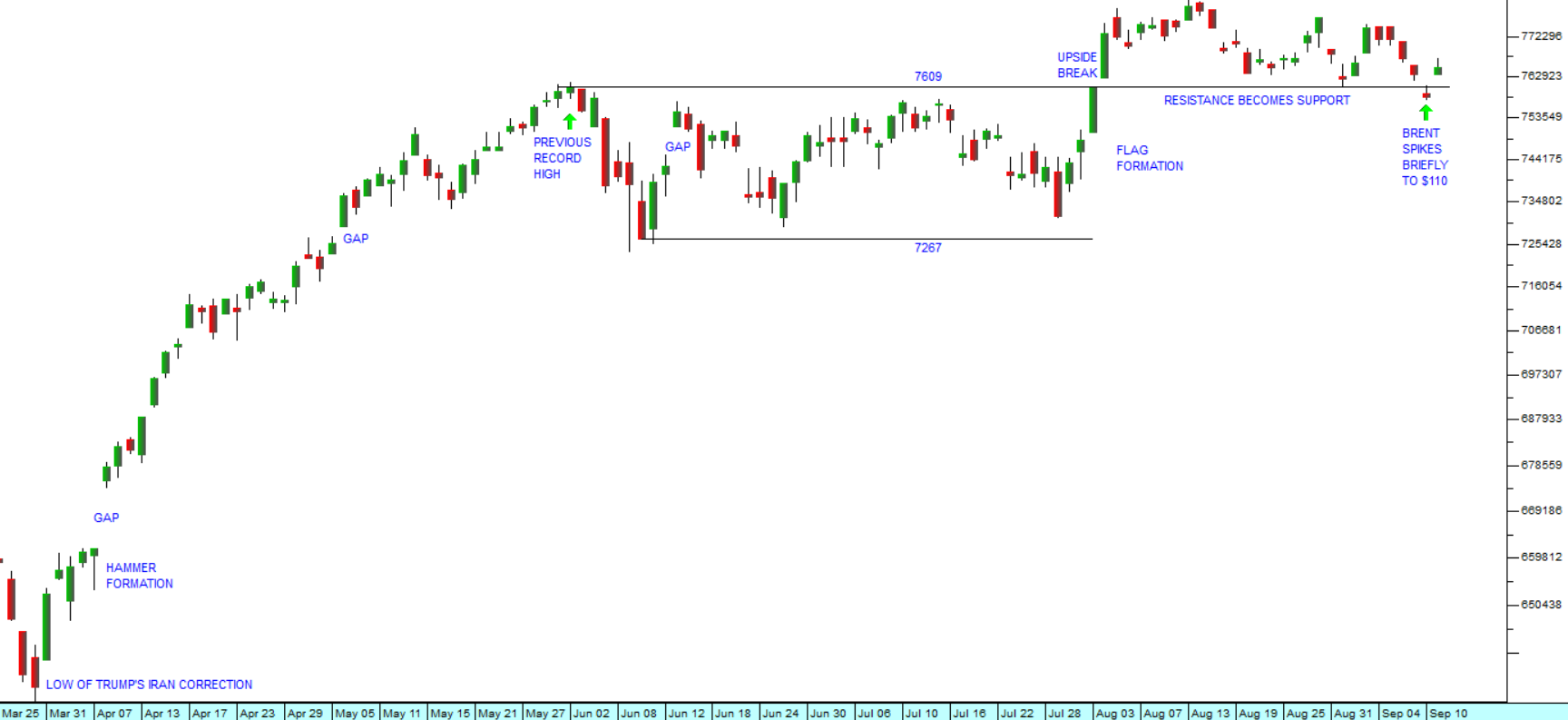
Investors are clearly looking beyond the oil price to the excellent results and predictions coming out of S&P500 companies, and especially the “magnificent seven”. Consider the chart:

S&P500 Index : 28th of October 2025 - 24th of April 2026. Chart by ShareFriend Pro.

The chart shows the previous 5% correction in November last year and then Trump’s Iran war correction which broke to a lower low and created the opportunity for a TACO trade. You will note the important hammer formation on 7th April 2026 which gave a clear early warning that a strong recovery was coming. Note also that the 50-day moving average turned upwards again, away from the 200-day – indicating that a death cross had been averted.

The general investor perception is that the Iran war is a temporary phenomenon which will be resolved one way or another relatively soon. The primary impact of the higher oil price, while negative for the economy, has been to seriously erode Trump’s MAGA support base. It is also having the effect accelerating the movement away from fossil fuels towards renewables.

There is now concrete evidence that somebody in Trump’s camp has been profiting massively from his announcements on the war in Iran. There are three clear instances of insider trading in the oil futures market coming immediately prior to his announcements:

  1. On 23rd March 2026, a $500m short placed 15 minutes before Trump announced a delay in Iranian strikes.
  2. On 7th April 2026, a $950m short placed immediately before Trump announced the US-Iranian ceasefire.
  3. On 17th April 2026, a $760m short, placed minutes before the opening of the Strait of Hormuz was declared by Trump.

The Commodity Futures Trading Commission (CFTC) is investigating these trades.

MAGA has been blithely unconcerned about the fact that Trump is inter alia a convicted criminal, a rapist, an inveterate liar or that he and his minions have been engaged in blatant insider trading. MAGA is, however, very much concerned about the price of petrol (“gas”) which has remained stubbornly above $4 per gallon since the war began.

At the same time, the stock market is bracing for the biggest wave of initial public offers (IPO) in its history with SpaceX, Open AI and Anthropic all planning to come to the market later this year. They are endeavouring to raise a total of $3 trillion led by SpaceX’s $1,75 trillion offer. Open AI is looking for about $1 trillion and Anthropic wants $380bn. What is interesting about this is that all three companies are currently running at a loss. Space X, particularly, reported a loss of $5bn last year on revenues of $18,6bn.

This almost looks like the start of a top-of-market listings boom. Investors are losing sight of the underlying fundamentals and focusing only on blue sky potential. With its latest all-time record high last Friday, the S&P500 is now trading at an historical price:earnings ratio (P:E) above 30 – which must be compared with the median average for that index of between 15 and 18. In other words the index is discounting a substantial increase in earnings for its component companies.

Can that be justified? We believe that it can. There is little doubt that the productivity benefits of AI have only just begun to impact the profits of S&P500 companies – let alone other emerging new technologies like humanoid robotics. We believe that the bull trend will continue – but your best defence against a market collapse remains your stop-loss strategy.

PSG Financial Services  (2026-04-20)

Now that the TACO trade associated with Trump’s war in Iran is over and markets are again posting new all-time record highs, it is worth noting that the JSE has not yet recovered completely and the JSE Overall Index (J203) is still 5,6% below its record high of 128456 made on 27th February 2026. As…

Now that the TACO trade associated with Trump’s war in Iran is over and markets are again posting new all-time record highs, it is worth noting that the JSE has not yet recovered completely and the JSE Overall Index (J203) is still 5,6% below its record high of 128456 made on 27th February 2026.

As an emerging market, the JSE always tends to be more volatile than first world markets – which means it falls further and goes higher. The JSE fell a total of 14,3% during this correction where the S&P500 fell by only 8,8%. It is also important to understand that the markets of the world (including the JSE) always tend to follow Wall Street – so we should expect the JSE Overall index to break to a new record high fairly soon. Consider the chart:

JSE Overall Index : 10th of December 2025 - 17th of April 2026. Chart by ShareFriend Pro.

Our Winning Shares List (WSL) is still dominated by commodity shares like Sasol, Pan African, Southern Palladium and Anglogold, so there are still investment opportunities to be found among the blue-chip industrials and financials.

One such blue chip is PSG Financial Services (KST). KST has been spun out of PSG which has spawned many very successful JSE listings like Capitec, and Curro. KST is a thoroughly South African company that has a long track record of excellent performance.

Its business consists primarily of asset management and insurance. In its results for the year to 28th February 2026 the company reported R540bn of assets under management (AUM), up 20% from the year before. It also reported its gross written premiums up 5% to R8bn. The company’s core income increased by 22% to R8,28bn and its recurring headline earnings per share (HEPS) rose by a whopping 34%. These are excellent results. Consider the chart:

PSG Financial Services (KST) : March 2024 - 17th of April 2026. Chart by ShareFriend Pro.

KST has been in a steady upward trend since March 2024. We added it to the Winning Shares List (WSL) on 23rd May 2024 at 1610c and since then it has nearly doubled to 2865c.

Like most blue-chip shares trading on the JSE, KST shares fell as a result of the war in Iran and the sharp rise in the price of oil. That sell-off gave private investors a rare opportunity to buy further in to this excellent company.

As a private investor it is important to understand that KST is a services company and has an insignificant working capital requirement, while much of its income is annuity income. Its staff are also highly educated and paid – which means that they are not unionised. Given its long track record of generating profits, this makes it an almost risk-free investment.

Of course, we are not the only ones who are aware of KST’s great performance. The institutional fund managers have long favoured its shares and as a result the shares trade for a relatively high P:E ratio of 21,22 – which compares with the JSE Overall indexes average P:E of 15,34. Nonetheless, it is a good share to accumulate during periods of weakness.

What we said...  (2026-04-13)

The S&P500 index ended last week just 2,3% below its all-time, record high of 6978.6 made on 27th January 2026. It is apparent that the V-bottom caused by Trump’s war in Iran is almost over. We anticipate a new record high on the S&P within the next few weeks. Consider the chart: S&P500 Index : 17th…

The S&P500 index ended last week just 2,3% below its all-time, record high of 6978.6 made on 27th January 2026. It is apparent that the V-bottom caused by Trump’s war in Iran is almost over. We anticipate a new record high on the S&P within the next few weeks. Consider the chart:

S&P500 Index : 17th of November 2025 - 10th of April 2026. Chart by ShareFriend Pro.

In the end, the Trump’s Iran war took the S&P down 8,8%. It did not even fall sufficiently (10%) to be considered an official correction. All markets have periodic corrections and Wall Street was overdue for a downward move at the time that this happened. You will note that the 50-day moving average did not break down through the 200-day moving average – so there was no death cross. And now the 50-day has started to move up again. The hammer formation which occurred on 7th April was probably the clearest indication that the market was returning to normal.

From an investor’s perspective, the result of the US/Israel war in Iran has come down to a temporarily raised oil price. Trump has predictably folded and backed down on all his bombastic rhetoric, leaving other people to clean up the mess. As the dust settles, we expect that the price of North Sea Brent will drift back down and eventually fall below resistance at $60 per barrel. The rand will resume its strengthening trend and the focus of the markets will return to the productivity gains flowing from AI.

One of the great understandings in the markets is that whatever happens, no matter how disastrous it may seem at the time, there is always a way for you as a private investor to turn it into a profitable investment. You just have to understand what is happening and then decide on the best way to position your capital to benefit. You must always see the situation as an opportunity and take advantage.

We really hope that you took our advice and profited from Trump’s war in Iran. Over the past month, we have run four articles about the situation in Iran and advised you as follows:

  1. In our article on 9th March we said, “...the war in Iran will be resolved on some basis - probably because he (Trump) will probably back down in the face of increasing pressure both at home and abroad. If this happens in a relatively short time, the market will turn its attention back to the rapid progress of new technologies and hopefully recover to make a further new all-time record high in due course”. 

  2. In our article on March 16th we said, “We believe that the situation will be resolved and that some degree of normalcy will return sooner or later. When and if that happens, we expect stocks around the world to bounce”.

  3. In our article on March 23rd we said, “So, we see this sell-off on the JSE as a buying opportunity to pick up high-quality shares at bargain prices” and “Buying shares at a time like this can be scary, but remember our maxim: If you don’t feel the risk, then you are probably not going to make any money”.
  1. In our article on 6th April we said, “The impact of artificial intelligence on productivity levels worldwide is a far more important trend and will continue to push markets up for years to come. In the context of that, Trump’s foray into Iran is a mere “bump in the road”. You should take this opportunity to buy high-quality blue-chip shares while they at these low levels”. 
JSE Top 40

110,096.00 (-1.10%)

All Share

117,889.00 (-1.06%)

Financial 15

25,150.00 (-1.30%)

J200
J203
J212
Top Gainers
# Code Name Close (c) % move
1 MTU MANTENGU 38 +26.67%
2 YRK YORK 209 +10.00%
3 DLT DELPROP 34 +6.25%
Top Losers
# Code Name Close (c) % move
1 PPR PUTPROP 502 -16.33%
2 EPE ETHOSCAP 612 -5.26%
3 4SI 4SIGHT 69 -4.17%

Top Movers – Charts

Top Gainer: MTU
Top Loser: PPR