Market View
J200 101,534.00 -1.79% J203 109,829.00 -1.62% J210 102,601.00 -5.25% J211 129,729.00 +1.36% J212 26,325.00 -1.79% J213 143,890.00 -0.19%
Winning Shares (Top 5)
Code Name Added Price Latest % Gain % Gain/Year
BAT BRAIT 2024-09-28 147 213 +44.90% +25.85%
NY1 NINETY-1L 2025-05-28 3790 4433 +16.97% +15.80%
IVT INVICTA 2024-07-09 2875 3650 +26.96% +13.76%
RMH RMBH 2026-04-30 49 49 +0.00% +0.00%
TKG TELKOM 2024-11-16 2884 5790 +100.76% +62.87%
Opinions (Top 5)
Code Name Date Action
GRT GROWPNT 2026-06-25 View

Growthpoint (GRT) is South Africa's largest real estate investment trust (REIT) with a primary listing on the JSE. Prior to COVID-19, it consistently grew its dividends 3% above the inflation rate on average over the last 15 years. The company owns 434 properties in South Africa worth R71bn.

In addition, it has a 62,2% interest in Growthpoint Properties Australia (GOZ) which is listed on the Australian Stock Exchange (ASX) and owns 57 properties worth R49,8bn and an 18,2% investment in ASX-listed Industrial REIT. It also has 4 equity-accounted investments worth R16bn - including a 50% holding of the V&A Waterfront in Cape Town, a 29,4% stake in Global Real Estate Investments which is listed on the London Stock Exchange (LSE) and a 21,6% interest in Global Worth Poland Real Estate (GWRE) which is listed in Warsaw.

Altogether, Growthpoint has 59,2% of its assets in South Africa and 40,8% elsewhere. The company has acquired a 60,8% stake in Capreg which is listed in London and on the JSE and owns 7 properties in the UK worth R14,8bn. We regard Growthpoint as a high-quality blue-chip property group and a solid long-term investment for private investors.

The company is battling with an over-supply of office space following COVID19 and the work-from-home move. In its results for the six months to 31st December 2025 the company reported distributable income per share up 2,3% and revenue up by 2,4%. The company's loan-to-value (LTV) improved slightly to 33,2%.

The company said, "A total of 364 813m² was renewed across 453 leases during the period with 140 632m² (82 leases) in the Logistics & Industrial portfolio, 118 262m² (103 leases) in the Office portfolio and 105 919m² (268 leases) in the Retail portfolio". In an update on the 9 months to 31st March 2026 the company reported, "In the nine-month period, we sold and transferred 21 assets for R2.0bn, realising a profit of R2.7m to book value. Considering our current SA Loan to value ratio (LTV), reduced debt levels and improved cost of capital, we are evaluating a number of strategic acquisitions and development opportunities". Technically, the Growthpoint share has been trending up since October 2023 and looks set to continue in that direction, especially if interest rates continue to fall once the Iran war is over.

In the short-term the share price has been hit by the war in Iran.  The share is still trading well below its NAV. We regard it as a solid, if unexciting, investment. 

SCD SEREIT 2026-06-25 View

Schroder European Real (SCD), Sereit, is a real estate investment trust (REIT) which invests in properties in Europe. The company listed in London and on the JSE on 9th December 2015. It owns a range of properties in high-growth cities across Europe, especially in London, Paris, Frankfurt, and Zurich.

Its properties are logistics, office, retail and leisure and it targets a dividend of 5,5% per annum. In its results for the six months to 31st March 2026 the company reported a net asset value (NAV) of 115,1 euro cents and a loan-to-value (LTV) of 27% with a cash balance of 5,7m euros.

The company said, "...the Board and Investment Manager have reviewed various options to maximise shareholder value and have concluded that a managed wind-down strategy and return of capital is in the best interest of shareholders". Technically, the share has been in a decline since February 2022.  We especially like SCD's low LTV, but its portfolio may still be impacted by developments in the war in Ukraine.  Unfortunately, it is relatively thinly traded with only R26 000 worth of shares changing hands on average each day - which makes it impractical for private investors.

NED NEDBANK 2026-06-25 View

Nedbank (NED) is the smallest of South Africa's five big banks with a client base of just over 8 million. It has (10-10-18) separated from Old Mutual (which is busy selling its remaining stake). Nedbank is extremely well capitalised and is making good progress in managing costs and implementing technical improvements.

The company is clearly benefiting from higher interest rates. Overall, we view this share as being a solid blue chip which is undervalued at current prices. In its results for the year to 31st December 2025 the company reported revenue up 3% and headline earnings per share (HEPS) up 2%.

The company said, "The increase in HE was driven by an improvement in the impairment charge while revenue growth was slow, associate income declined in the second half of the year given the sale of our 21% shareholding in Ecobank Transnational Incorporated (ETI), and we reported a higher expense base given a once-off settlement with Transnet". In a pre-close update on 24th June 2026 the company said that in the first 5 months of 262 it had performed in line with the previous year.

The company said, "Diluted headline earnings per share (DHEPS) growth for FY 2026 is expected to remain slightly ahead of HE growth given the ongoing run-rate impact of the share buybacks concluded in 2025". Nedbank shares have been trending up since their low in September 2025. The company is on a P:E of 7,42 which compares with FirstRand’s 12,19 and Standard's 10,52 (24-6-26).

We see it as good value at current levels.

CKS CROOKES 2026-06-25 View

Crookes Brothers (CKS) is an agricultural and property company which was formed in 1913 and listed on the JSE in 1948. The company produces sugar cane, bananas, macadamia nuts, deciduous fruit and has a property division. The company owns Renshaw farm which consists of 1800 hectares between Scottburgh and Umkomaas.

Of this, 266 hectares has been re-zoned for development, of which 52 hectares is the subject of a contested land claim. The company has decided to sell the 28 hectares which is being developed as Renshaw Hills, a 500-unit residential development. The deciduous fruit operation consists of 5 farms in the Western Cape with 43 hectares of deciduous orchards.

The macadamias are grown on a farm in Mozambique on a 99-year lease. The sugarcane operation is on 4 leased farms in Mpumalanga plus other farms in KwaZulu Natal, Swaziland and Zambia. In its results for the six months to 30th September 2025 the company reported revenue down 5% and headline earnings per share (HEPS) down 44%.

The company said, "The fair value of biological assets decreased by R81.6 million (Sep 2024: R68.8 million), mainly due to the year-end standing crop of sugar cane and macadamias being harvested and sold at substantially lower prices during the period.

Operating profit after biological assets decreased by 51% to R46.7 million (Sep 2024: R94.5 million)" In a trading statement for the year to 31st March 2026 the company estimated that it would make a headline loss of 167,2c compared with a profit of425,1c in the previous period.

The company said, "The expected decline in basic earnings is attributable to lower earnings across all the Group segments, primarily due to pressure on sugar prices, delayed land sales, together with an anticipated capital impairment of approximately R256 million in the Macadamia segment due to underperformance". A problem with this share is that it is sometimes thinly traded.

The average value of shares changing hands each day is about R41000 and on many days it does not trade at all. This generally may make it riskier even for private investors.

SLG SALUNGANO 2026-06-25 View

Salungano, previously Wescoal, engages in the mining and trading of coal. The company began production in 2021 producing coal from its Moabsvelden mine for Eskom. Today the company produces 300m tons from five coal mines. Mining accounts for 82% of revenue, but it owns 50% of the Arnot Mine and is looking to broaden its business into other parts of energy.

In its financials for the six months to 30th September 2025 the company reported revenue of R3,03bn and headline earnings per share (HEPS) of 38.48c compared with 21.56c in the previous period. In a trading statement for the year to 31st March 2026 the company estimated that HEPS would be between 50,59c and 51,11c compared with 2,62c in the previous period.

The share's suspension has been lifted since 15th May 2026 and it has been moving up steadily. It is trading at less than half of its net asset value (NAV) so it will probably continue to climb.

Winning Share: IVT
Opinion: NED
MTN  (2026-06-22)

Private investors should prefer to invest in service industry companies, especially those which derive a large proportion of their income from passive or annuity income. Such a companies typically require minimal working capital and are not burdened by a large unionised unskilled or semi-skilled…

Private investors should prefer to invest in service industry companies, especially those which derive a large proportion of their income from passive or annuity income. Such a companies typically require minimal working capital and are not burdened by a large unionised unskilled or semi-skilled labour-force.

If most of a company’s revenue comes from regular monthly payments (such as debit orders) then it will typically be profitable even before opening its doors each month. This contrasts sharply with most companies in manufacturing or retail which begin each month from zero and only reach profitability on the 24th or 25th. MTN is a service company which receives a very large proportion of its income from its existing client base in the form of regular payments.    

The company describes itself as a pan-African mobile operator whose purpose is "Leading digital solutions for Africa's progress". Most of its growth these days comes from its data and fintech offerings. It is an interesting company because its largest market is Nigeria and South Africa is only its third largest market. It also has strong markets in Ghana, Uganda and Rwanda.

It has shown itself to be very capable of dealing with Africa’s disparate and politically unstable administrations. This can be seen from its ability to take out large chunks of its profits from various countries. Thus, in the first three months of 2026 it “upstreamed” R2.3bn and generated a healthy corporate liquidity headroom of R42.6bn. After the end of the quarter, R2.7bn of cash was brought in from Nigeria and R5.3bn from Ghana.

In the first quarter of 2026, the company increased its subscriber base by 5,4% to 312,7m and the number of active data users increased by 8,7% to 175,6m. Data traffic was up 20,2% from the same quarter in 2025.

Fintech transactions were up 15,8% and the value of fintech transactions rose by 32,8%. Overall service revenue rose by 41,7% in Nigeria, 35,7% in Ghana, 14,4% in Cameroon and 18,3% in Cote D’Ivoire. All of this compares with South Africa’s paltry 0,7% increase in service revenue. The provision of data is by far the company’s largest contributor to service revenue growth and was up 34,5%.  

From this you can see that while South Africa is an important part of their business, the lion’s share of the growth is coming from elsewhere in Africa. This makes the company a higher risk, higher return investment than other mobile operators but gives it enormous blue sky potential.

In the year to 31st December 2025 the company reported service revenue up 22,9% and data revenue up 37,7%. Headline earnings per share (HEPS) rose by a massive 67% with total customers rising 5,6% to 307,2m. MTN is growing rapidly in line with the growth of the African continent.

The share has also demonstrated its virtual immunity to the war in Iran and the subsequent rise in the cost of energy world-wide. It continues to grow rapidly even though most countries are raising interest rates and tightening their fiscal belts.

Consider the chart:

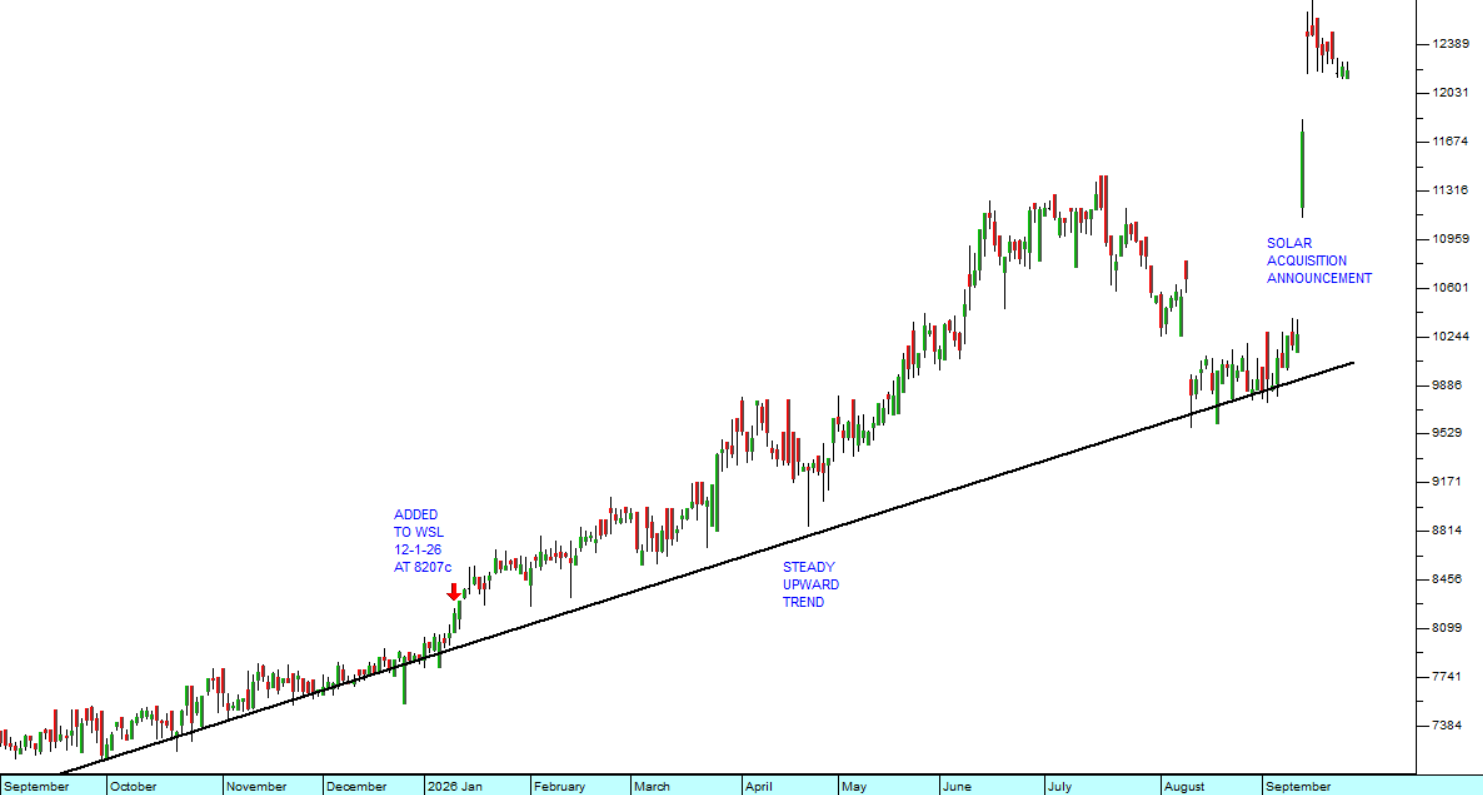
MTN (MTN) : February 2022 - 19th of June 2026. Chart by ShareFriend Pro.

The chart shows that MTN is in the process of recovering from a major downward trend which began in February 2022 when the war in Ukraine began. From a technical perspective the company completed an almost perfect reverse head-and-shoulders formation during 2024, finally breaking up through the neckline in mid-January 2025. Added to the Winning Shares List (WSL) on 15th January 2025 at a price of 9729c, it has subsequently risen to 23068c – a gain of 133,47% in 17 months. It also paid out a R5 dividend to shareholders for the 2025 year.

In our view, the spread of digital solutions in Africa is making the various African countries more reliable both politically and economically. They are no longer backwaters of progress and knowledge, but are able to share in the massive explosion of information that is sweeping the world. Africa has enormous resources of metals and minerals as well as proven agricultural potential. It is steadily catching up with the rest of the world economically and MTN is participating in that growth.  

The Collapse of Bitcoin  (2026-06-15)

We have never liked Bitcoin or even regarded it as a true investment. As Charlie Munger famously said about those who buy cryptocurrencies, “...somebody else is trading turds and you decide I can't be left out.” More recently, the esteemed Professor Paul Krugman has linked the price of Bitcoin…

We have never liked Bitcoin or even regarded it as a true investment. As Charlie Munger famously said about those who buy cryptocurrencies, “...somebody else is trading turds and you decide I can't be left out.” More recently, the esteemed Professor Paul Krugman has linked the price of Bitcoin directly to the political influence and dominance of Trump. He described its value as nothing but “technobabble”.

We have always advised people not to invest in it and to sell it if they had it. We hope that you took our advice. Our main reason for not considering it to be an investment is that it offers no return. It generates no interest, dividends or rent – meaning it lacks fundamental value. So, its value really only exists in the minds of the people who buy it and as they come to realise their mistake, the price will inevitably decline.

At one point there was the suggestion that cryptocurrencies were somehow digital gold, but nothing could be further from the truth. The truth is that the demand for cryptos is much more similar to the demand for tulips in Holland in the seventeenth century. It exists only in the minds of a relatively few individuals who have been swept away by the rapid advances in technology in the modern world. Cryptos lack universal appeal. By contrast, gold has been known and prized by every human being on earth for millennia no matter what their culture, creed or background.

In any event we will let the chart tell the story.

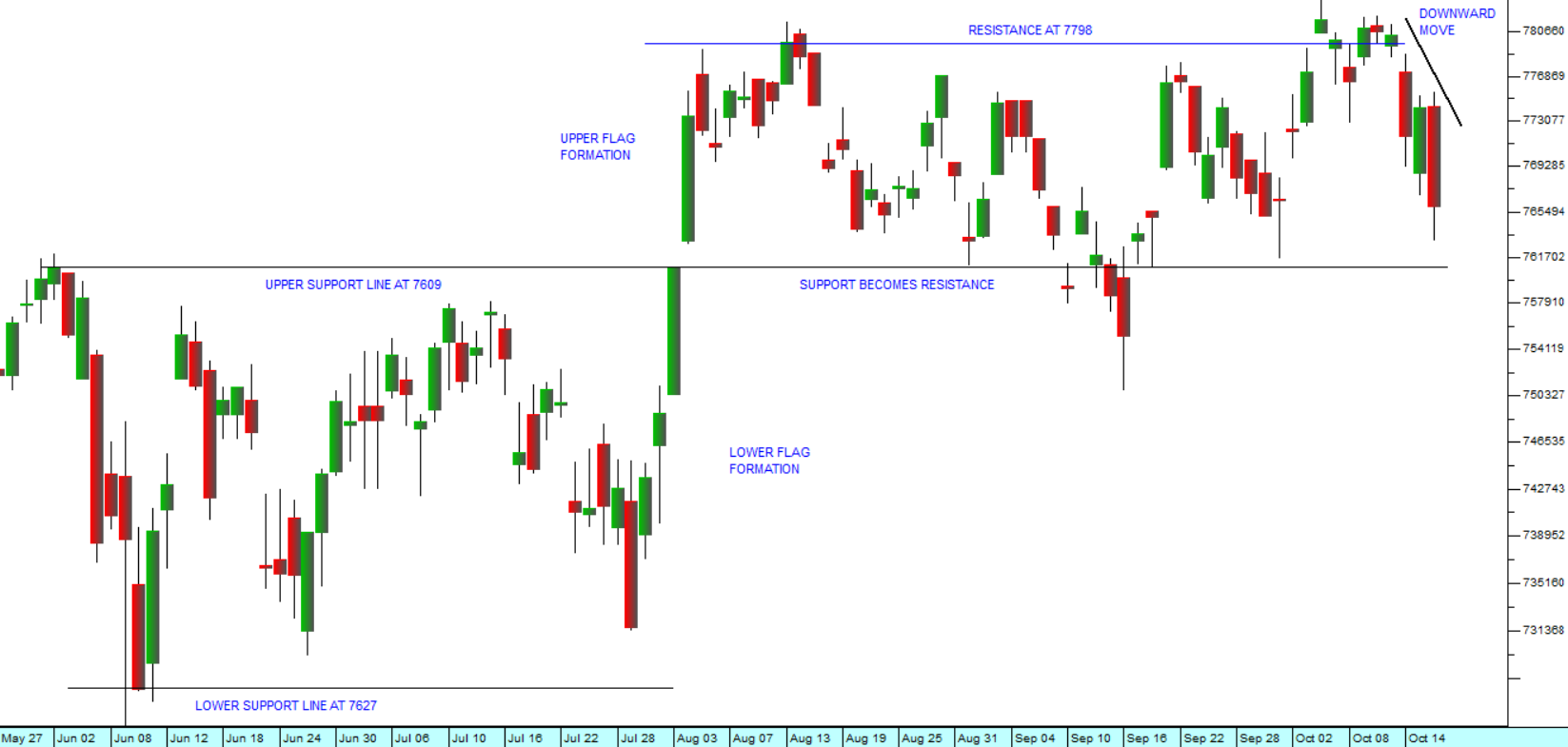
Bitcoin : April 2025 - 12th of June 2026. Chart by ShareFriend Pro.

The collapse of Bitcoin from its peak in October 2025 has been dramatic. Its value has more than halved through a series of cycles. The cycles are caused by the “stale bulls” who simply refuse to acknowledge that Bitcoin’s popularity is now permanently and irreversibly damaged. The Bitcoin price is falling just as Trump’s popularity and political clout are falling.

The effect of Trump’s ill-advised decision to go to war with Iran and the consequent jump in the price of fuel worldwide can be clearly seen. His popularity has nose-dived. Even hardline MAGA supporters who remained loyal through all his other obvious problems found the jump in the price of “gas” just too much to stomach.

From a technical perspective Bitcoin has broken down through a series of key support levels. Firstly, it found support at $83268 – the cycle low of November 2025 and that was followed by quite a significant “stale bull” rally. The rally came to an end when Bitcoin broke below that support level in February 2026 and then smashed down through the earlier cycle low at $77380 established in April 2025.

When Trump began bombing Iran, a new low point was established on 24th February 2026 at $64 000 and again the stale bulls motivated a rally which took the crypto briefly back above $80 000. However, Trump’s continued unpopularity and the growing evidence that he may be suffering from some kind of dementia has resulted in Bitcoin breaking decisively below $64 000 – which has now become a technical resistance level.   

While we see Wall Street recovering from the current correction, we do not see Bitcoin recovering. As Trump inevitably descends into political oblivion, so too will Bitcoin. Already it is an investment sideshow used primarily by organised crime to move money with impunity.  

From our very first article on Bitcoin in December 2017, The Bitcoin Bubble, we have always advised investors to stay away from it. Our advice remains unchanged:

“If you have it, sell it. If you don’t have it, don’t buy it”.

Market Catching its Breath  (2026-06-08)

Experienced investors know that when a market has run hard for a while, as it has for the last two months, some sort of correction is more-or-less inevitable. We suggested in the recent Confidential Report that right now you should be looking for that correction – and then on Friday the 5th of June…

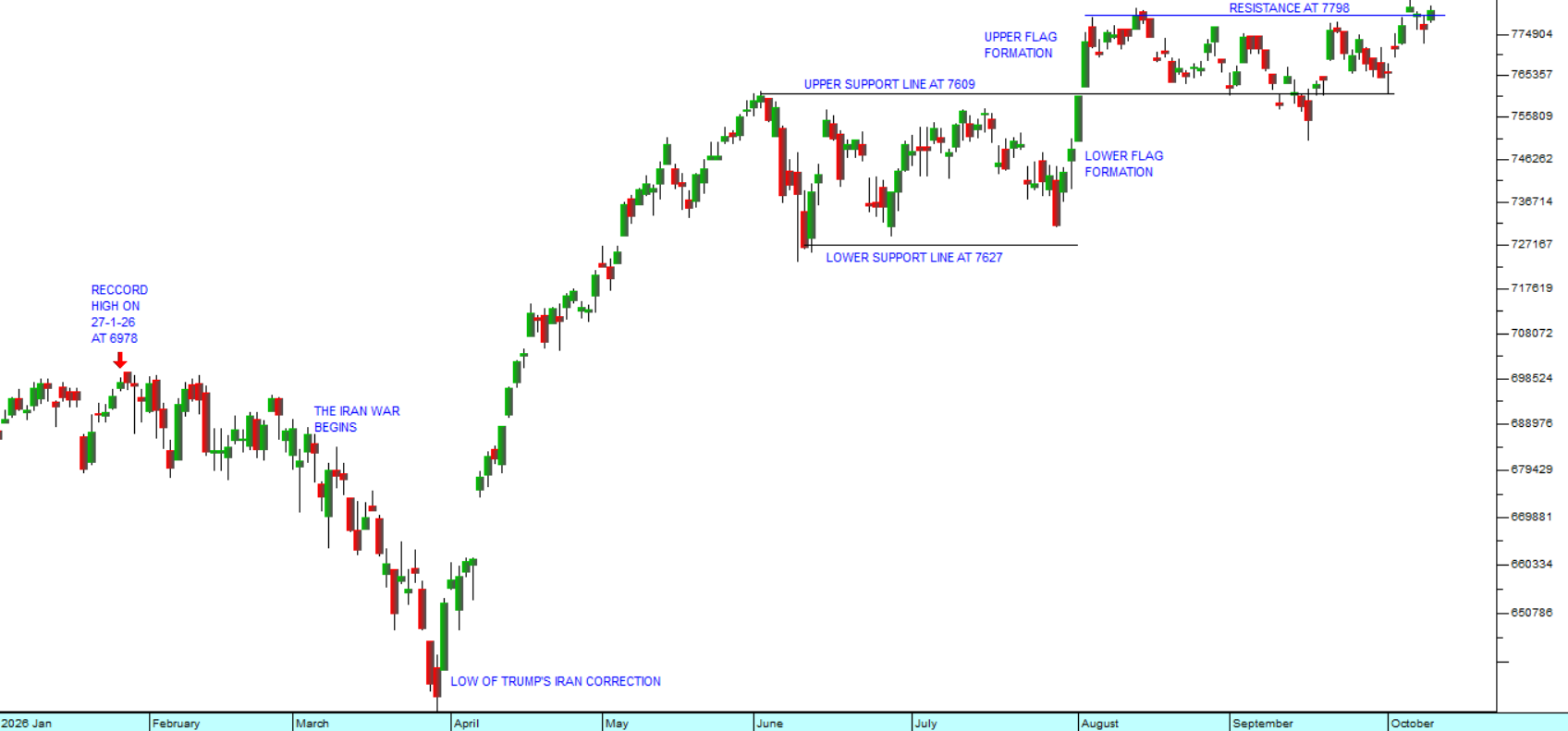
Experienced investors know that when a market has run hard for a while, as it has for the last two months, some sort of correction is more-or-less inevitable. We suggested in the recent Confidential Report that right now you should be looking for that correction – and then on Friday the 5th of June 2026, the S&P500, which was teetering after having made a new record high (7609.78) fell by an impressive 2,64%. Consider the chart:

S&P500 Index : 21st of January 2026 - 5th of June 2026. Chart by ShareFriend Pro.

The anatomy of a correction is that the positive news in the market reaches a point where it has been heavily over-discounted and shares begin to look seriously vulnerable and over-priced. Profit taking then sets in and the market falls back to more reasonable levels. This is a natural and normal pattern - even healthy - which reflects the interaction of the two great human emotions which dominate the market – fear and greed.

The fundamentals of a share can indicate what profits are likely to flow from owning it, while the technicals show the thrust of investor sentiment towards or away from it. When it comes to analysis, there are two kinds of people in the market – those that say they will not buy a share unless they can see the “real” value (the fundamentalists) – and those who say that the real value does not matter. What matters is what people think the real value is (the technicians). In other words, the reality and the perception of that reality.

And markets, like wildfires, can sometimes create their own energy. They can reach a point where they get carried up or down by the mere fact of their own momentum. In the longer term, the positivism or bullishness which is driving this market up today is beginning to become a self-fulfilling prophecy. Some investors are now coming into the market, not because they have done their homework and can see the earning potential of the shares that they want to buy, but rather because they are confident that in a few weeks’ or months’ time, someone with even less knowledge than them will buy the same shares back from them at a higher price.

When this begin to happen, the share’s price tends to lose touch with its underlying fundamentals and become over-priced. The fundamentals may be very good – but the important question is, “Are they good enough to justify the current price?” In 1998, during the dot-com boom, the blue sky potential of the nascent internet boom seemed immense – just as the potential of AI seems immense to us today. But, markets went too far, bid shares up too high, and inevitably fell back to more reasonable levels. However that did not mean that the potential of the internet was suddenly gone – far from it. The internet’s potential was only just beginning to be understood. It was just that markets had become too excited and lost sight of their underlying fundamentals.

We pointed out in our article of 18 May 2026 that the S&P 500 chart is becoming exponential. The blue sky potential of shares is now the dominant factor in investors’ assessments, with the focus shifting to possible future profits rather than established track records. Investors are concentrating on forward, rather than historical, P:E ratios. It is sobering to realise that all three of the enormous new listings coming to Wall Street this year—SpaceX, OpenAI, and Anthropic—are still unprofitable..

In our view, the current correction on Wall Street, and hence on markets around the world including the JSE, is more than likely temporary. After a period of selling, the downward trend will almost certainly give way to bullish investors seeking to buy the dip. Since there is no obvious fundamental factor driving this downward trend we see it as almost completely technical – and therefore temporary and healthy. The market is literally catching its breath.

What is interesting is that the JSE Overall index made its record high on 27th February 2026, at 128456, and has been basically trending down since then. It is apparent that local investors never really believed much in Wall Street’s strong recovery from Trump’s Iran war correction. We have found that often the JSE is a leading indicator of what happens on Wall Street.

JSE Top 40

101,534.00 (-1.79%)

All Share

109,829.00 (-1.62%)

Financial 15

26,325.00 (-1.79%)

J200
J203
J212
Top Gainers
# Code Name Close (c) % move
1 LAB LABAT 5 +66.67%
2 RNG RANGOLD 195 +39.29%
3 PHP PHP 2500 +25.82%
Top Losers
# Code Name Close (c) % move
1 ENX ENXGROUP 249 -45.87%
2 OAO OANDO 19 -20.83%
3 MTU MANTENGU 25 -13.79%

Top Movers – Charts

Top Gainer: LAB
Top Loser: ENX