Market View
J200 108,579.00 -1.47% J203 116,449.00 -1.37% J210 131,351.00 -2.56% J211 128,796.00 -1.28% J212 25,406.00 -0.40% J213 140,417.00 -0.84%
Winning Shares (Top 5)
Code Name Added Price Latest % Gain % Gain/Year
FTB FTBPROPB 2024-05-21 392 715 +82.40% +42.84%
SSS STOR-AGE 2024-08-30 1449 1770 +22.15% +13.45%
PMR PREMIER 2024-08-21 7635 17500 +129.21% +77.31%
MTN MTN-GROUP 2025-01-15 9729 20401 +109.69% +86.47%
CPP COLLINS 2024-05-23 840 1046 +24.52% +12.79%
Opinions (Top 5)
Code Name Date Action
ZED ZEDER 2026-04-24 View

Zeder (ZED) is PSG's listed, 43,7%-held, investment holding company in agriculture. Zeder sold its stake (28,6%) in Pioneer Foods (PFG) with a sum-of-the-parts (SOTP) value of R10,7bn to PepsiCo for which Zeder got about R6,41bn - and Zeder declared a special dividend of 230c as a result.

Zeder's largest investment now is its 98% stake in Capespan which markets fruit both locally and overseas. Then comes a 93% holding in Zaad which specialises in seeds and seed production and a 41% holding in Kaap Agri. In September 2019, the CEO of Zeder acquired 40% of East Africa Seeds (EAS) for Zeder subsidiary Zaad.

That holding has subsequently been increased to 97%. The company warned of rising food prices as a result of rising fertilizer and fuel prices following the February 2022 invasion of Ukraine. In its results for the year to 28th February 2026 the company reported a 15,3% drop in its net asset value (NAV) to 150c.

The company made a headline loss of 27,3c per share. The company said, "On 31 January 2026, Zeder entered into a Sale Agreement to dispose of Zaad. Following the implementation of the Disposal, Zeder will continue to own the current 48.6% interest held in May Seed". The company carries the exposure of agricultural enterprises to drought and other negative weather conditions, but it is well managed.

The share is volatile and has been falling since September 2024, but is now moving sideways.

VAL VALTERRA 2026-04-24 View

Valterra, (VAL) was previously Anglo American Platinum, or Amplats, and is the second largest platinum producing company in the world (after Sibanye), producing a large portion of the world's platinum. VAL was one of the first platinum mining companies in South Africa to move away from expensive deep-level mining towards shallower, more mechanised mining.

The company has reduced the number of mines it is operating from 18 to 7 over 5 years, decreased overheads by 50% and its number of employees by 50%. This shift is now paying dividends. The Mogalakwena open-cast operation is a palladium-rich operation with costs in the lowest quartile in the platinum group metals (PGM) industry world-wide.

A new project at Mogalakwena will see platinum production up by 250 000 ounces and palladium production up by 270 000 ounces. The company also recently bought out Glencore's 40,2% stake in their joint venture Mototolo mine and the adjacent Der Brochen property for R1,5bn. Mototolo is a highly mechanised shallow mine which can be extended into Der Brochen without putting in new surface infrastructure.

The platinum price is plagued by an effective re-cycling industry which produces about 2 million ounces a year by recovering from old auto catalysts. We believe VAL is one of the best of the PGM shares on the JSE - but it remains a commodity share and thus volatile and unpredictable.

In its results for the year to 31st December 2025 the company reported revenue up 7% and headline earnings per share (HEPS) up 98%. The company said, "Our M&C production volumes of 3.2 million PGM ounces and refined production of 3.4 million PGM ounces were both marginally above guidance.

Our operational excellence and pit-optimisation efforts delivered positive results, including a 22% reduction in the strip ratio at Mogalakwena". In an update on the 3 months to 31st March 2026 the company reported PGM production up 7%. The company said, "Purchase of PGM concentrate (POC) increased by 10% to 257,300 ounces, reflecting an improvement in operational performance from the various third-party producers from which we purchase concentrate. PGM sales volumes for the quarter increased by 60%". Technically, the share was moving sideways from September 2023 to June 2025, mainly due to the challenges faced by the industry including loadshedding and falling PGM prices, but is now responding to rising PGM prices and moving into a strong upward trend.

We added it to the Winning Shares List (WSL) on 2nd July 2025 at 83183c and it has since gone up to 144221c (23-4-26). It remains a volatile commodity play.

SOL SASOL 2026-04-24 View

Sasol (SOL) is a massive international chemicals and energy company which has its roots in the oil-from-coal technology developed during the apartheid era in South Africa. About 50% of the company's profits are directly linked to the oil price. It has two main growth areas - its 50% stake in an ethane cracker plant in Louisiana, America, known as "Lake Charles Chemical Project" (LCCP), and its development of gas resources in Mozambique.

Sasol was awarded two new licences in Mozambique to explore for gas in an onshore development of approximately three thousand square kilometres. This could significantly add to its existing gas projects in the Rovuma province. One area of concern for Sasol is that it is the biggest producer of greenhouse gases in South Africa and on the JSE.

It is listed as one of the 100 fossil-fuel companies world-wide that contribute to more than 70% of Greenhouse gases. The company remains under international pressure to deal with its carbon emissions effectively. After the impact of COVID-19, the share made a dramatic recovery which was been brought to an end by the decline in commodity prices, especially oil.  The company is planning to close some international operations to reduce costs.

On 25th May 2025 the company announced a settlement in its dispute with Transnet in terms of which Transnet will pay it R4,3bn. In its results for the six months to 31st December 2025 the company reported turnover unchanged with a 3% increase in sales volumes. Headline earnings per share (HEPS) fell 34% and net debt increased substantially to $63,3bn.

The company said, "The Group generated positive free cash flow in the first half of the financial year for the first time in four years, despite the challenging macro environment. This was supported by the higher sales volumes, lower cash fixed costs and lower capital expenditure".

In an update on the nine months to 31st March 2026 the company reported, "Despite the Middle East conflict constraining sour crude supply, Sasol mitigated this through sourcing sour crude from other regions, resulting in continued strong sales volumes for the quarter". Technically, the share has recently (on 25th May 2025) broken up through its long-term downward trendline on 20th May 2025 at a price of 7950c and has now moved up to 14110c.

It is in a volatile new upward trend which was interrupted on Friday 16th January 2026 when Morgan Stanley downgraded the company to "underweight" according to the Business Day (19/1/26). It is benefiting from the rise in the fuel price and was added to the Winning Shares List (WSL) on 18th February 2026 at a price of 12838c.

It has subsequently moved up to 21760c - a gain of 69,5% in just over 2 months. While the oil price remains high Sasol will benefit, but as soon as it begins to fall again the share price will come off.

SEA SPEARRIT 2026-04-24 View

Spear (SEA) is a real estate investment trust (REIT) which specialises in properties in and around Cape Town. It was started by Mike Flax and the CEO is Quintin Rossi. Both of these men have a very good understanding of property in the Cape area. At listing in November 2016, the company had a portfolio worth R1,5bn and that has grown to 32 properties worth about 4,5bn now - but the company's market capitalisation has remained well below that at around R1,416bn.

Property in Cape Town has generally done better than in the rest of the country and this REIT benefits from being very focused. On 31st January 2022 the company announced that it had received commitments for R253,9m for a placement of 30,2m new shares at R8.40 per share. The money will be used to settle debt and fund the acquisition of the 27 Junction Road property.

On 13th February 2023 the company announced that it had sold its Century City office block to Capitec for R400m. In its results for the six months to 31st August 2025 the company reported distributable income per share up 5,21% and revenue up 25,72%. Headline earnings per share (HEPS) rose by 11,88% and the company's loan-to-value (LTV) was 13,85%.

The company said, "Robust rental collections, growing letting activity, tenant retention, and hands-on financial, debtors and vacancy management remain the key building blocks for the entire Spear team in FY2026 and beyond." In an operational update for the ten months to 31st December 2025 the company reported revenue up 21,59% and HEPS up 2,77%. The company said, "During the year to date Spear acquired additional real estate assets to the value of R1,074 billion at an average acquisition yield of 9.54%." In our view, this is definitely one of the better REIT's on the JSE and it has substantial upside potential.

We see this as a good value investment at 1175c - about 94% of its NAV. On 23rd April 2026 the company announced that it had sold 78,740m new ordinary shares at a price of R12.70 in a bookbuild to raise R1bn.

QLT QUILTER 2026-04-23 View

Quilter Plc (QLT) is a company spun out of Old Mutual as part of that group's "managed separation" process. It was admitted to trading on the London Stock Exchange (LSE) and has had a secondary listing on the JSE from 25th June 2018 following the issue of a prospectus on 20th April 2018.

Quilter is a UK financial services group which offers asset management in the UK and internationally. It has 900 000 customers and had GBP101,7bn assets under management (AUM) at 30th June 2023. It is also involved in life assurance. The company has a good track record as a multi-manager for client wealth.

More than 60% of Quilter's shareholders are South African institutions. As this company is wholly based overseas it is a rand-hedge. Any strengthening of the rand against the British pound will see this share fall and vice versa. In its results for the year to 31st December 2025 the company reported AUM up 18% to GBP141,2bn and revenue up 5%.

Headline earnings per share (HEPS) was 8,7p compared with 2,5p in the previous period. The company said, "Proposed Final Dividend of 4.3 pence per share taking the total dividend for the year to 6.3 pence per share (2024: 5.9 pence per share), representing an increase of 7% and a payout ratio of 60%".

In a trading statement for the first quarter of 2026, the company reported AUM of GBP1,4bn. The company said, "Quarterly net inflows of £2,857 million represented 11% (annualised) of opening AuMA (Q1 2025: £2,198 million representing 10% of opening AuMA, annualised)".

Technically, the share has broken up out of an "island" formation and is in a strong upward trend. We regard this company as solid rand hedge and an institutional favourite. It was added to the Winning Shares List (WSL) on 23rd November 2023 at 2154c and has risen to 4219c (22-4-26).

As the UK economy recovers it should do well. 

Winning Share: MTN
Opinion: ZED
PSG Financial Services  (2026-04-20)

Now that the TACO trade associated with Trump’s war in Iran is over and markets are again posting new all-time record highs, it is worth noting that the JSE has not yet recovered completely and the JSE Overall Index (J203) is still 5,6% below its record high of 128456 made on 27th February 2026. As…

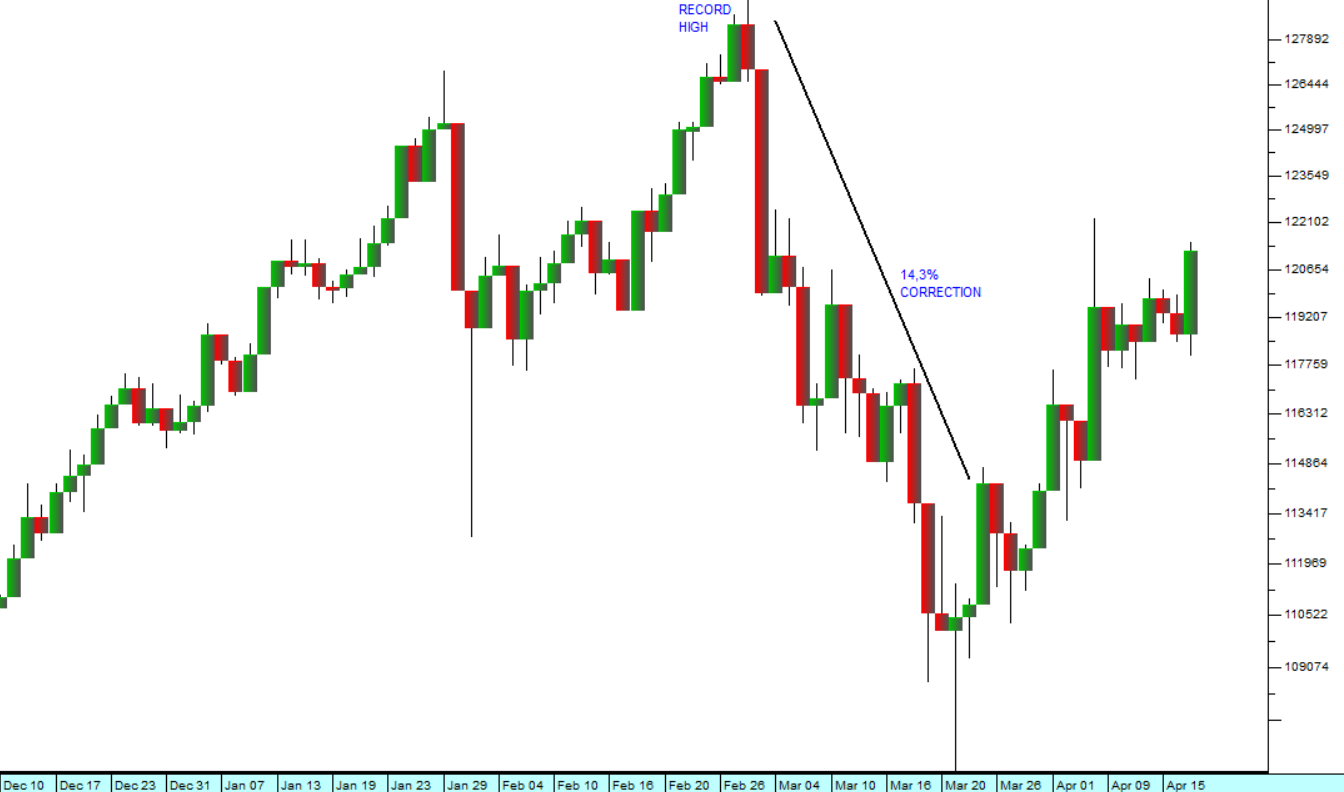
Now that the TACO trade associated with Trump’s war in Iran is over and markets are again posting new all-time record highs, it is worth noting that the JSE has not yet recovered completely and the JSE Overall Index (J203) is still 5,6% below its record high of 128456 made on 27th February 2026.

As an emerging market, the JSE always tends to be more volatile than first world markets – which means it falls further and goes higher. The JSE fell a total of 14,3% during this correction where the S&P500 fell by only 8,8%. It is also important to understand that the markets of the world (including the JSE) always tend to follow Wall Street – so we should expect the JSE Overall index to break to a new record high fairly soon. Consider the chart:

JSE Overall Index : 10th of December 2025 - 17th of April 2026. Chart by ShareFriend Pro.

Our Winning Shares List (WSL) is still dominated by commodity shares like Sasol, Pan African, Southern Palladium and Anglogold, so there are still investment opportunities to be found among the blue-chip industrials and financials.

One such blue chip is PSG Financial Services (KST). KST has been spun out of PSG which has spawned many very successful JSE listings like Capitec, and Curro. KST is a thoroughly South African company that has a long track record of excellent performance.

Its business consists primarily of asset management and insurance. In its results for the year to 28th February 2026 the company reported R540bn of assets under management (AUM), up 20% from the year before. It also reported its gross written premiums up 5% to R8bn. The company’s core income increased by 22% to R8,28bn and its recurring headline earnings per share (HEPS) rose by a whopping 34%. These are excellent results. Consider the chart:
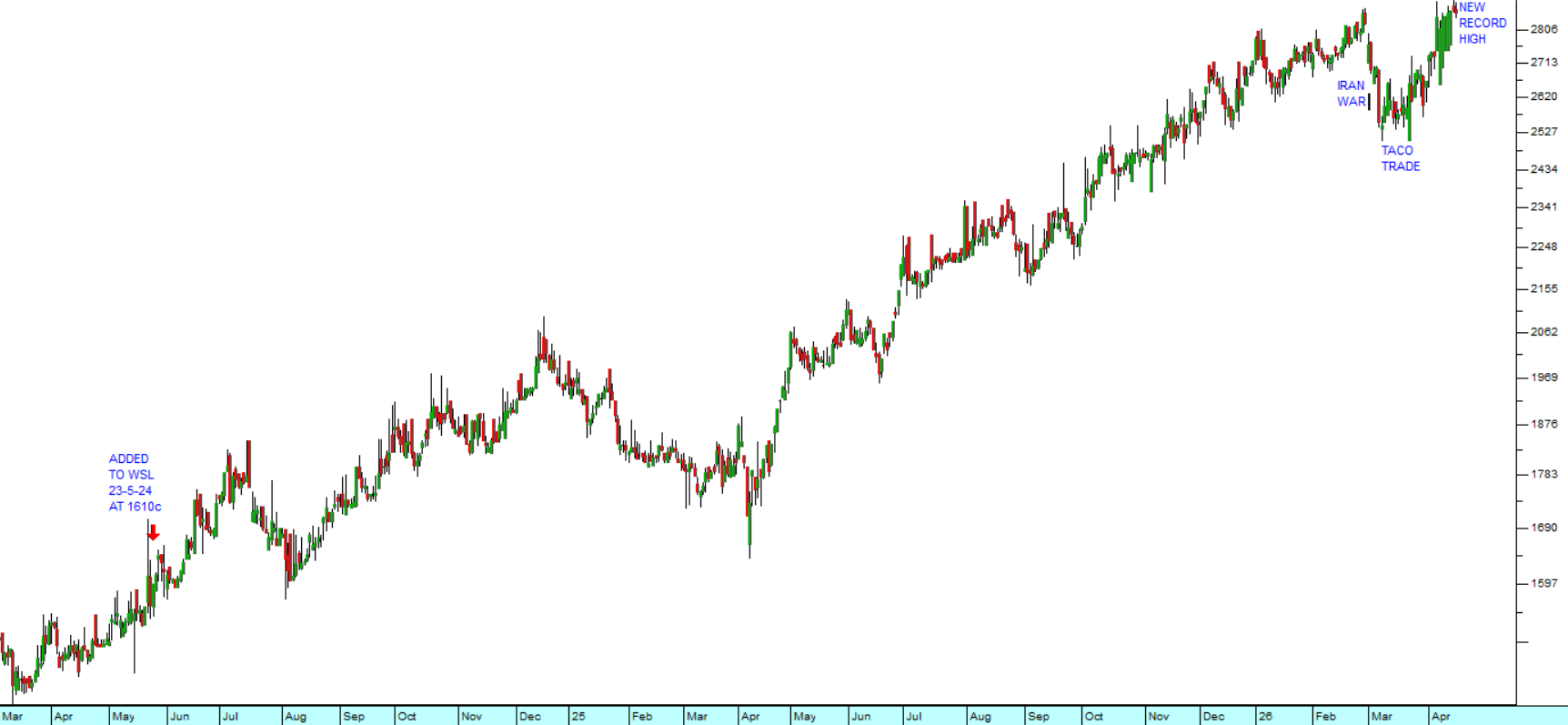
PSG Financial Services (KST) : March 2024 - 17th of April 2026. Chart by ShareFriend Pro.

KST has been in a steady upward trend since March 2024. We added it to the Winning Shares List (WSL) on 23rd May 2024 at 1610c and since then it has nearly doubled to 2865c.

Like most blue-chip shares trading on the JSE, KST shares fell as a result of the war in Iran and the sharp rise in the price of oil. That sell-off gave private investors a rare opportunity to buy further in to this excellent company.

As a private investor it is important to understand that KST is a services company and has an insignificant working capital requirement, while much of its income is annuity income. Its staff are also highly educated and paid – which means that they are not unionised. Given its long track record of generating profits, this makes it an almost risk-free investment.

Of course, we are not the only ones who are aware of KST’s great performance. The institutional fund managers have long favoured its shares and as a result the shares trade for a relatively high P:E ratio of 21,22 – which compares with the JSE Overall indexes average P:E of 15,34. Nonetheless, it is a good share to accumulate during periods of weakness.

What we said...  (2026-04-13)

The S&P500 index ended last week just 2,3% below its all-time, record high of 6978.6 made on 27th January 2026. It is apparent that the V-bottom caused by Trump’s war in Iran is almost over. We anticipate a new record high on the S&P within the next few weeks. Consider the chart: S&P500 Index : 17th…

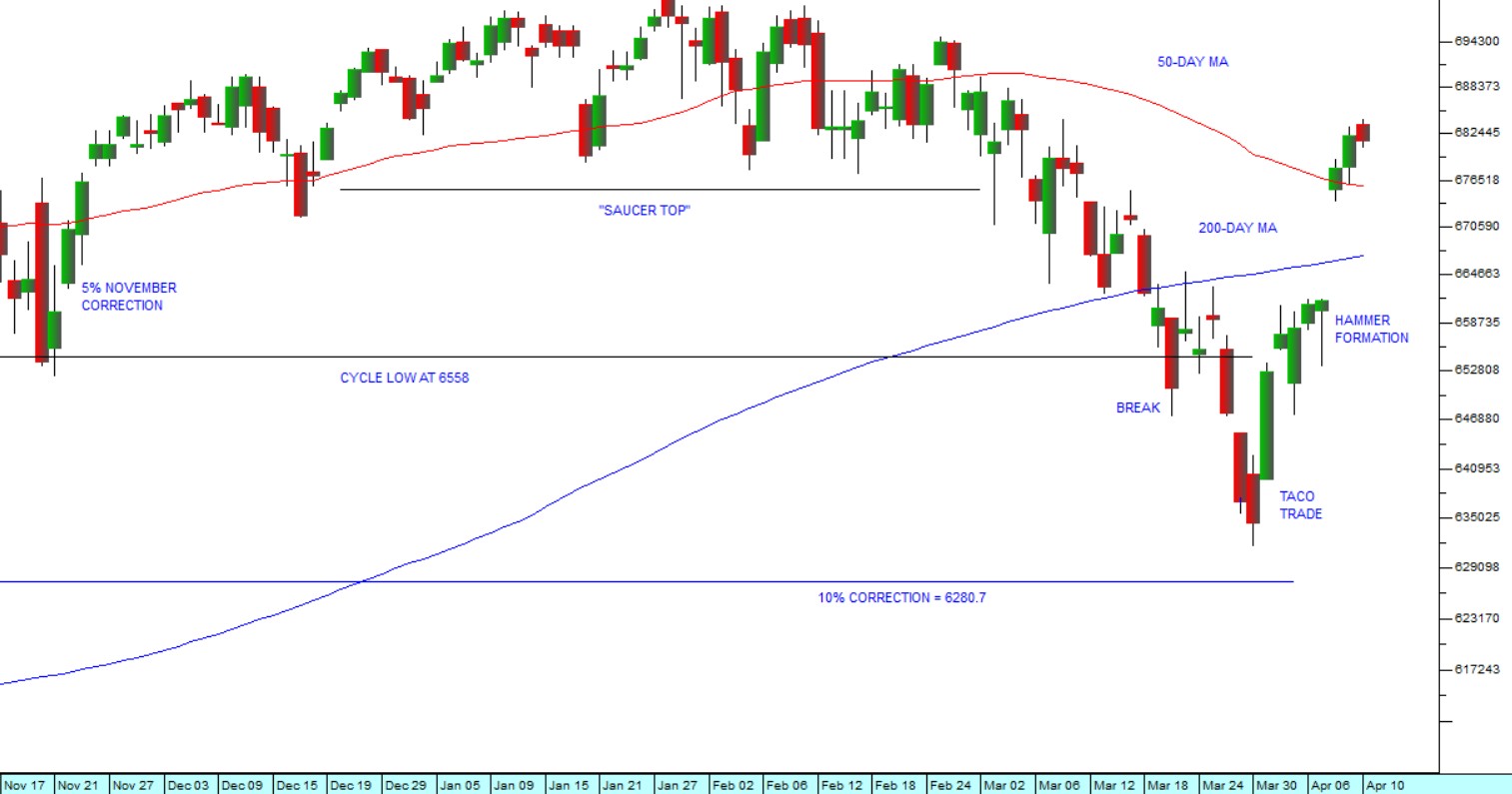
The S&P500 index ended last week just 2,3% below its all-time, record high of 6978.6 made on 27th January 2026. It is apparent that the V-bottom caused by Trump’s war in Iran is almost over. We anticipate a new record high on the S&P within the next few weeks. Consider the chart:

S&P500 Index : 17th of November 2025 - 10th of April 2026. Chart by ShareFriend Pro.

In the end, the Trump’s Iran war took the S&P down 8,8%. It did not even fall sufficiently (10%) to be considered an official correction. All markets have periodic corrections and Wall Street was overdue for a downward move at the time that this happened. You will note that the 50-day moving average did not break down through the 200-day moving average – so there was no death cross. And now the 50-day has started to move up again. The hammer formation which occurred on 7th April was probably the clearest indication that the market was returning to normal.

From an investor’s perspective, the result of the US/Israel war in Iran has come down to a temporarily raised oil price. Trump has predictably folded and backed down on all his bombastic rhetoric, leaving other people to clean up the mess. As the dust settles, we expect that the price of North Sea Brent will drift back down and eventually fall below resistance at $60 per barrel. The rand will resume its strengthening trend and the focus of the markets will return to the productivity gains flowing from AI.

One of the great understandings in the markets is that whatever happens, no matter how disastrous it may seem at the time, there is always a way for you as a private investor to turn it into a profitable investment. You just have to understand what is happening and then decide on the best way to position your capital to benefit. You must always see the situation as an opportunity and take advantage.

We really hope that you took our advice and profited from Trump’s war in Iran. Over the past month, we have run four articles about the situation in Iran and advised you as follows:

  1. In our article on 9th March we said, “...the war in Iran will be resolved on some basis - probably because he (Trump) will probably back down in the face of increasing pressure both at home and abroad. If this happens in a relatively short time, the market will turn its attention back to the rapid progress of new technologies and hopefully recover to make a further new all-time record high in due course”. 

  2. In our article on March 16th we said, “We believe that the situation will be resolved and that some degree of normalcy will return sooner or later. When and if that happens, we expect stocks around the world to bounce”.

  3. In our article on March 23rd we said, “So, we see this sell-off on the JSE as a buying opportunity to pick up high-quality shares at bargain prices” and “Buying shares at a time like this can be scary, but remember our maxim: If you don’t feel the risk, then you are probably not going to make any money”.
  1. In our article on 6th April we said, “The impact of artificial intelligence on productivity levels worldwide is a far more important trend and will continue to push markets up for years to come. In the context of that, Trump’s foray into Iran is a mere “bump in the road”. You should take this opportunity to buy high-quality blue-chip shares while they at these low levels”. 
A Bump in the Road  (2026-04-06)

It is always worth stepping back to look at where the markets are over the long-term. It helps you to view current events within their historical context to obtain some perspective. Consider the following chart of the JSE Overall index going back to February 1985: JSE Overall Index: February 1985 -…

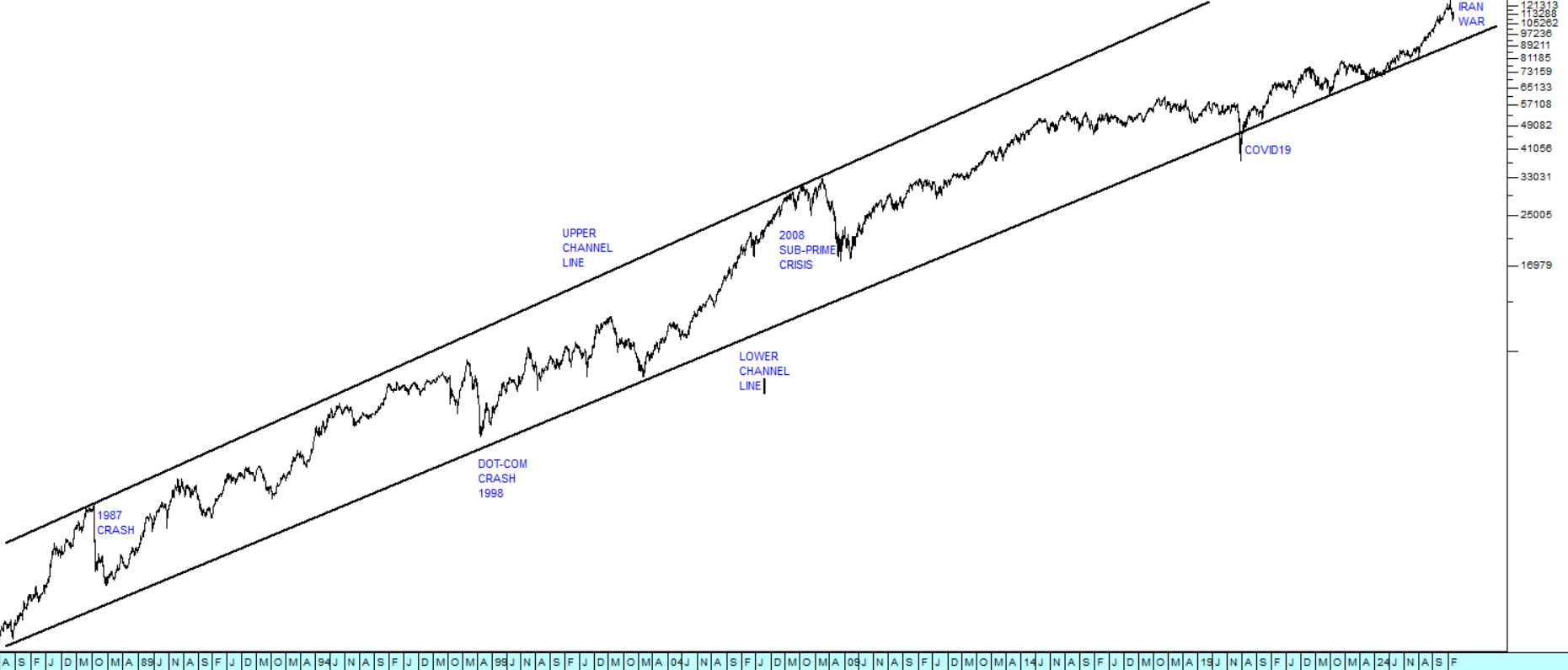
It is always worth stepping back to look at where the markets are over the long-term. It helps you to view current events within their historical context to obtain some perspective. Consider the following chart of the JSE Overall index going back to February 1985:

JSE Overall Index: February 1985 - 1st April 2026. Chart by ShareFriend Pro.

What you are looking at here is the history of the past 41 years. I have marked on the chart the 1987 crash, the 1998 dot com crash, the 2008 sub-prime crisis, the impact of COVID-19, and now Trump’s Iran war.  Obviously, the chart is semi-logarithmic because on a linear chart, events from the remote past, like the 1987 crash, become almost invisible, while current events, like the war in Iran, would assume a disproportionate importance.

From a long-term technical perspective, I have always viewed the downward spike associated with COVID-19 to be an “aberration” because it was not caused by economic events. Rather, it was a once-off, black swan event that resulted in a sharp and short-lived V-bottom. As soon as it became apparent that the pandemic would be controlled, the markets resumed their upward trend.

Disregarding this aberration, it is clear that the JSE Overall Index has been moving between two almost parallel upward sloping trendlines. These are known to technical analysts as channel lines and they show where the market is now in terms of its past extremes.

Perhaps what stands out the most from this chart is just how insignificant the impact of the Trump war in Iran really is. At the worst point, on 20th March 2026, events in Iran took our market down a total of 14,3% - and it had even less impact on Wall Street where the S&P500 came off by only 9,1%. This difference is as it should be because the JSE represents emerging markets generally and is always more volatile than Wall Street.

It has become apparent that Trump, in his second term, set out to try and roil markets, and especially Wall Street, as much as possible. His first efforts came in the form of a wild and inconsistent tariff policy which impacted markets - until investors became inured to his on again, off again policies. Then the TACO trade became a feature of Wall Street where traders capitalised on his repeated and predictable propensity to back down.

Seeing that tariffs no longer had the power to move the market he resorted to foreign invasions. He talked about invasions of Greenland and Canada, but the idea of going to war with America’s erstwhile long-term allies proved to be too much even for his sycophantic staff. So, he invaded Venezuela and executed a leadership change there.

This event went very smoothly, but disappointingly it did not have a major impact on Wall Street. So, encouraged by the "success” of his leadership change in Venezuela, and egged on by Israel’s President Netanyahu, he decided to try something much more dangerous – the attack on Iran. Without considering the consequences, he arranged for the assassination of the spiritual leader of 250 million Shiite Muslims.

By so doing he has set in motion a chain of events that can only be bad for Americans worldwide – and which has short-term negative consequences for everyone on the planet.

Despite this, we see two positives coming out of this mess:

  1. It will probably lead directly to the end of the MAGA movement and Trump’s influence. MAGA supporters have shown that they are completely unconcerned about Trump’s criminal convictions for fraud, his abuse of women, his January 6th insurrection and by his persistent lying, but that the increase in the “gas” price to above $4 per gallon in Texas is simply unacceptable.  
  2. It will sharply accelerate the world’s move away from fossil fuels generally. The world economy has been moving steadily towards renewables ever since they became cheaper than their fossil fuel alternatives – but the doubling of the oil price has made that move an imperative.

Like all events which impact directly on the stock market, Trump’s war in Iran provides an opportunity for private investors to capitalise.

Oil prices will probably remain high for the rest of this year, but they will gradually come down as markets find other sources of energy and find ways around the bottleneck in the Strait of Hormuz.

The impact of artificial intelligence on productivity levels worldwide is a far more important trend and will continue to push markets up for years to come. In the context of that, Trump’s foray into Iran is a mere “bump in the road”. You should take this opportunity to buy high-quality blue-chip shares while they at these low levels. 

JSE Top 40

108,579.00 (-1.47%)

All Share

116,449.00 (-1.37%)

Financial 15

25,406.00 (-0.40%)

J200
J203
J212
Top Gainers
# Code Name Close (c) % move
1 QFH QUANTUM 1099 +14.36%
2 EUZ EUROMET 25 +13.64%
3 ADR ADCORP 710 +13.60%
Top Losers
# Code Name Close (c) % move
1 TLM TELEMASTR 130 -34.01%
2 SDL SOUTH-PD 1700 -15.00%
3 CLS CLICKS 27588 -8.31%

Top Movers – Charts

Top Gainer: QFH
Top Loser: TLM