Market View
J200 99,991.00 -0.55% J203 108,020.00 -0.47% J210 111,881.00 -1.26% J211 119,778.00 -0.19% J212 25,258.00 -0.20% J213 135,122.00 -0.20%
Winning Shares (Top 5)
Code Name Added Price Latest % Gain % Gain/Year
CFR RICHEMONT 2025-01-09 292438 325900 +11.44% +6.41%
WBC WEBUYCARS 2024-05-03 2085 2639 +26.57% +10.74%
VAL VALTERRA 2025-07-03 83183 113323 +36.23% +27.73%
IOC IOCO 2024-11-06 220 400 +81.82% +41.71%
NY1 NINETY-1L 2025-05-28 3790 4090 +7.92% +5.63%
Opinions (Top 5)
Code Name Date Action
VAL VALTERRA 2026-10-25 View

25-10-2026   Valterra, (VAL) was previously Anglo American Platinum, or Amplats, and is the second largest platinum producing company in the world (after Sibanye), producing a large portion of the world's platinum. VAL was one of the first platinum mining companies in South Africa to move away from expensive deep-level mining towards shallower, more mechanised mining.

The company has reduced the number of mines it is operating from 18 to 7 over 5 years, decreased overheads by 50% and its number of employees by 50%. This shift is now paying dividends. The Mogalakwena open-cast operation is a palladium-rich operation with costs in the lowest quartile in the platinum group metals (PGM) industry world-wide.

A new project at Mogalakwena will see platinum production up by 250 000 ounces and palladium production up by 270 000 ounces. The company also recently bought out Glencore's 40,2% stake in their joint venture Mototolo mine and the adjacent Der Brochen property for R1,5bn. Mototolo is a highly mechanised shallow mine which can be extended into Der Brochen without putting in new surface infrastructure.

The platinum price is plagued by an effective re-cycling industry which produces about 2 million ounces a year by recovering from old auto catalysts.  In its results for the six months to 30th June 2026 the company reported revenue up 93% and headline earnings per share (HEPS) of 82,02c compared with 4,73c in the previous period. The company said, "Our exceptional results were a direct consequence of a solid metal-in-concentrate (M&C) production increasing by 4% to 1.5 million PGM ounces and sales volumes rising by 18% to 1.7 million PGM ounces".

In an update  on the third quarter to 30th September 2026 the company reported PGM production down 6% and PGM sales volumes down 27%. Guidance for the full year remains unchanged. Technically, the share was moving sideways from September 2023 to June 2025, mainly due to the challenges faced by the industry including loadshedding and falling PGM prices, but is now responding to rising PGM prices and moving into a strong upward trend.

We added it to the Winning Shares List (WSL) on 2nd July 2025 at 83183c and it has since gone up to 186439c (27-2-26). Since then it has fallen back to 113323c (23-10-26). It remains a volatile commodity play.

FGL FINBOND 2026-10-25 View

25-10-2026   Finbond (FGL) is a micro-lending and insurance operation which operates in South Africa and America. This company wants to expand in the US to the point where 70% to 80% of its income is derived from that country within 3 to 5 years. It already has 66% of its income coming from the US and believes that the US offers significant growth opportunities.

Including South Africa, Finbond has a total of 694 branches. In its results for the six months to 31st August 2026 the company reported revenue down 3,4% and a headline loss of 5,9c per share compared with a profit of 1,1c in the previous period. The company said, "While the period under review saw a decline in headline earnings due to macroeconomic headwinds".

Technically, the share has been downward trend since November 2025. It trades about R63 000 worth of shares each day on average which makes it barely practical for private investors. 

CLS CLICKS 2026-10-23 View

23-10-2026 Clicks (CLS) describes itself as a retail-led healthcare group. It incorporates Clicks, GNC and The Body Shop. Clicks has 782 stores of which 585 include pharmacies - which makes Clicks the largest pharmacy chain in Southern Africa. Although more retail outlets are installing pharmacies in their shops, the listed Dischem is Clicks main competitor.

Probably the only negative about this company was its involvement with the fifty-nine stores of Musica, which it has now closed. On 10th May 2021 the company announced that it had acquired the pharmacy business of Pick n Pay - which consists of twenty-five pharmacies located inside Pick 'n Pay stores.

These will now be re-branded to Clicks stores. Technically, the share has been a steady performer over the past 20 years. Its share price has risen by more than 2500% since it listed - which compares very well with the JSE's average over the same period. We regard this as one of the best blue-chip shares trading on the JSE.

It has proven that it is more-or-less recession-proof and continues to perform remarkably well. In its results for the year to 31st August 2026 the company reported turnover up 5,4% and headline earnings per share up 4,4%. The company said, "In an environment of constrained consumer spending and aggressive competitor discounting, group turnover increased by 5.4% to exceed R50 billion for the first time.

Retail turnover increased by 4.2% and UPD’s reported turnover grew by 9.2%". As a result of its high rating, the share trades on a P:E of 16,5 - but we believe that it remains an excellent medium-term investment which should find a place in every private investor's portfolio.

It is what we refer to as a "diagonal" share because over the past 15 years its chart goes from the bottom left-hand corner of your screen to the top right-hand corner. It is a "must have" for private investors and should be bought on any weakness. On 28th September 2026 the company announce that it had increased its stake in ARC Store to 61%.

ZED ZEDER 2026-10-23 View

23-10-2026   Zeder (ZED) is PSG's listed, 43,7%-held, investment holding company in agriculture. Zeder sold its stake (28,6%) in Pioneer Foods (PFG) with a sum-of-the-parts (SOTP) value of R10,7bn to PepsiCo for which Zeder got about R6,41bn - and Zeder declared a special dividend of 230c as a result.

Zeder's largest investment now is its 98% stake in Capespan which markets fruit both locally and overseas. Then comes a 93% holding in Zaad which specialises in seeds and seed production and a 41% holding in Kaap Agri. In September 2019, the CEO of Zeder acquired 40% of East Africa Seeds (EAS) for Zeder subsidiary Zaad.

That holding has subsequently been increased to 97%. The company warned of rising food prices as a result of rising fertilizer and fuel prices following the February 2022 invasion of Ukraine. In its results for the six months to 31st August 2026 the company reported a net asset value (NAV) of 141c per share and a headline loss of 2,8c per share.

The company said, "On 31 January 2026, Zeder entered into a Sale Agreement to dispose of Zaad (excluding Excluded Assets)". The company carries the exposure of agricultural enterprises to drought and other negative weather conditions so it is vulnerable to the super el Nino conditions, but it is well managed.

The share is volatile and has been falling since September 2024, but is now moving sideways.

AFT AFRIMAT 2026-10-23 View

23-10-2026   Afrimat (AFT) is an open-pit mining company that supplies composites, construction materials and other commodities to a range of industries in Southern Africa. Until the end of 2015, Afrimat was one of the best performing shares on the JSE. The share broke up out of a 3-year sideways pattern which included the COVID-19 crisis.

The company benefited from rising iron ore prices due to supply constraints in Brazil and rising demand from China. On 17th August 2020, the company announced that it had bought a mining exploration company (Coza Mining) involved in looking for iron and manganese in the Northern Cape for R300m.

On 20th March 2022 the company announced that its listing had been moved from Basic Materials Construction and Materials to the General Mining sector which better reflected its business.  In its results for the six months to 31st August 2026 the company reported revenue down 4,3% and headline earnings per share down 58%. The company said, "Since listing in 2006, Afrimat has never faced trading conditions as challenging as those experienced during the six months ended 31 August 2026".

Like all commodity companies, Afrimat's shares have declined with the drop in commodity prices, but this company is well diversified making it less risky. The share has broken up through its downward trendline and so may be headed into a new upward trend. We suggest that it now deserves further investigation.  

Winning Share: CFR
Opinion: ZED
October Month  (2026-10-19)

There are generally two types of risk in the share market – the risk that a specific share which you have bought falls known as unsystematic risk, and then the risk that the market as a whole falls and drags all your shares down with it - known as systematic risk. The systematic risk that the market…

There are generally two types of risk in the share market – the risk that a specific share which you have bought falls known as unsystematic risk, and then the risk that the market as a whole falls and drags all your shares down with it - known as systematic risk. The systematic risk that the market is in or about to enter a bear trend is obviously a vital consideration for the private investor. During a bear trend about 80% (or more) of shares will fall while only 20% will rise. This means that from a purely statistical point of view it is better for private investors to stay out of the market during bear trends.

It is also very important to be able to distinguish between a correction (which is often a buying opportunity) and a bear trend. The safest approach is always to always buy shares which are rising, in sectors which are rising in a market which is rising. At the same time keeping a strict stop-loss strategy is vital to protect the bulk of your capital. As a private investor you should have an absolute rule that you never lose more than 15% on any share market investment – ever – and that should include your dealing costs. This can only be achieved if you buy free-dealing shares and always adhere to a strict stop-loss strategy.

Today, Monday 19th October 2026 is the exact anniversary of the greatest single day crash in stock market history. Thirty nine years ago, on Monday 19th October 1987, Wall Street collapsed. The S&P500 index fell more than 20% in the day. Other famous bear trends have also begun in October month, including the infamous 1929 crash, the bear trend of the year 2000, the 2008 sub-prime crisis, and the bear trend of 2022 associated with the Ukraine War. So, October month has a bad reputation with investors, and they generally heave a sigh of relief when it is over.

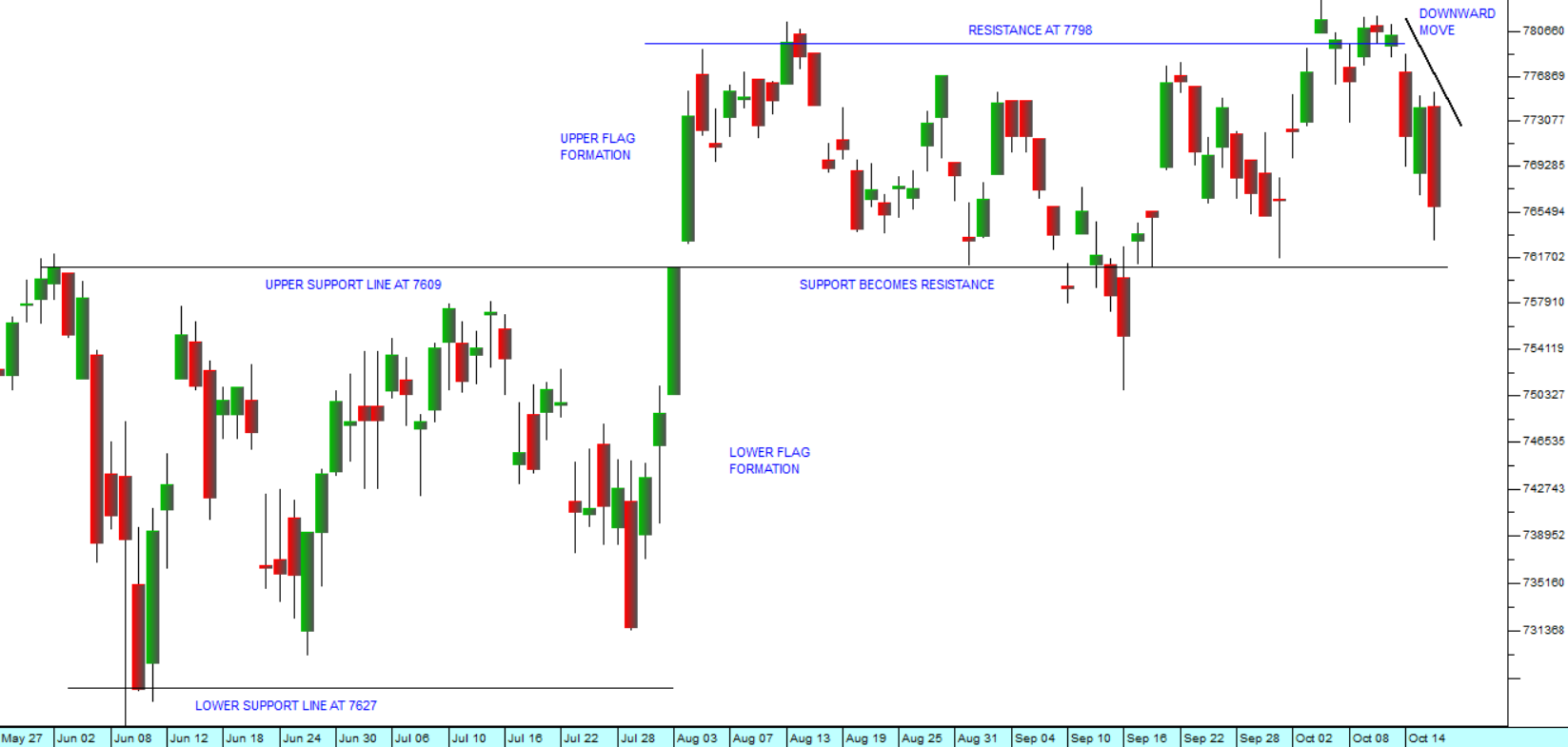
Ominously, Wall Street has been falling over the last week as the Iran war flared up again, pushing the price of North Sea Brent up to nearly $110 per barrel. Consider the chart:

S&P500 Index : 27th of March 2026 - 16th of October 2026. Chart by ShareFriend Pro.

In our analysis, we have drawn your attention to the fact that the S&P500 index has been moving through two sideways markets or flags as the countervailing forces of the rising oil price and the profitability of the artificial intelligence (AI) revolution play out.

The climb in the fuel price is causing a re-evaluation of inflationary risks throughout the world, but especially in America, where the price of petrol has remained stubbornly above $4 per gallon and diesel has hovered above $6 per gallon. With the mid-term elections just weeks away, Republicans and especially Trump are facing a barrage of criticism for their handling of the economy. The Iranians on the other hand are doing everything in their power to keep the oil price at high levels to put the maximum pressure on Trump.

What is notable is that the high oil price appears to be having less and less impact on Wall Street as time goes by. When Trump and Netanyahu began their war with Iran the S&P fell back sharply to 6611 on the 6th of April 2026, and the price of Brent oil went above $110 per barrel. Today Brent is again hovering close to those levels and the S&P has recently managed to reach a new record high at 7818. The world has been facing increased levels of inflation, rising interest rates, and record bond yields - but despite that, AI and corporate profits continue to take the market higher.  

In our opinion, as soon as October month is safely behind us and especially if the mid-term elections have the effect of reducing Trump to a lame dog president, we can look forward to a Christmas rally in the S&P500 during the festive season and into next year. As usual, we strongly advise you to be vigilant and to maintain your stops.

Quantum Computing  (2026-10-12)

We live in an age where advances in technology are driving the gains in productivity and profits, and then being discounted directly into share prices. Artificial intelligence (AI) is already well established and being used by most companies to improve productivity. This can be seen in the results…

We live in an age where advances in technology are driving the gains in productivity and profits, and then being discounted directly into share prices. Artificial intelligence (AI) is already well established and being used by most companies to improve productivity. This can be seen in the results coming out of the companies in the S&P500 index. The impact of AI has only just begun to be discounted and now the next major technological breakthrough, quantum computing, is hovering in the background.

Quantum computing is essentially a jump forward in hardware which allows computers to analyse multiple different solutions simultaneously. Instead of using bits which are either 1 or 0, a quantum computer uses qubits which can exist in multiple states simultaneously - together with quantum entanglement. The technology uses the laws of physics at the atomic and subatomic level to solve complex problems much faster than regular computers, even supercomputers. Microsoft, Google, Amazon, Oracle, and even Meta and Tesla, are rushing to install quantum computing into their infrastructure. In a word, quantum computing will increase the power of AI substantially making it even faster and more powerful than it already is.

With that background, the earnings of S&P companies for the third quarter are beginning to trickle in, with 19 companies having reported so far. Total 3rd quarter earnings for those companies that have reported results already are up +150.9% from the same period last year on the back of revenues which are +27% higher. 79% of those companies are beating EPS estimates and 73.7% are beating revenue estimates.

The average estimate for all S&P500 companies is that earnings will be up by 24,3% in the 3rd quarter when compared with a year ago – and this will be the 8th straight quarter where estimates have been in positive double digits. 15 out of 16 sectors are expected to make significant gains – led by the technology and energy sectors.

As things stand now, the progress of the S&P500 index is being significantly held back by developments in Trump’s Middle East war and the price of oil. Iran would like to hold the price of North Sea Brent above $100 per barrel, at least until after the mid-term elections on 3rd November 2026 – which of course is very bad news for the struggling Republican party and Trump.

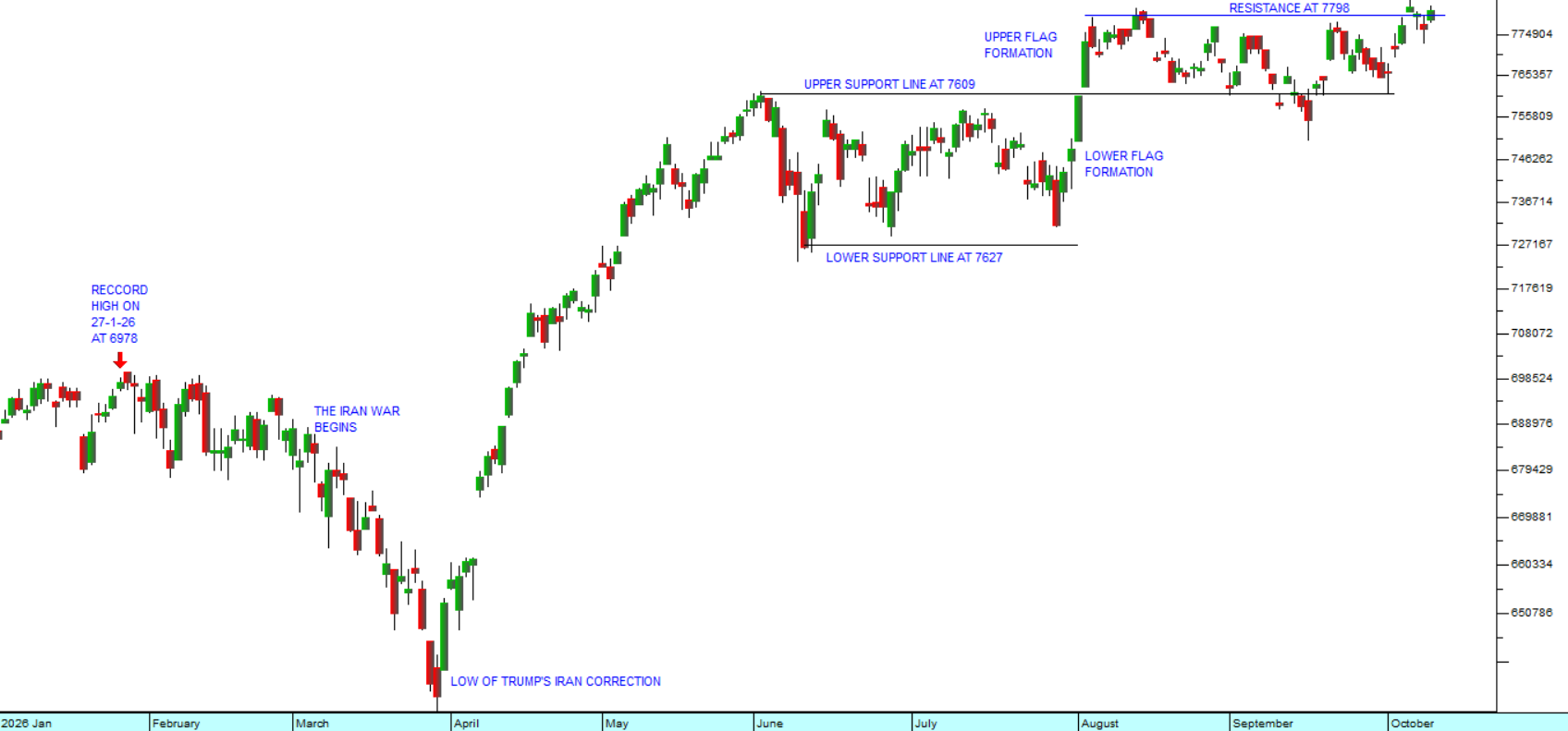
Looking at the chart, the S&P500 index has been moving through a series of protracted sideways markets for the past four months. During that time, technology and the prospects of that technology have not stood still. They have been advancing at a rapid pace.

Our belief is that as soon as the situation in the Middle East is resolved and the oil price comes back to where it was before the war began, the S&P will suddenly begin discounting the impact of the accumulated technical advances and move sharply higher. It will be like removing the lid from a pressure cooker. Consider the chart:

S&P500 Index : January 2026 - 9th of October 2026. Chart by ShareFriend Pro.

So, what we are saying is that considerable bullish potential has been built up by this war and its impact on oil prices. This can be seen from the fact that even with Brent at over $100 a barrel now, the S&P is still making new record highs, based on the exceptional estimates of 3rd quarter earnings and beyond.

There are, of course, those who believe that Brent is about to go much higher – like to $125 per barrel - given the escalation in Yemen with the Houthis and the attacks on the Saudi pipeline. But in our view the underlying direction of the oil price must be downwards as the world moves away from fossil fuels and towards renewables, especially solar.

To be safe, ensure that you have a strict stop-loss level for all the shares in your portfolio. That is the ultimate protection against unexpected downtrends and bear markets. Your absolute rule should be to never lose more than 15% on any share market investment ever – including your dealing costs. Sometimes it is difficult to achieve this, but provided you always choose shares which are free-dealing, it simply becomes a matter of self-discipline. And then if you are able to make several hundred percent on your winners, mathematically, you must be successful over time.


The Omnia Takeover  (2026-09-28)

Omnia is a manufacturer of chemicals used in agriculture (fertilisers), mining (explosives) and various industries. It operates primarily in South Africa, but its products are sold throughout Southern Africa and abroad. In its latest financial statements for the year to 31st March 2026 the company…

Omnia is a manufacturer of chemicals used in agriculture (fertilisers), mining (explosives) and various industries. It operates primarily in South Africa, but its products are sold throughout Southern Africa and abroad.

In its latest financial statements for the year to 31st March 2026 the company reported revenue up 6% and headline earnings per share (HEPS) up 21%. The company benefited in some ways from the war in Iran and the closure of the Strait of Hormuz because that restricted the flow of agricultural chemicals onto world markets resulting in higher prices. Omnia was able to pay a dividend of 470c for the year, plus a special dividend of 280c. During the year it also bought back and cancelled 187436 of its own shares at an average price of 6465c per share returning a further R12,1m to shareholders.

This is one of the companies that was very hard hit by the COVID-19 pandemic, and its share price fell to a low of 1536c in May 2020. We published an article about it on 2nd September 2019, drawing attention to the fact that it had been consistently trading well below its net asset value (NAV) for some time. Obviously, when a profitable listed company trades below its NAV, it generally becomes a potential take-over target for both local and international investors.

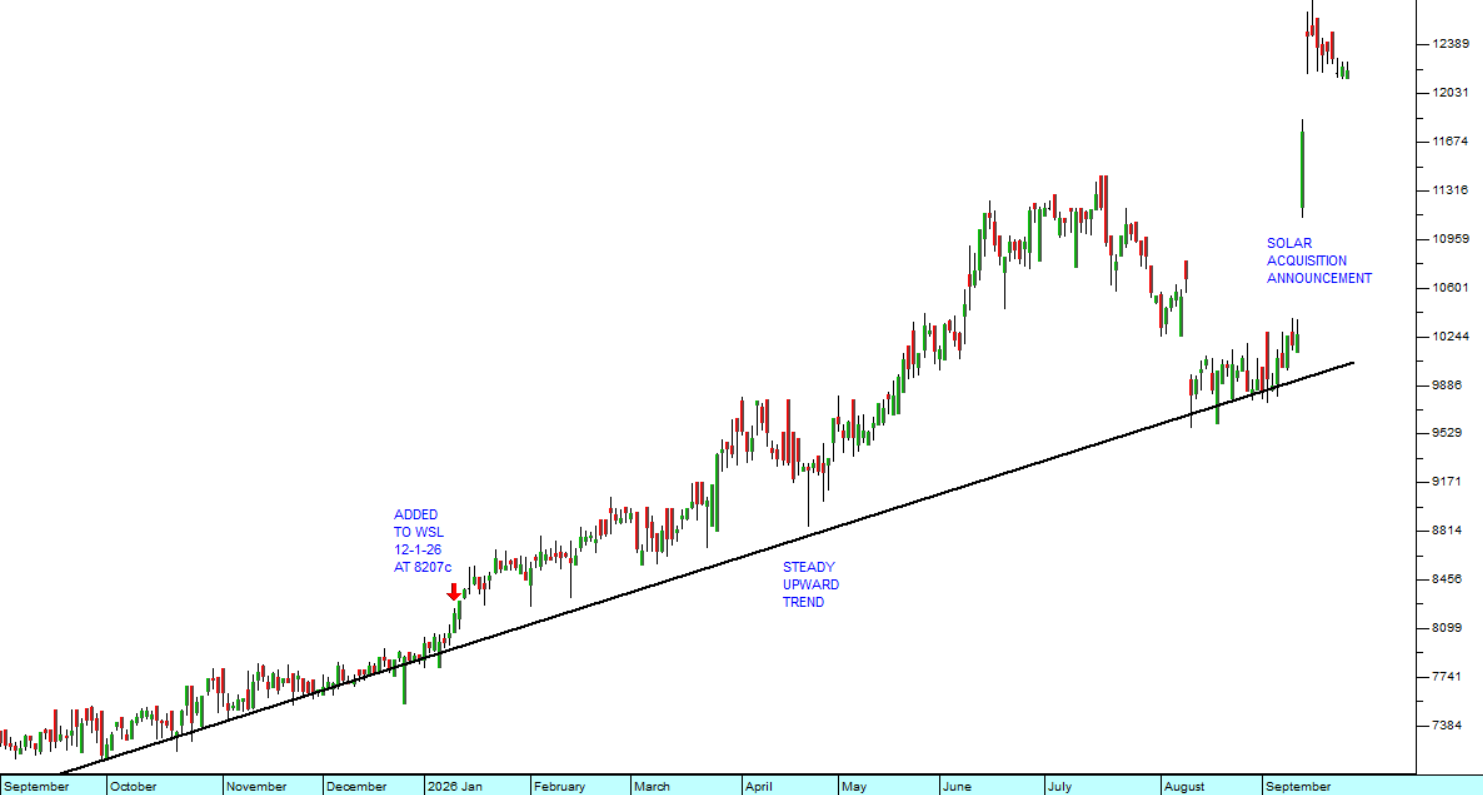
For the next five years Omnia continued to strengthen and diversify its position. By March this year it was growing profits in all divisions and had a strong balance sheet. This attracted the attention of a large international chemicals company operating out of India, The Solar Group, who have now made an offer to buy 100% of Omnia’s ordinary shares for 13450c each. Omnia will delist from the JSE once the acquisition scheme by Solar SA Investments is implemented.

The cautionary announcement was published on the Stock Exchange News Service (SENS) on 11th September this year and the share price immediately rose sharply in response. The fact that it did not rise earlier indicates that there was little or no insider trading associated with this announcement. Consider the chart:

Omnia (OMN) : September 2025 - 25th of September 2026. Chart by ShareFriend Pro.

In anticipation of good results at the year-end in March 2026, we added Omnia to the Winning Shares List (WSL) on 12th January 2026 at a price of 8207c per share. At the time we felt that the company was trading well below its value given its track record and performance.

The Solar Group sells its products in 90 countries around the world and has manufacturing facilities in 11 countries. There are considerable synergies flowing from the acquisition, especially considering that Solar does not appear to be in agricultural sector. Omnia’s expertise and product knowledge will add considerably to the group over time.

Taking into account that an investor would have received 750c in dividends, the decision to buy into Omnia when we added it to the WSL would have yielded a return of 13450c + 750c – 8207c = 5993c or 73% in a period of much less than a year. Altogether a very satisfactory investment!

JSE Top 40

99,991.00 (-0.55%)

All Share

108,020.00 (-0.47%)

Financial 15

25,258.00 (-0.20%)

J200
J203
J212
Top Gainers
# Code Name Close (c) % move
1 MCZ MC-MINING 304 +9.75%
2 APF ACCPROP 41 +7.89%
3 EMN E-MEDIA-N 180 +5.88%
Top Losers
# Code Name Close (c) % move
1 ACS ACSION 1078 -38.33%
2 RHB RHBOPHELO 120 -22.58%
3 GML GEMFIELDS 69 -9.21%

Top Movers – Charts

Top Gainer: MCZ
Top Loser: ACS