Market View
J200 107,088.00 +2.27% J203 115,038.00 +2.04% J210 120,622.00 +4.64% J211 128,157.00 +1.31% J212 26,829.00 +0.77% J213 144,217.00 +1.07%
Winning Shares (Top 5)
Code Name Added Price Latest % Gain % Gain/Year
ABG ABSAGROUP 2025-10-11 19460 23388 +20.18% +18.70%
PIK PICKNPAY 2026-11-03 2488 2600 +4.50% +273.85%
AFT AFRIMAT 2026-10-22 3400 3915 +15.15% +307.15%
SAC SA-CORP 2023-11-16 211 346 +63.98% +21.44%
SDO STADIO 2024-06-29 525 1460 +178.10% +75.32%
Opinions (Top 5)
Code Name Date Action
OCT OCTODEC 2026-11-10 View

10-11-2026 Octodec (OCT) is a real estate investment trust (REIT) which owns 246 properties mainly in the inner cities of Johannesburg (33,9%) and Pretoria (66,1%). It has a gross lettable area (GLA) of 1 557 460m² and is valued at R11bn. It is owned and controlled by the founding Wapnick family and Jeffrey Wapnick is the CEO.

It owns Killarney Mall and Woodmead Value Mart. In its results for the six months to 28th February 2026 the company reported revenue up 2,4% and headline earnings per share (HEPS) up 15,4%. The company's loan-to-value (LTV) was 37,3%. In our view this is an interesting REIT which has performed relatively well in very difficult conditions.

On a P:E ratio of 9,45 and trading at 65% of its NAV, we consider this share to be a possible long-term buy, especially now that it has reduced its loan-to-value (LTV). In a trading statement for the year to 31st August 2026 the company estimated that dividend income per share would increase by between 10% and 13%.

Technically, the share reached a peak of 1261c on 21-11-24 and then fell to a low of 890c on 9-4-25. Since then it has been in a strong new upward trend and was added to the Winning Shares List (WSL) on 21st August 2025 at 1100c. It has since moved up to 1962c (9-11-26). 

HAR HARMONY 2026-11-10 View

10-11-2026   Harmony (HAR) was probably South Africa's most marginal gold mine until it got Mponeng gold mine working effectively. The development of this mine and its processing plant are expected to cost around US$2,8bn - and Harmony does not at this stage have its share of that cash (about R20bn).

During 2021 the company purchased Mponeng gold mine for R4,2bn. Mponeng is the world’s deepest mine and has all the problems of ultra-deep level mining. The company is building a 30mw solar park in the Free State and has plans to build a further 80mw of green power. On 6th October 2022, the company announced that it had agreed to buy 100% of the Eva copper project in Australia for R4,1bn.

Harmony remains a volatile gold producer and hence risky - although recent acquisitions could change its direction significantly, taking it out of precious metals. Eva is only expected to commence production in 3 years and is expected to add 260 000 ounces of gold and 1,7 billion pounds of copper to Harmony's reserves.

On 3rd April 2024 the company announced that it had signed a wage deal with all of its unions for the next five years. In its results for the year to 30th June 2026 the company reported a 3% drop in gold production and a 34% increase in revenue due to a 35% increase in the average gold price received.

Headline earnings per share (HEPS) doubled in US dollars. The company said, "Achieved copper production of 18 207 tonnes from CSA mine, towards the upper end of guidance, with a recovered grade of 3.75%, well above guidance". In an update on the 3 months to 30th September 2026 the company reported gold revenue up 3% and gold production down 12%.

All-in sustaining costs (AISC) were up 17% and the company had cash of R4,2bn. Technically, the share, while volatile, has been in a strong upward trend, but fell back when gold corrected. Now that gold is again rising the share is performing very well again.  It is a play on the gold price and the rand/US dollar exchange rate.

It was added to the Winning Shares List (WSL) on 16-11-23 at 9920c. Today it is at 28720c (9-11-26). It remains a volatile commodity play.

MTN MTN-GROUP 2026-11-10 View

10-11-2026 MTN is a leading emerging market mobile operator, serving 290 million people (including 29m in South Africa) in 19 countries across Africa and the Middle EaSt. MTN's three largest subscriber bases are in Iran, Nigeria and South Africa. Generally, companies supplying a mobile service have been faced with very stiff competition and declining voice revenue.

The sharp increase in data usage has, to some extent, mitigated this change, but these companies remain quite risky. MTN is especially risky because of the political risk in Iran and Nigeria. MTN is working with Sanlam to offer insurance products to its clients in the hopes that "fintech" will become a major part of its business.

The goal is to turn MTN into a "...digital operator with a major focus on the fintech, digital, enterprise and wholesale business areas." MTN has rolled out its mobile money services in both Nigeria and South Africa. It is currently offering these services in 14 out of the 21 countries where it operates, and it has 41,8m mobile money customers.

It is trying to increase that number to 60m. MTN has now listed on the Nigerian stock exchange. The company announced that Mastercard would take a R100bn stake in its fintech business and partner with it to expand that business. In its results for the six months to 30th June 2026 the company reported service revenue up 17,5% and fintech revenue up 13,3%.

Headline earnings per share (HEPS) increased by 21,3%. Total customers increased by 6,7% to 317,7m. The company said, "MTN delivered strong growth, record profitability and robust cash generation in H1 2026, while maintaining balance sheet strength and advancing key strategic initiatives that support long-term shareholder value creation".

In an update for the 3 months to 30th September 2026b the company reported service revenue up 17,2% and EBITDA up 22,9%. The company said, "Share buyback progressing: R2 billion worth of shares bought back during the period under the R6 billion buyback programme".

The share fell from its cycle high in March 2022 and we recommended applying a downward trendline from that peak and waiting for a clear upside break before investigating further. That break came on 7th December 2024 at a price of 9289c. It was added to the Winning Shares List (WSL) on 14-1-25 at 9729c and has since moved up to 22419c (9-11-26) after some profit taking.

We still see it as a good opportunity at the current price.

ENX ENXGROUP 2026-11-10 View

10-11-2026 The enX Group (ENX) is a "...diversified industrial group that provides branded products and services to the petrochemical, fleet management, logistics and industrial sectors." It includes Austro which distributes wood-working equipment and tooling. Finally, it includes New Way Power which manufactures, installs, and maintains diesel generators.

Its fleet division engages in fleet management and logistics as well as vehicle tracking. Then ENX Petrochemicals produces and markets oil lubricants, plastics polymers, rubber, and speciality chemicals in Southern Africa". It disposed of the EIE group with effect from 1st April 2022.  On 15th July 2019, the company announced that it had sold Eqstra, a fleet management company, to Bidvest for R3,1bn.

On 15th April 2021, the company announced that it had sold its British fork-lift and container business for GBP31m. The proceeds will be used to pay down debt. This is clearly a company that will benefit directly from any improvement in the South African economy, but which is making acquisitions both locally and, in the UK, to ensure growth, no matter what happens.

On 4th April 2022, the company announced a special dividend of 200c per share as a result of the sale of its subsidiary, EIE. In its results for the six months to 28th February 2026 the company reported revenue down 37% and a headline loss of 3c per share compared with a profit of 3c in the previous period.

The company said, "The decrease in revenue was primarily attributable to lower activity on large, project-based data centre contracts, which are inherently lumpy and dependent on project timing". In a trading statement for the year to 31st August 2026 the company estimated that it would make a headline loss of between 5,3c and 14,2c.  Technically, the share has been moving down since July 2024.

We advise waiting for it to establish a new upward trend before investigating further.

OMN OMNIA 2026-11-10 View

10-11-2026 Omnia (OMN) is a diversified chemicals company supplying products to the agricultural, chemicals and mining industries in South Africa and 48 other countries. The Agricultural division is the leader in fertilizers in Southern Africa. It supplies granular, liquid and speciality fertilizers in Southern Africa, Eastern Africa, Australia, New Zealand, and Brazil.

The mining division is the leading supplier of explosives in South Africa, Mali, Swaziland, Sierra Leone, Malawi, Senegal, Zambia, Zimbabwe, Botswana, Mozambique, and the DRC. The chemicals division is a manufacturer and distributor of speciality, functional and effect chemicals and polymers operating throughout the African continent.

The company gets most of its sales from agriculture for fertilizers and the mining industry for explosives. In its efforts to diversify away from the South African economy, OMN acquired Oro Agri in America for $100m and Umongo Petroleum for R780m. They also commenced the construction of a R630m nitro phosphate plant at Sasolburg.

This company's performance reflects the general performance of the South African economy. It has been very well managed and grows consistently by acquisition and organically, but it is in very tough markets where it has become difficult to make good profits. It is a relatively risky investment and dependent on commodity prices and agriculture - but both of which have done well.

In its results for the six months to 30th September 2026 the company reported revenue up 2% and headline earnings per share (HEPS) up 25%. The company said, "Despite geopolitical uncertainty, global supply chain disruptions and commodity price volatility, operating profit grew by 26%, supported by cost management, portfolio diversification and agile sourcing". Technically, the share was in a downward trend from its peak in May 2022.

We recommended waiting for it to break up through its long-term downward trendline, which happened on 18th June 2024 at 6087c and then the share was added to the Winning Shares List (WSL) on 12th January 2026 at 8207c. The share has since moved up to 12180c (9-11-26). On the 14th of September 2026 the company announced that it had received a firm offer to buy all of its ordinary shares for R21,8bn or 13450c per share.

The announcement caused the share price to jump up. Omnia shares are expected to be delisted from the JSE on 29th June 2027.

Winning Share: AFT
Opinion: OCT
Democrat Sweep  (2026-11-09)

It seems fair to say that while most analysts and investors expected the Democrats to do well in the US mid-term elections, most were also caught completely off-guard by the extraordinary extent and depth of that win - and this has resulted in a burst of increased volatility in the markets as they…

It seems fair to say that while most analysts and investors expected the Democrats to do well in the US mid-term elections, most were also caught completely off-guard by the extraordinary extent and depth of that win - and this has resulted in a burst of increased volatility in the markets as they adjust to the new reality. Trump’s decision to appoint Stephen Miller as his Chief of Staff shows that he has no intention of moderating his position by working with the Democrats – instead he is doubling down on the extreme right-wing politics which has made him so unpopular.

The initial reaction to the vote was undoubtedly one of relief and euphoria as the Democrats claimed first the House and then the Senate. Then the next day that excitement gave way to fear that they might use their now overwhelming power to somehow curtail or limit AI and the build out of data centres across America.

This led, the next day, to a massive 4,4% drop in the S&P500, completely wiping out the gains of the previous day and taking the NASDAQ particularly, down sharply. Voters and newly elected officials have already passed dozens of local measures restricting data centres (from outright bans to temporary moratoriums), while incoming governors in states like Texas and Georgia have signalled plans to pause or heavily regulate new construction.

Hyperscalers and data centre operators have been funding massive expansions with heavy borrowing and private credit. Rising AI credit costs and heavy debt loads have sparked fears among investors of financial strain, stranded assets, or potential defaults if demand falls short. What if the direction of the technology changes and these huge investments are suddenly irrelevant and there is an unsupportable overhang of debt and abandoned assets?

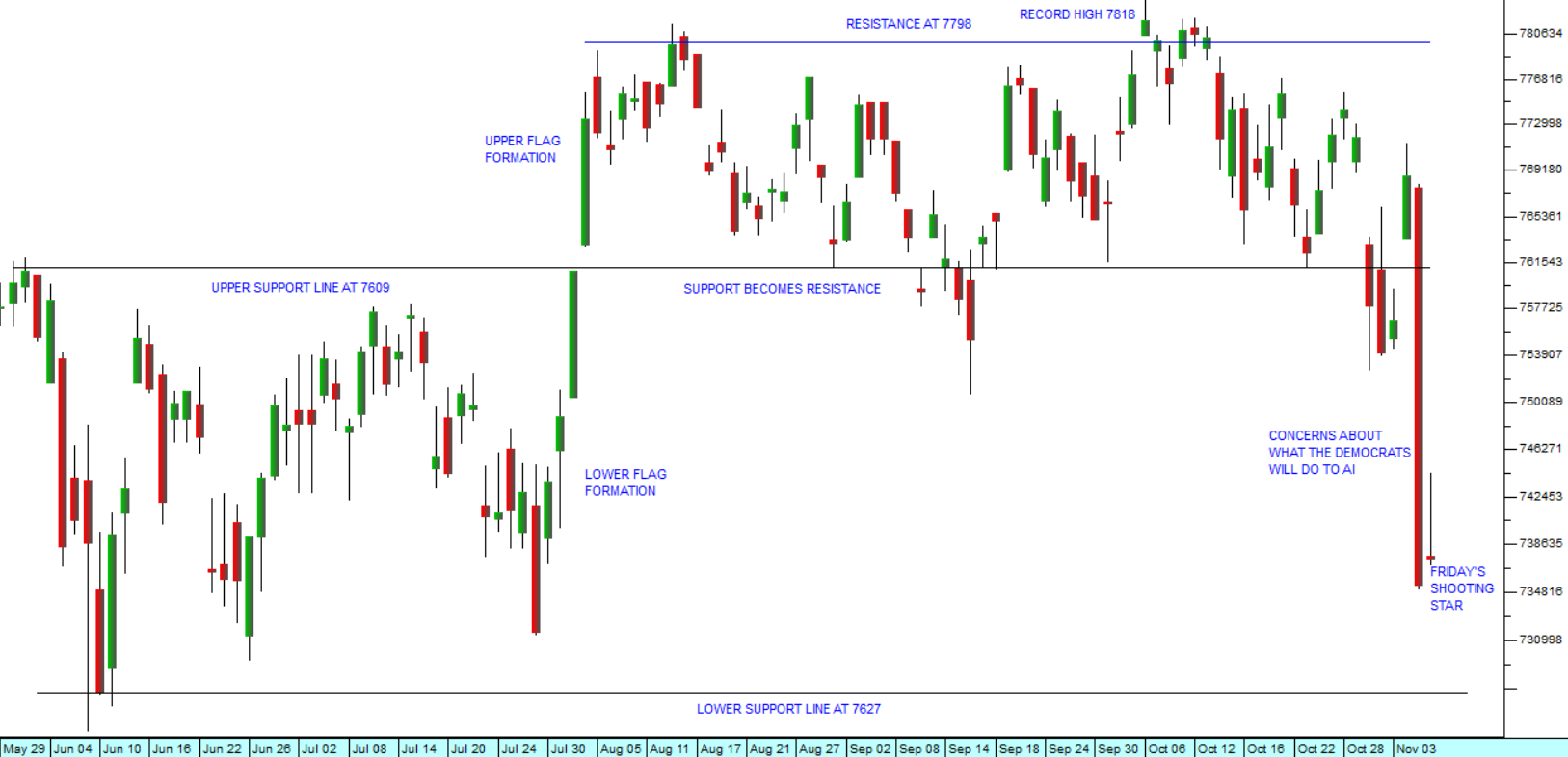
Those fears, added to the fact that tech shares were very already high and due for some kind of correction, has led to a rapid rotation out of AI and into other sectors or into cash. Consider the chart:

S&P500 Index : 29th of May 2026 - 6th of November 2026. Chart by ShareFriend Pro.

Of course, the Anthropic IPO is due to happen on 19th November 2026 and their prospectus has already been issued. They are looking to raise between $80bn and $100bn off a market valuation of between $1,5tr to $2tr. That will now almost certainly have to be curtailed – possibly to as little as $1tr. While Anthropic showed explosive growth - posting $16.3 billion in revenue for the first half of 2026 (up 1,300% year-over-year) - it also recorded an $80.7 billion net loss during that same period.

As a private investor on the JSE watching all this unfold on world markets and with our own election results in the background, you must obviously ask how these things will impact on emerging markets and on South Africa in particular. Our markets, and especially the rand have remained remarkably stable throughout the turbulence. The rand weakened, as far as R16,75 to the US$ and strengthened as far as R16,35, and now has settled in the middle ground of R16,51. This shows that the sharp downward move on Wall Street has not resulted in a huge shift towards risk-off among international investors. The smart money is still buying South African high-yield bonds and our relatively cheap high-quality equities.

On Friday, the US markets stabilised with many investors buying the dip and other even going as far as selling put options for a quick gain if the market recovers some of its former balance. However, the  shooting star formation does not bode well for the coming week. From a purely technical perspective, the lower support line on the S&P at 7626 now becomes important. If that is broken then we are in a full-blown correction.

Against this, we look at the underlying fundamentals of the third quarter S&P500 company earnings and feel that, at the very least, the Thursday sell-off was over-done. At this time 88,2% of S&P500 companies have reported and 82% of those have beaten earnings projections while 74,6% beat revenue expectations. This shows that the bull trend has been very well supported by rising profits across the board. In other words, it does not have the look of a bubble in the throes of bursting. But, in these turbulent times, your ultimate protection remains your stop-loss strategy.

Sasol and the Rising Oil Price  (2026-10-26)

Every major event that happens in the world inevitably offers some kind of investment opportunity for the private investor. The challenge is to work out how best to capitalise on it. So, it was with the war in Iran. At the time that the war began with the Israeli and American bombing raids on 28th…

Every major event that happens in the world inevitably offers some kind of investment opportunity for the private investor. The challenge is to work out how best to capitalise on it. So, it was with the war in Iran.

At the time that the war began with the Israeli and American bombing raids on 28th February 2026, we had already been watching the progress of Sasol for some time. The situation in Iran was tense with riots reported and North Sea Brent had climbed back up to $70 per barrel, but we had no idea that the Americans and Israelis were about to launch a bombing attack.

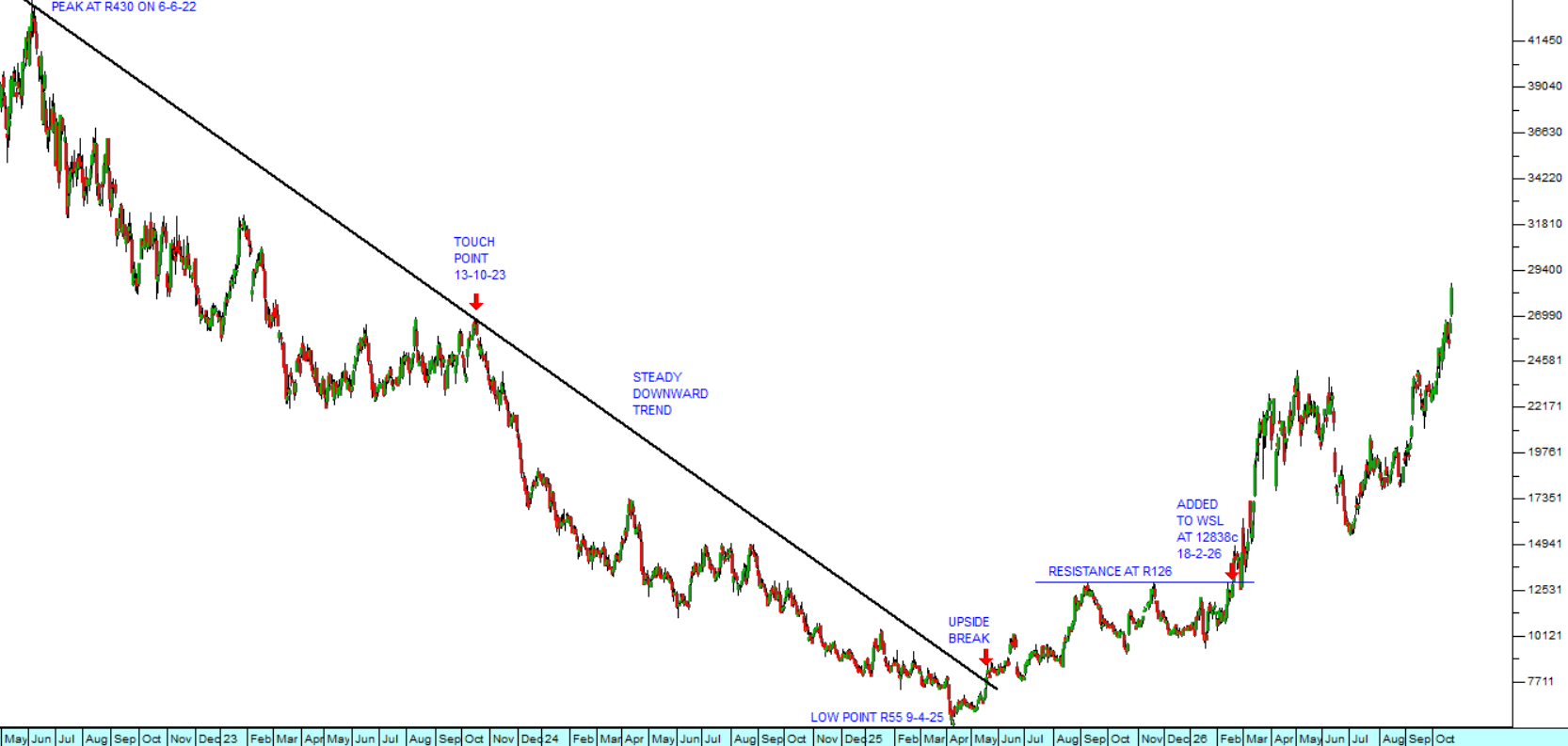
Sasol was always a blue-chip share and has historically occupied a dominant position in South Africa's synthetic fuels industry. It had, however been through some difficult times and the share price had fallen from a high of R430 per share to as low as R55 in April 2025. It then went through an extended period of sideways consolidation. We finally decided to add it to the Winning Shares List (WSL) on 18th February 2026 at a price of R128.36. Technically the share broke above resistance at R126 indicating that something was afoot. Consider the chart:

Sasol (SOL) : May 2022 - 23rd of October 2026. Chart by ShareFriend Pro.

The chart shows Sasol’s long downward trend that began in the middle of 2022, mainly because of the falling price of various grades of oil. North Sea Brent oil fell from a high of $125 per barrel on 8th March 2022 to its cycle low just below $60 per barrel in mid-December 2025. Since Sasol derives more than half of its revenues and profits from the fuel industry, it is directly linked to the price of oil.

Sasol had been recovering but had encountered significant resistance at R126 per share. When it broke decisively above that level, that gave us the signal we needed. Immediately prior to the start of the war the oil price had been climbing, and in January 2026 there were riots in Iran which Trump and Netanyahu used as a pretext to begin the bombing. The price of Brent rose above $70 per barrel on 18th February, before the bombing started, and that triggered a rise in Sasol’s share price. We decided then that Sasol was probably under-valued and due for an upside move.

Sasol’s latest results for the year to 30th June 2026 show the benefits of the rising price of oil. Turnover was up 9% and earnings before interest taxation depreciation and amortisation (EBITDA) was up 17% while the company reduced its debt by 11%.

We do not normally advise investors to buy commodity shares like Sasol because they are riskier, but sometimes they can offer very good capital gains. In the case of Sasol the share appreciated rapidly after we added it to the WSL and then there was a correction as the oil price temporarily fell back in June and July this year. We held on because we thought there might be further upside potential.

The best investment policy is to try to hold onto your shares for at least three years, unless you are moving into a loss position (i.e. you had to execute an early stop-loss sale). This is because if you hold them for less than 3 years the Receiver may seek to declare you to be a share dealer – and then any gain you make will be added to your taxable income and you will be taxed on it at your marginal rate. If you hold for longer than 3 years, then your appreciation is treated as a capital gain for tax purposes and taxed at 18%.

As it turns out holding on to Sasol was the right decision and the share has now appreciated by 134% in about 8 months since we added it to the WSL – which is just shy of 200% per annum.

October Month  (2026-10-19)

There are generally two types of risk in the share market – the risk that a specific share which you have bought falls known as unsystematic risk, and then the risk that the market as a whole falls and drags all your shares down with it - known as systematic risk. The systematic risk that the market…

There are generally two types of risk in the share market – the risk that a specific share which you have bought falls known as unsystematic risk, and then the risk that the market as a whole falls and drags all your shares down with it - known as systematic risk. The systematic risk that the market is in or about to enter a bear trend is obviously a vital consideration for the private investor. During a bear trend about 80% (or more) of shares will fall while only 20% will rise. This means that from a purely statistical point of view it is better for private investors to stay out of the market during bear trends.

It is also very important to be able to distinguish between a correction (which is often a buying opportunity) and a bear trend. The safest approach is always to always buy shares which are rising, in sectors which are rising in a market which is rising. At the same time keeping a strict stop-loss strategy is vital to protect the bulk of your capital. As a private investor you should have an absolute rule that you never lose more than 15% on any share market investment – ever – and that should include your dealing costs. This can only be achieved if you buy free-dealing shares and always adhere to a strict stop-loss strategy.

Today, Monday 19th October 2026 is the exact anniversary of the greatest single day crash in stock market history. Thirty nine years ago, on Monday 19th October 1987, Wall Street collapsed. The S&P500 index fell more than 20% in the day. Other famous bear trends have also begun in October month, including the infamous 1929 crash, the bear trend of the year 2000, the 2008 sub-prime crisis, and the bear trend of 2022 associated with the Ukraine War. So, October month has a bad reputation with investors, and they generally heave a sigh of relief when it is over.

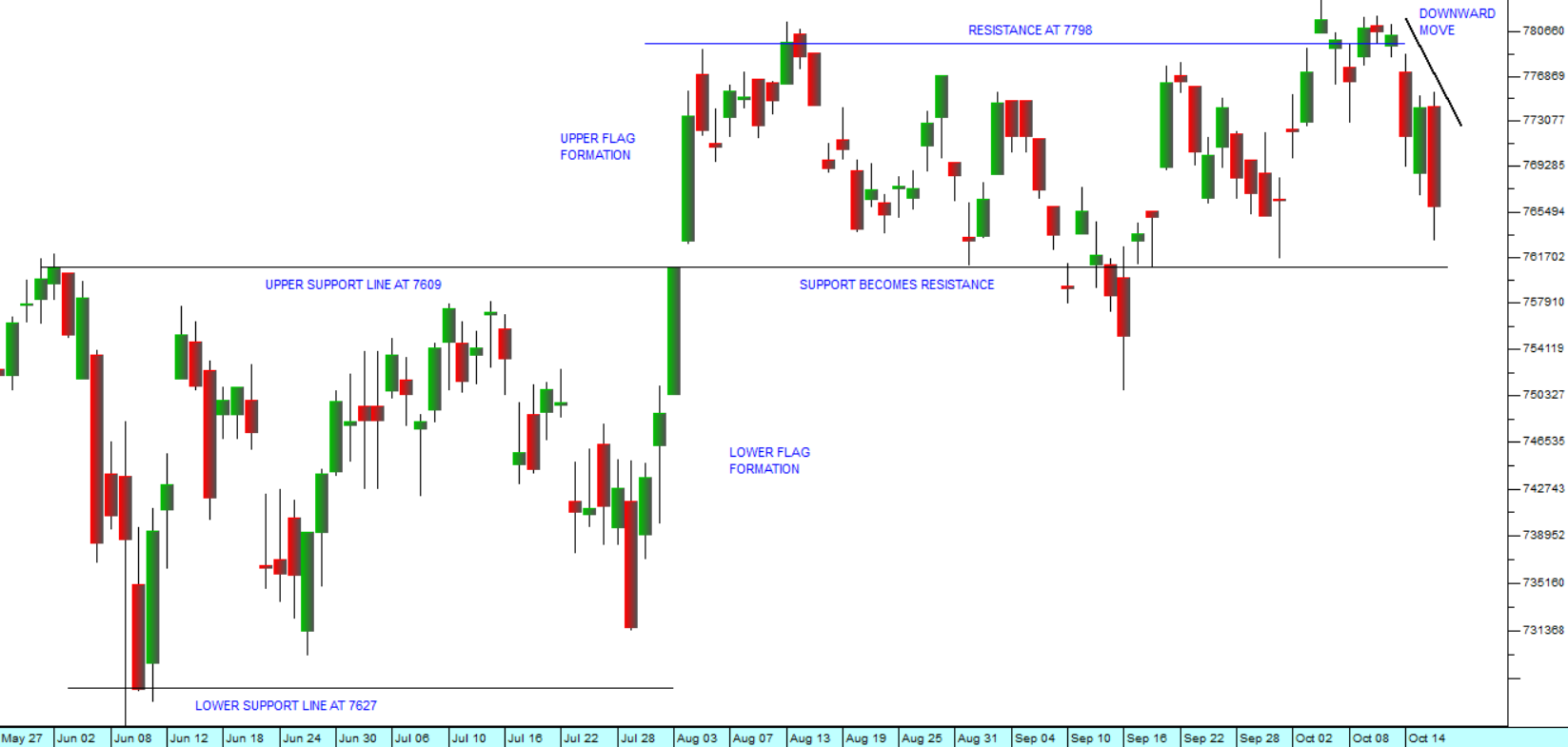
Ominously, Wall Street has been falling over the last week as the Iran war flared up again, pushing the price of North Sea Brent up to nearly $110 per barrel. Consider the chart:

S&P500 Index : 27th of March 2026 - 16th of October 2026. Chart by ShareFriend Pro.

In our analysis, we have drawn your attention to the fact that the S&P500 index has been moving through two sideways markets or flags as the countervailing forces of the rising oil price and the profitability of the artificial intelligence (AI) revolution play out.

The climb in the fuel price is causing a re-evaluation of inflationary risks throughout the world, but especially in America, where the price of petrol has remained stubbornly above $4 per gallon and diesel has hovered above $6 per gallon. With the mid-term elections just weeks away, Republicans and especially Trump are facing a barrage of criticism for their handling of the economy. The Iranians on the other hand are doing everything in their power to keep the oil price at high levels to put the maximum pressure on Trump.

What is notable is that the high oil price appears to be having less and less impact on Wall Street as time goes by. When Trump and Netanyahu began their war with Iran the S&P fell back sharply to 6611 on the 6th of April 2026, and the price of Brent oil went above $110 per barrel. Today Brent is again hovering close to those levels and the S&P has recently managed to reach a new record high at 7818. The world has been facing increased levels of inflation, rising interest rates, and record bond yields - but despite that, AI and corporate profits continue to take the market higher.  

In our opinion, as soon as October month is safely behind us and especially if the mid-term elections have the effect of reducing Trump to a lame dog president, we can look forward to a Christmas rally in the S&P500 during the festive season and into next year. As usual, we strongly advise you to be vigilant and to maintain your stops.

JSE Top 40

107,088.00 (+2.27%)

All Share

115,038.00 (+2.04%)

Financial 15

26,829.00 (+0.77%)

J200
J203
J212
Top Gainers
# Code Name Close (c) % move
1 ISO ASPI 3480 +19.96%
2 HUG HUGE 214 +16.94%
3 MKR MNTKRENEW 4447 +14.00%
Top Losers
# Code Name Close (c) % move
1 MCZ MC-MINING 248 -24.39%
2 MTU MANTENGU 9 -10.00%
3 PHP PHP 2006 -8.82%

Top Movers – Charts

Top Gainer: ISO
Top Loser: MCZ