Market View
J200 106,842.00 -2.59% J203 114,544.00 -2.40% J210 127,061.00 -6.13% J211 128,868.00 +0.11% J212 24,864.00 -1.08% J213 139,364.00 -0.43%
Winning Shares (Top 5)
Code Name Added Price Latest % Gain % Gain/Year
GFI GFIELDS 2025-02-04 32915 67824 +106.06% +83.25%
MTM MOMENTUM 2024-07-25 2402 3676 +53.04% +29.38%
ADH ADVTECH 2023-08-14 1975 4357 +120.61% +43.80%
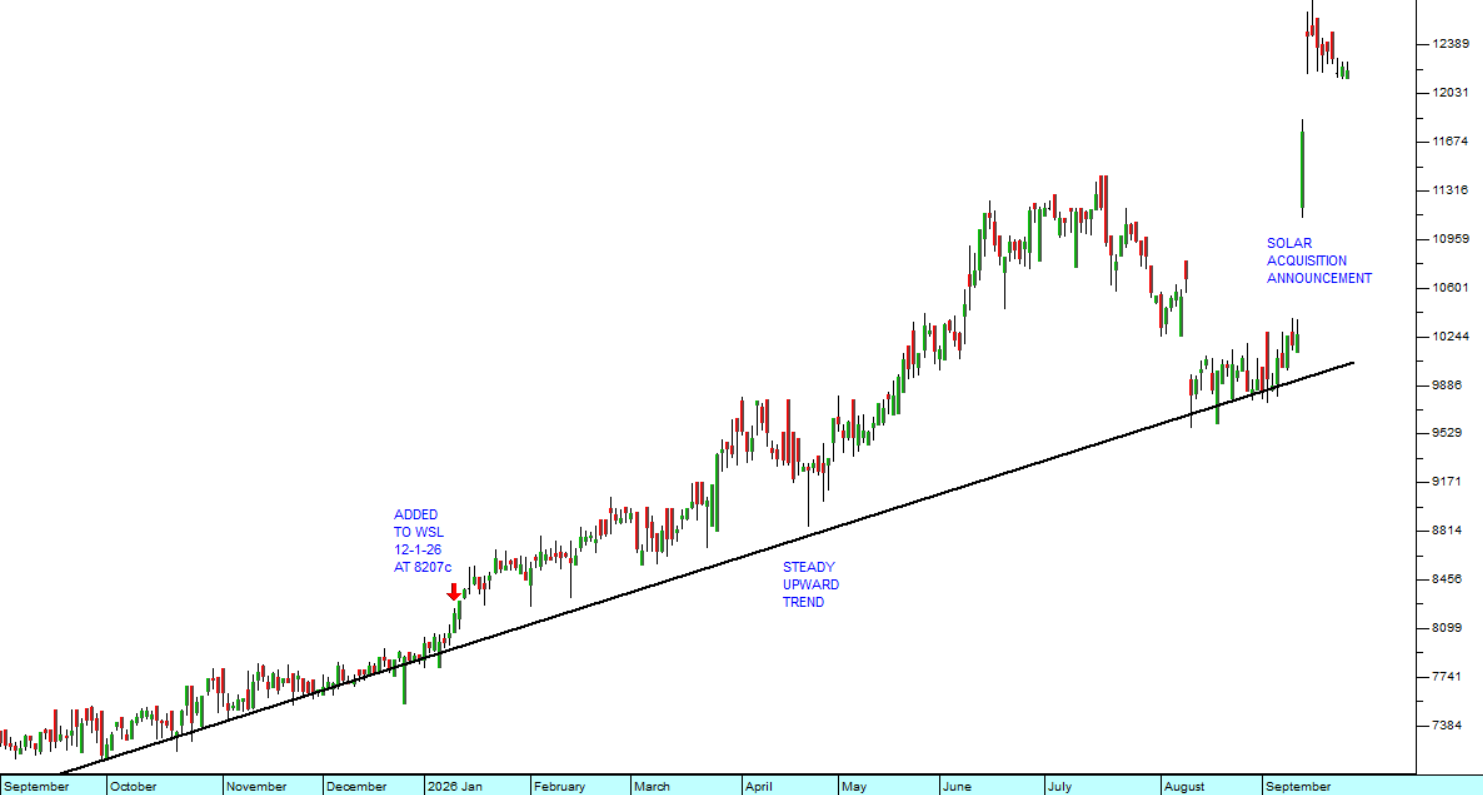
SOL SASOL 2026-02-19 12838 22472 +75.04% +322.24%
DTC DATATEC 2024-10-26 3950 7560 +91.39% +58.94%
Opinions (Top 5)
Code Name Date Action
NRL NEWPARK 2026-05-18 View

Newpark is a South African real estate investment trust (REIT) which has commercial and industrial properties worth R1,37bn and with a gross lettable area (GLA) of 57249 square meters. It owns four properties - two in Sandton CBD and one in Linbro Business Park and one in Crown City.

In its results for the year to 28th February 2026 the company reported revenue down 2,6% and headline earnings per share (HEPS) up 18,7%. The company said, "Newpark's loan-to-value (LTV) ratio decreased to 37,7% (F2025: 43,1%), primarily due to the reduction of debt following the disposal of the Crown Mines property". The enduring problem has always been that its shares were extremely thinly traded and therefore not suitable for the private investor.

However, from April 2026 the volumes traded have picked up and are now averaging R2300 per day. If they continue increasing perhaps the share could become more interesting.

EPS EASTPLATS 2026-05-18 View

East Plats (EPS) is a mining exploration and development company engaged in the platinum group metals (PGM) and chrome markets in South Africa. The company is listed on the Toronto Stock Exchange (TSX) and the JSE. The company has three projects - the Crocodile mine, which ceased operating in 2012 and is under care and maintenance, Sound Mine Solutions engaged to produce an independent technical report on the Zandfontein tailings retreatment and storage facility to recover chrome, and the Zandfontein project, which is a tailing retreatment project conducted with Union Goal.

On 11th February 2019, the company announced that it had made its first shipment of 10 000 tons of chrome concentrate from the Zandfontein operation. The company still foresees considerable cash flow uncertainties over the next 12 months which brings its "going concern" status into question.

In its results for the year to 31st December 2025 the company reported revenue up 31,2% and a loss of 9c (US) compared with a loss of 6c in the previous period. The auditors expressed a material concern over the company's ability to continue as a going concern. The company said, "Net loss attributable to equity shareholders was $18.4 million ($0.09 loss per share) in FY2025 compared to net loss attributable to equity shareholders of $12.8 million ($0.06 loss per share) in FY2024".

In an update on the 1st quarter of 2026 the company reported revenue down 6,8% and an attributable loss of $4,1m compared with a loss of $6,9m in the comparable period. The company said, "We had a challenging first quarter as monthly run-of-mine processing tonnages at the Crocodile River Mine were lower than targeted". The share is very thinly traded with very few shares trading on average, each day - which makes it impractical for private investors. 

SSK STEFSTOCK 2026-05-18 View

Stefanutti (SSK) is a South African construction company which offers roads and earthworks, marine construction, concrete structures, bulk pipelines, piling, geotechnical services, open pit contract mining, affordable housing, mine residue disposal, and other services. It operates in sub-Saharan Africa and the United Arab Emirates (UAE).

The company is considering further down-sizing to match its falling order book, and this will mean retrenchments. The share price has fallen from its high of 2650c in November of 2007 to current levels around 56c. The company is not paying dividends. Construction is always a risky investment in South Africa.

Much will depend on the progress of the South African economy and the availability of construction work from the government. This share is probably going to continue its long-term downward trend for the foreseeable future. In July 2020 Stefanutti was accused by Eskom of being overpaid R1bn for work done on Kusile - which the company denies.

In a restructuring plan the company is selling non-core assets and plant and equipment and trying to obtain further funding of R430m to counter the impact of COVID-19. The company is engaging in a restructuring plan which involves the sale of non-core assets, securing additional short-term funding of R430m and cutting costs.

The company is technically insolvent, and we think that this company may well be following many of its peers in the construction industry into consolidation or business rescue if the current restructuring does not work. In its results for the six months to 31st August 2025 the company reported revenue up 1% and headline earnings per share (HEPS) up 161%.

The company said, "In terms of the "Interim Arrangement" entered into with Eskom in February 2020, for the Purposes of Agreeing or Determining the Contractor's Claims and Facilitating the Dispute Resolution Process relating to Claim 5 (delay events up to 31 December 2019), the DAB issued its Sub-clause 20.4 decision on 17 October 2025, awarding Stefanutti Stocks R685 million (excluding VAT)." Technically the share entered a new upward trend in June 2024 and was added to the Winning Shares List (WSL) on 22-6-24 at 146c.

It has subsequently risen to 720c (15-5-26). Its latest results indicate that it may once again be in a strong upward trend. In a trading statement for the year to 28th February 2026 the company estimated that HEPS would increase by between 195% and 215%. 

DNB DENEB 2026-05-18 View

Deneb (DNB) is a 67,8% subsidiary of Hosken Consolidated Investments (HCI), listed on the JSE under specialty financial services. Deneb is an investment holding company with four divisions - (1) a property portfolio in Natal, the Western Cape and Gauteng worth about R1bn, (2) a branded products division which supplies toys, electronics and stationery, (3) a manufacturing division which produces products for the mining, agriculture, construction and automotive industries, and (4) a textile division which makes cotton, worsted and polyester fabrics.

In its results for the six months to 30th September 2025 the company reported revenue up 22% and headline earnings per share (HEPS) up 101%. The company's net asset value (NAV) rose 6% to 440c per share. The company said, "Although most businesses delivered revenue growth, it was particularly strong in our lower margin businesses within the Branded Product Distribution segment.

The growth in lower margin turnover resulted in gross margin being down 160 basis points and thus gross profit was only up 14,2%." In a trading statement for the year to 31st March 2026 the company estimated that HEPS would increase by between 47% and 67%. The problem with this share is that it is extremely tightly held with only R4000 worth of shares changing hands on average each day and therefore not practical for private investors.

KAL KAL Group 2026-05-15 View

Previously, Kaap Agri, the KAL Group is an agricultural company owned 40,9% by Zeder, which is, in turn, 43,7% held by PSG. The company operates through over 190 retail outlets offering a wide range of products and services mainly to the farming community. Kaap Agri has seven divisions: (1) Pakmark offers a wide range of packaging materials for the local and export markets, especially to the fruit industry.

(2) Agrimark has over 70 stores in South Africa and Namibia offering a wide range of animal feeds, gardening equipment, tools, outdoor and camping equipment and pet accessories. (3) Liquormark offers a wide range of liquor products from beers to wines, spirits and mixers. (4) Kaap Agri Mechanisation offers farming machinery and equipment.

(5) Wesgraan offers grain handling and management services. (6) Expressmark supplies fuel, especially diesel, mainly to the farming community. It also has convenience stores. (7) The Fuel Company (TFC) aims to be the market leader in the independent fuel retail market in South Africa.

The group's product diversity has reduced its exposure to weather conditions in the agricultural sector, especially in the Western Cape, but it remains essentially a retail outlet which focuses on the agricultural sector and as such its results are impacted by the general level of consumer spending in South Africa and the state of the local economy as well agricultural conditions. On 4th October 2021 Kaap Agri announced that it had sold its 70,5% stake in TFC Properties for R446m.

On 19th January 2022 the company announced the acquisition of PEG Retail Holdings for R1,09bn. This acquisition increases the number of petrol stations which Kaap Agri has from 43 to 84. In its results for the six months to 31st March 2026 the company reported revenue up 5% and headline earnings per share (HEPS) up 12,5%.

The company said, "Net cash from operating activities R575.2 million, increased by 3.9% (31 March 2025: R553.6 million). Net interest-bearing debt to equity improved to 32.9% (31 March 2025: 48.4%)". We see KAL as a well-managed company that has exposure to South Africa's retail environment, loadshedding and also to the state of agriculture in this country.

Technically, the share has been moving sideways and is fairly volatile. We recommend waiting for the share to begin a new upward trend before investigating further. Issues surrounding expropriation of land without compensation have an impact on the company as does the price of fuel.

However, with a P:E multiple of 7,2 these risks look to be at least partly discounted. 

Winning Share: MTM
Opinion: KAL
Exponential Bull Trend  (2026-05-18)

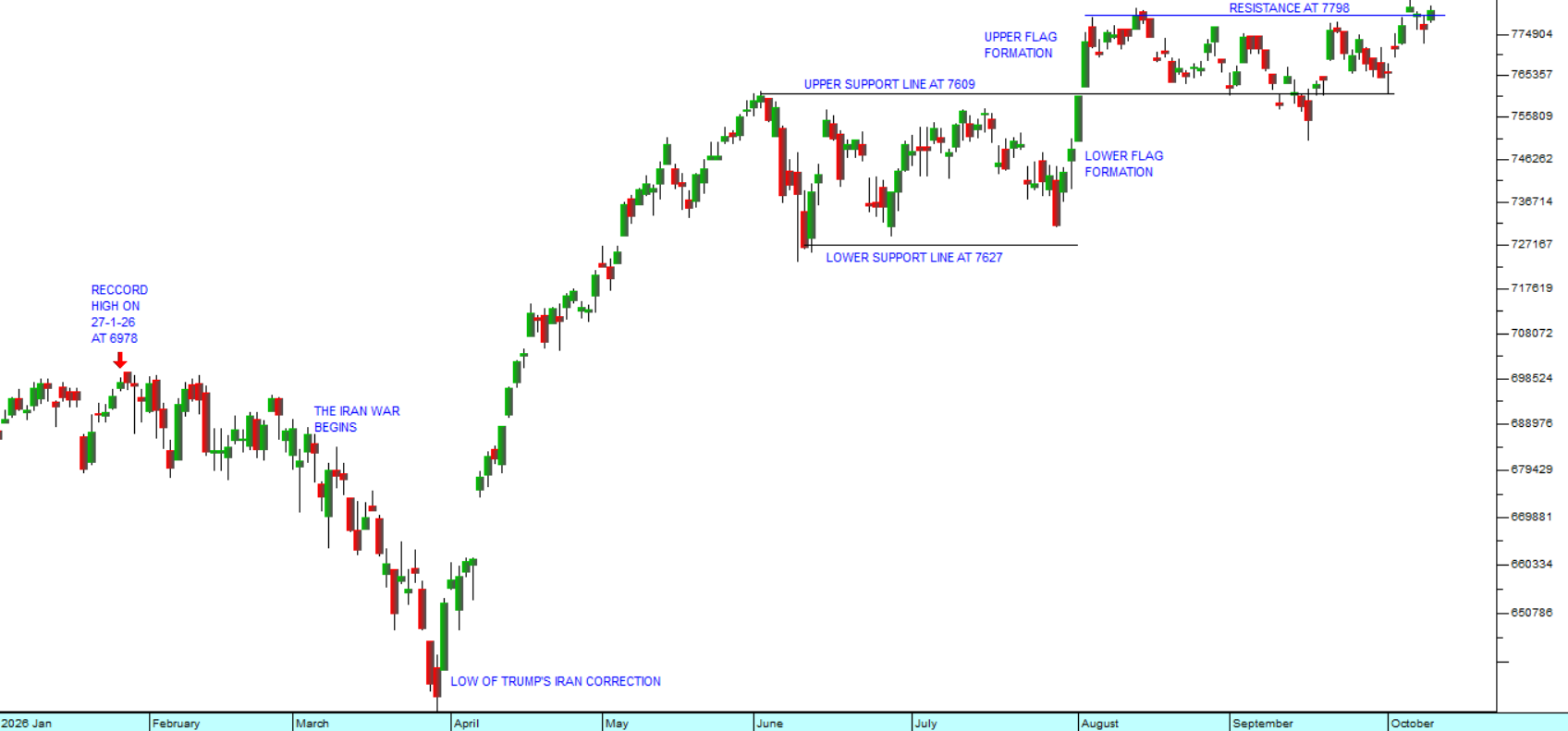
The current bull trend, in our opinion, began in 2009 from the low point on the S&P500 index of 676 reached on 9th March of that year. It has now been going on for over 17 years – making it the longest bull trend in the history of Wall Street by far. On Thursday, May 14, 2026, the S&P 500 closed at…

The current bull trend, in our opinion, began in 2009 from the low point on the S&P500 index of 676 reached on 9th March of that year. It has now been going on for over 17 years – making it the longest bull trend in the history of Wall Street by far.

On Thursday, May 14, 2026, the S&P 500 closed at a new all-time record high of 7,501 and the Dow Jones Industrial index went back above 50 000. This means the market has gone up 11-fold over the past 17 years. The question which investors have to ask themselves is, “How much further up can it go?” – and nobody really knows the answer to that question.

The historical price:earnings ratio (P:E) of the S&P500 is now just under 32 – which is well above its average level, but this does not necessarily mean that it cannot go higher. The fundamentals driving the 500 shares which make up the index are a direct function of their perceived future earnings and their potential to increase those earnings even further.

This in turn is a function of the on-going impact of new technologies like AI, and humanoid robotics on productivity levels. The problem is that during a protracted bull trend like this one, markets tend to become over-enthusiastic about that future potential, to the point where they begin to create their own momentum. Then share prices can begin to lose touch with the underlying profitability of the companies which they represent – and Wall Street is certainly moving in that direction.

A similar situation arose in the 1920’s when the new technologies of the motor car and the telephone began to become ubiquitous. These technologies impacted the profitability of all companies big and small giving rise to the “Roaring Twenties”. As Wikipedia puts it, “...the decade was characterized by economic prosperity, rapid social and cultural change, and a mood of exuberant optimism.

The problem is that investors tend to push share prices up so high that their potential to produce concomitant profits becomes irrelevant to investors. In other words, the investors get carried away in the excitement and bid shares up to absurd and unsustainable levels. Eventually a “bigger fool” point is reached where investors buy a share, not because of its earnings potential, but because a bigger fool will buy it back from them in a few weeks for even more money. The inevitable result is a 1929-style crash.

So, we need to ask, “Is Wall Street at a similar position now?” We believe it is getting there, but not yet. The new technologies are certainly impacting profitability across the board but the upward trend has not yet become crazy. It is still linked to future profits. So, we believe that Wall Street is still at a relatively early stage in this process and that the bull trend will continue for quite a while, getting steadily more and more excessive.

Our view is that the profitability gains flowing from AI are only just beginning. We are expecting far greater gains in the future. In our view America and the world is at much the same point that it was at, say, in 1923 or thereabouts, just when the Roaring Twenties were just getting going.

Sometimes it is useful to step back from the immediate excitement of the latest all-time record highs to look at the big picture. Consider the following chart which shows the progress of the S&P500 index since the start of this great bull trend 17 years ago:

S&P500 Index : November 2008 - 15th of May 2026. Chart by ShareFriend Pro.

The chart shows the progress of the S&P500 index since March 2009. You can see there the low point of 676 followed by a very gentle upward slope until about 2016. Thereafter, the gradient increased, but not very much and it was interrupted by the COVID-19 pandemic in 2020. Bear in mind that we regard COVID-19 as an aberration, not directly related to the stock market from a technical point of view. After that came the war in Ukraine which held the market back for a time, but since then the market has been accelerating despite Trump’s two interventions. What you can see from this chart is that the market is definitely becoming exponential. It is going up faster and faster. The move from 7000 on the S&P to 8000 is definitely quicker than the move from 6000 to 7000. The chart is rising almost vertically now.

And we can only imagine where the S&P500 would be now if the Brent oil price was still at around $70 per barrel instead of close to $110. Trump’s war in the Middle East has had the effect of temporarily cooling markets, but it has been insufficient to dampen the tidal wave of investor enthusiasm for the “blue sky” potential of AI and related technologies.

It is always fun to participate in the final stages of a great bull market, but you must be aware that nothing goes up forever. Your best protection against the coming bear, whenever it happens, is to maintain a strict stop-loss strategy on all your share investments. Remember, it is acceptable to widen your stop-loss percentages when your investments are strongly in-the-money, but you can never lose sight of the fact that at some unpredictable date in the future the market will come down – so it is important to have a clear strategy that locks in your profits.  

Stefanutti  (2026-05-11)

Stefanutti is a highly diversified construction company operating in Southern Africa. Its operations include roads and earthworks, marine construction, concrete structures, bulk pipelines, piling, geotechnical services, open pit contract mining, affordable housing, mine residue disposal, renewable…

Stefanutti is a highly diversified construction company operating in Southern Africa. Its operations include roads and earthworks, marine construction, concrete structures, bulk pipelines, piling, geotechnical services, open pit contract mining, affordable housing, mine residue disposal, renewable energy and other services.

It’s status as a level one BBBEE operator enables it to successfully tender for numerous government and state-owned enterprise (SOE) contracts inside South Africa. The company has benefited directly from the advent of the government of national unity (GNU) and the increase in infrastructure spend.

Historically, like the entire construction industry in South Africa, Stefanutti initially suffered from the suppression of the industry by the ANC and the adjustment to BEE requirements. Its share price fell from a peak of 2700c on the 14th of November 2007 to a low of 8c on the 13th of December 2019.

From that low point began a slow, but steady, recovery. We became interested in the share in June 2024 when its potential became more obvious. It had been in an extended sideways and downward market for 18 months before breaking up at the end of June 2024. Seeing its potential, we added it to the Winning Shares List (WSL) on the 22nd of June 2024 at a price of 146c. Consider the chart: 

STEFSTOCK (SSK) : May 2024 - 8th of March 2026. Chart by ShareFriend Pro.

The chart shows the end of the share’s sideways pattern in May and June of 2024 and then the sharp upward trend that followed. This upward trend came to an abrupt halt in September 2024 – but by then the share had already risen to a cycle high of 494c on the 30th of September 2024.

What followed was an 8-month downward channel in which the share price fell back to a cycle low of 300c on the 17th of April 2025. During this period, we maintained our view that the share had considerable upside potential and so kept it on the WSL.

Now a new upward trend has emerged, and the share has appreciated strongly to its close last Friday at a new record high of 654c.

In many senses, Stefanutti is an investment in the new South Africa and the potential of GNU to bring about significant economic reforms. Its wide diversity and BEE status means that it can benefit from projects in almost any industry, while being a preferred bidder for government contracts. This has enabled it to increase its order book and become more profitable.

In its financials for the six months to the 31st of August 2025 the company reported revenue unchanged, but headline earnings per share (HEPS) up 161%.

Since we added it to the WSL the share has appreciated by 338,36% - which amounts to over 180% per annum. Very few companies have achieved this level of growth. We expect the share to continue performing well going forward, especially given that the November 2026 elections are likely to result in further economic reform and a focus on infrastructure development.  

Record Highs  (2026-04-28)

Wall Street’s relationship with Trump is evolving. At the start of his current term, when he was playing with the US tariff system, everything he said moved the markets. Today, tariffs have completely lost their force in the market and Trump has moved on to being a warmonger instead. His attack on…

Wall Street’s relationship with Trump is evolving. At the start of his current term, when he was playing with the US tariff system, everything he said moved the markets. Today, tariffs have completely lost their force in the market and Trump has moved on to being a warmonger instead.

His attack on Venezuela did not move the markets, but it boosted his confidence and made him easy prey for Israel’s Netanyahu, allowing him to embroil the US in a war which does absolutely nothing for America and has certainly damaged Trump’s mid-term election prospects beyond repair.

The US/Iran war has reached a stalemate with both sides closing the Strait of Hormuz and both sides seizing commercial ships in the vicinity. What is interesting is that while the price of North Sea Brent oil has now climbed back above $105 per barrel, the S&P500 index has made yet another new all-time record high.

Investors are clearly looking beyond the oil price to the excellent results and predictions coming out of S&P500 companies, and especially the “magnificent seven”. Consider the chart:

S&P500 Index : 28th of October 2025 - 24th of April 2026. Chart by ShareFriend Pro.

The chart shows the previous 5% correction in November last year and then Trump’s Iran war correction which broke to a lower low and created the opportunity for a TACO trade. You will note the important hammer formation on 7th April 2026 which gave a clear early warning that a strong recovery was coming. Note also that the 50-day moving average turned upwards again, away from the 200-day – indicating that a death cross had been averted.

The general investor perception is that the Iran war is a temporary phenomenon which will be resolved one way or another relatively soon. The primary impact of the higher oil price, while negative for the economy, has been to seriously erode Trump’s MAGA support base. It is also having the effect accelerating the movement away from fossil fuels towards renewables.

There is now concrete evidence that somebody in Trump’s camp has been profiting massively from his announcements on the war in Iran. There are three clear instances of insider trading in the oil futures market coming immediately prior to his announcements:

  1. On 23rd March 2026, a $500m short placed 15 minutes before Trump announced a delay in Iranian strikes.
  2. On 7th April 2026, a $950m short placed immediately before Trump announced the US-Iranian ceasefire.
  3. On 17th April 2026, a $760m short, placed minutes before the opening of the Strait of Hormuz was declared by Trump.

The Commodity Futures Trading Commission (CFTC) is investigating these trades.

MAGA has been blithely unconcerned about the fact that Trump is inter alia a convicted criminal, a rapist, an inveterate liar or that he and his minions have been engaged in blatant insider trading. MAGA is, however, very much concerned about the price of petrol (“gas”) which has remained stubbornly above $4 per gallon since the war began.

At the same time, the stock market is bracing for the biggest wave of initial public offers (IPO) in its history with SpaceX, Open AI and Anthropic all planning to come to the market later this year. They are endeavouring to raise a total of $3 trillion led by SpaceX’s $1,75 trillion offer. Open AI is looking for about $1 trillion and Anthropic wants $380bn. What is interesting about this is that all three companies are currently running at a loss. Space X, particularly, reported a loss of $5bn last year on revenues of $18,6bn.

This almost looks like the start of a top-of-market listings boom. Investors are losing sight of the underlying fundamentals and focusing only on blue sky potential. With its latest all-time record high last Friday, the S&P500 is now trading at an historical price:earnings ratio (P:E) above 30 – which must be compared with the median average for that index of between 15 and 18. In other words the index is discounting a substantial increase in earnings for its component companies.

Can that be justified? We believe that it can. There is little doubt that the productivity benefits of AI have only just begun to impact the profits of S&P500 companies – let alone other emerging new technologies like humanoid robotics. We believe that the bull trend will continue – but your best defence against a market collapse remains your stop-loss strategy.

JSE Top 40

106,842.00 (-2.59%)

All Share

114,544.00 (-2.40%)

Financial 15

24,864.00 (-1.08%)

J200
J203
J212
Top Gainers
# Code Name Close (c) % move
1 SLG SALUNGANO 75 +50.00%
2 CPR COPPER360 49 +13.95%
3 XII NUMERAL 35 +9.38%
Top Losers
# Code Name Close (c) % move
1 RLO REUNERT 6101 -14.07%
2 FTH FRONTIERT 601 -11.49%
3 GML GEMFIELDS 82 -8.89%

Top Movers – Charts

Top Gainer: SLG
Top Loser: RLO