Market View
J200 105,887.00 -3.37% J203 113,710.00 -3.02% J210 126,484.00 -5.49% J211 127,893.00 -3.07% J212 24,743.00 -1.12% J213 138,259.00 -2.19%
Winning Shares (Top 5)
Code Name Added Price Latest % Gain % Gain/Year
SUR SPURCORP 2023-08-08 2488 3898 +56.67% +21.71%
ADH ADVTECH 2023-08-14 1975 3863 +95.59% +36.84%
CGR CALGRO-M3 2023-08-15 356 450 +26.40% +10.19%
CAA CA-SALES 2023-08-25 775 1418 +82.97% +32.35%
CPI CAPITEC 2023-11-04 185496 419000 +125.88% +53.12%
Opinions (Top 5)
Code Name Date Action
ARL ASTRAL 2026-03-19 View

Astral Food (ARL) is a leading poultry producer in South Africa. The company's activities include integrated broiler operations, where they have a processing capacity of 4,4 million broilers per week; Ross Poultry Breeders, which supplies breeding stock to the South African broiler industry; National Chicks, which is a day-old chick and hatching egg supplier; and Meadowfeeds, which has seven mills producing a wide range of specialised products for farm animals.

Buying this share is a gamble on weather conditions and the cost of feed (maize). Since poultry imports into South Africa are about 30% of total consumption, it is also a gamble on the dumping of cheap chicken onto the South African market by Europe, Brazil, and the US - but at current levels the share looks reasonable.

As an essential service, Astral has not been greatly impacted by COVID-19 except that it is expecting an over-supply of chicken as a result of higher unemployment in due course. Overall, we view this as a relatively risky commodity share, but one which is trading well below previous levels.

In its results for the year to 30th September 2025 the company reported revenue up 10% and headline earnings per share (HEPS) up 14%. The company said, "The Poultry Division contributed 82.5% (2024: 82.6%) and the Feed Division 17.5% (2024: 17.4%) to total external revenue.

The increase in revenue was primarily attributable to increased broiler slaughter volumes and sales in the second half of the year (2H2025), as well as a recovery in selling price realisations following selling price deflation during the first half of the year." In a trading statement for the six months to 31st March 2026 the company estimated that HEPS would rise by at least 435%. The company said, "Astral's results for the period were positively impacted by the following: • Strong demand for poultry products has resulted in higher sales, and has enabled Astral to increase broiler production volumes.

• Poultry selling prices recovering through 2025". Technically, the share has been in an upward trend since August 2025. The company has had problems with feed costs and has been impacted by the unreliability and costs of electricity and water. Rising maize and fertiliser costs as a result of the war in Ukraine impacted margins and the recent avian flu had a negative impact.

We find this company generally well-managed and cheap at current levels - but volatile.

SBP SABCAP 2026-03-19 View

Sabvest Capital (SBV) is an investment holding company which listed on the JSE in 1988. Previously, the company had both ordinary and "N" shares which were very thinly traded. To rectify this situation a new company was registered, called Sabcap, and the shares of Sabvest were swapped out for Sabcap shares.

This happened on 12th May 2020. Sabcap has investments in five private companies, by far the largest of which is SA Bias where its investment is 60% and worth R673m. SA Bias is predominantly involved in the textiles industry but also has an interests in a company involved in handling equipment and parts.

The other private companies in which it has an interest are: Classic Food Brands (30%), Flexo Line Products (47,5%), Mandarin Holdings (30%), JAA Holdings (35,7%) and Sunspray Food Ingredients (28,2%). Aside from this, Sabvest has a listed portfolio worth about R700 000 and offshore investments worth about R573 000.

It also owns 11,7% of Metrofile worth R82,3m, 300 000 shares in Net1 UEPS, and 31% of Rolfes. In its results for the year to 31st December 2025 the company reported net asset value (NAV) up 21,9% to 16105c per share. The company said, "The 20-year compound annual growth rate (CAGR) in NAV per share to the 2025 year-end was 19,2%, calculated without reinvesting dividends".

This share is very difficult to analyse because of its diverse and constantly changing portfolio but its performance has been good. The restructuring of the business does appear to have increased the volumes traded a little in the company with an average of about R880 000 worth of shares changing hands each day and the share is in an upward trend.

Like most investment holding companies, it trades at a significant discount to its NAV.

PPR PUTPROP 2026-03-19 View

Putprop (PPR) is a property company which was spun out of Putco (the bus company) and separately listed on the JSE in July 1988. The company owns 16 properties in industrial, retail and office with a gross lettable area (GLA) of 97601 square meters and a value of R1095m. In its results for the six months to 31st December 2025 the company reported rental income of R72,3m down from the previous period's R74,8m.

The company's headline earnings per share (HEPS) fell to 24,19c compared with 28,35c in the previous period. From a private investor's perspective, the main problem with this share is that it is relatively thinly traded with many days on which there are no trades at all. It is clearly not a share that the institutional investors are interested in.

We believe that there are better counters in the property sector.

EPE ETHOSCAP 2026-03-19 View

Ethos Capital Partners (EPE) is a private equity fund (PEF), incorporated in Mauritius, which invests into unlisted companies for long-term capital appreciation on behalf of its investors. Like most investment holding companies, Ethos trades at a significant discount to its net asset value (NAV).

Fifty-six percent of their assets are in South Africa and 39% in the rest of Africa. It has stakes in Tymebank, Ster Kinekor and Brait. The risk in this company appears to be minimal since it does not invest a significant proportion of its funds in any one investment and its investments have performed well in the circumstances.

It does not pay dividends, so the investor has to look for a capital gain. In its results for the six months to 31st December 2025 the company reported net asset value (NAV) up 0,5% at 792c per share. The company said, "Return of capital to shareholders - From listing to 30 June 2025: - R243 million returned via share buybacks and the unbundling of Brait ordinary shares ("Brait Shares") - During the period ended 31 December 2025: - Unbundling of Brait Bonds on 8 December 2025 which resulted in the return of R171 million to shareholders". EPE is well-traded with an average of over R5m worth of shares changing hands on average every day.

It made a low at 360c in June 2024 and has since started to move up as its investments recover from the sell-off due to Ukraine crisis. In our opinion this share, although volatile, should turn out to be a good investment at current levels - depending on the progress of the current trend in world markets.

The separate and successful listing of Optasia on 4th November 2025 resulted in a jump in the EPE share price. 

BHG BHP 2026-03-19 View

BHP is a world-wide commodities company with its headquarters in Melbourne, Australia. It processes minerals, oil and gas and it has 62000 employees, mostly in the Americas and Australia. It produces copper, iron, coal, oil, and gas. BHP owns 57,5% of the Escondida mine in Chile which is one of the world's largest copper producers and also produces some gold and silver.

It owns 33,75% of Antamina in Peru which produces copper and zInc. It owns 100% of Pampa Norte which produces copper cathode in the Atacama Desert in Northern Chile. It owns 50% of Samarco in Brazil which produces iron ore and a one third interest in Cerrejon in Colombia which produces coal from an open-cut coal mine.

It owns mineral rights in Saskatchewan in Canada which contains one of the world's largest unexploited potash deposits. In Australia, BHP owns Olympic Dam which is one of the world's largest copper, uranium, and gold ore bodies. It also owns Western Australia Iron Ore which is a system of five mines connected by more than 1000km of railway lines.

It owns Queensland Coal which comprises the Mitsubishi Alliance and Mitsui Coal. It also owns the Mt. Arthur open-pit coal mine in New South Wales. It owns Nickel West which is a nickel mine with smelters, concentrators, and a refinery. In the petroleum field it owns high quality resources in the Gulf of Mexico, Australia, Trinidad, and Tobago.

This is a diversified international mining company which is impacted directly by commodity prices and hence from any recovery in the world economy. In its results for the year to 31st December 2025 the company reported a 30% growth in copper production with copper now accounting for 51% of its earnings before interest, taxation, depreciation, and amortisation (EBITDA).

The company said, "BHP is the world’s largest copper producer and with strong performance at Escondida, and solid contributions from our other operations in Chile and South Australia, we have increased FY26 group copper guidance to 1.9 – 2.0 Mt. This is allowing us to maximise increased earnings from the recent run up in copper prices as well as gold".

The share was rising steadily since April 2025 and we added it to the Winning Shares List (WSL) on 5th December 2025 at a price of 50350c. It has since risen to 57744c and we expect it to go further. It remains vulnerable to commodity prices. On 18th March 2026 the company announced that Brandon Craig would succeed Mike Henry as BHP CEO on 1st July 2026. 

Winning Share: ADH
Opinion: BHG
The Strait of Hormuz  (2026-03-16)

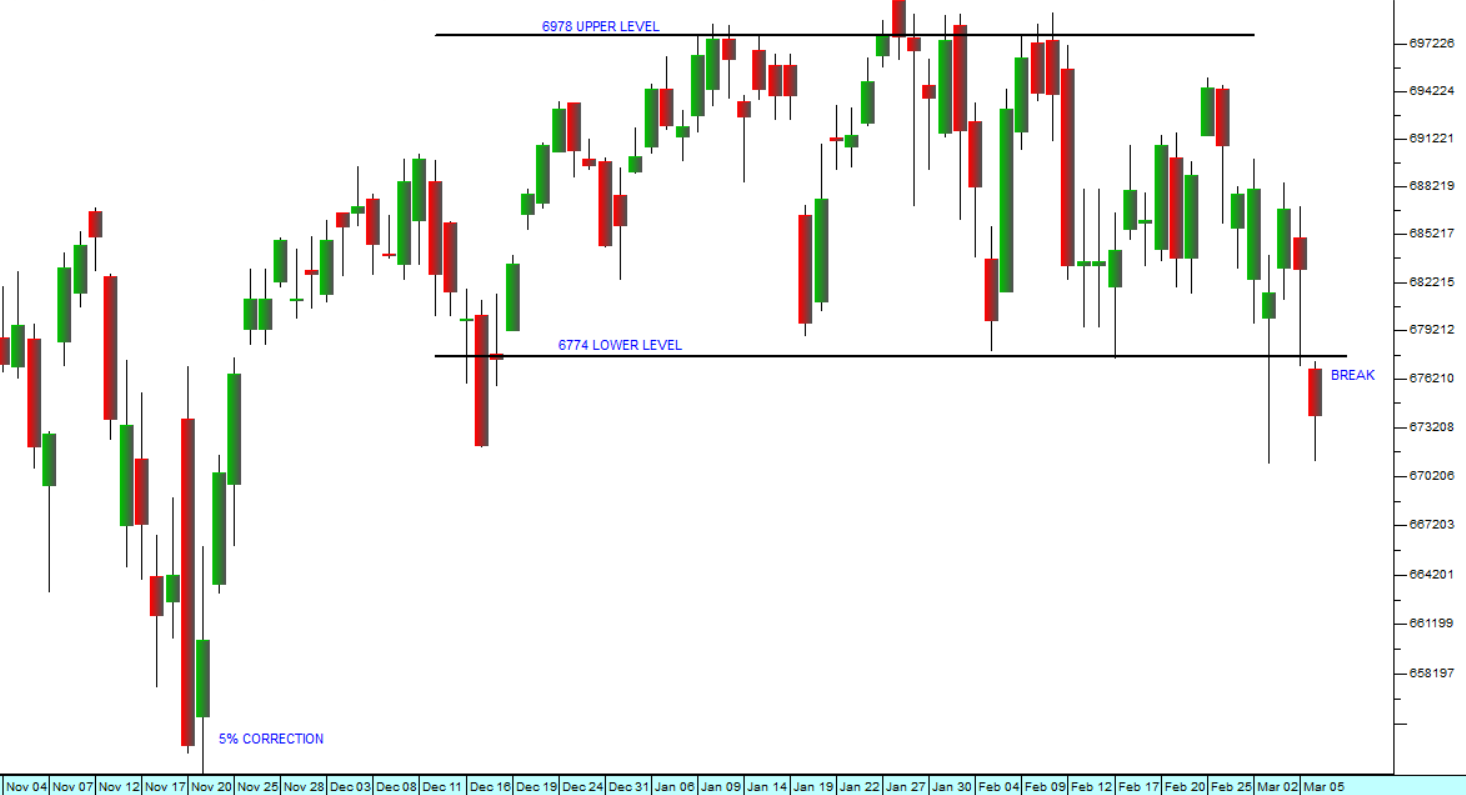
Are we teetering on the edge of a major bear trend? After Friday the 13th of March 2026's S&P500 close at 6632, Wall Street is now down 5% from its all-time record closing high of 6978.6 on the 27th of January 2026. This down-move is similar to the 5% correction which occurred in the first three…

Are we teetering on the edge of a major bear trend? After Friday the 13th of March 2026's S&P500 close at 6632, Wall Street is now down 5% from its all-time record closing high of 6978.6 on the 27th of January 2026. This down-move is similar to the 5% correction which occurred in the first three weeks of November last year and it is evident that there is still considerable bullish sentiment in Wall Street, just waiting for their moment to buy the dip .

Into this mix, Oracle (ORCL) delivered strong Q3 FY2026 results on March 10, 2026, beating estimates with $17.2 billion in revenue, driven by a 243% surge in AI infrastructure demand. This demonstrates that the underlying strength of the AI boom in the US is still alive and well. If the war situation in Iran can be resolved, it is clear that the stock market will continue up to new record highs very quickly. Consider the chart:

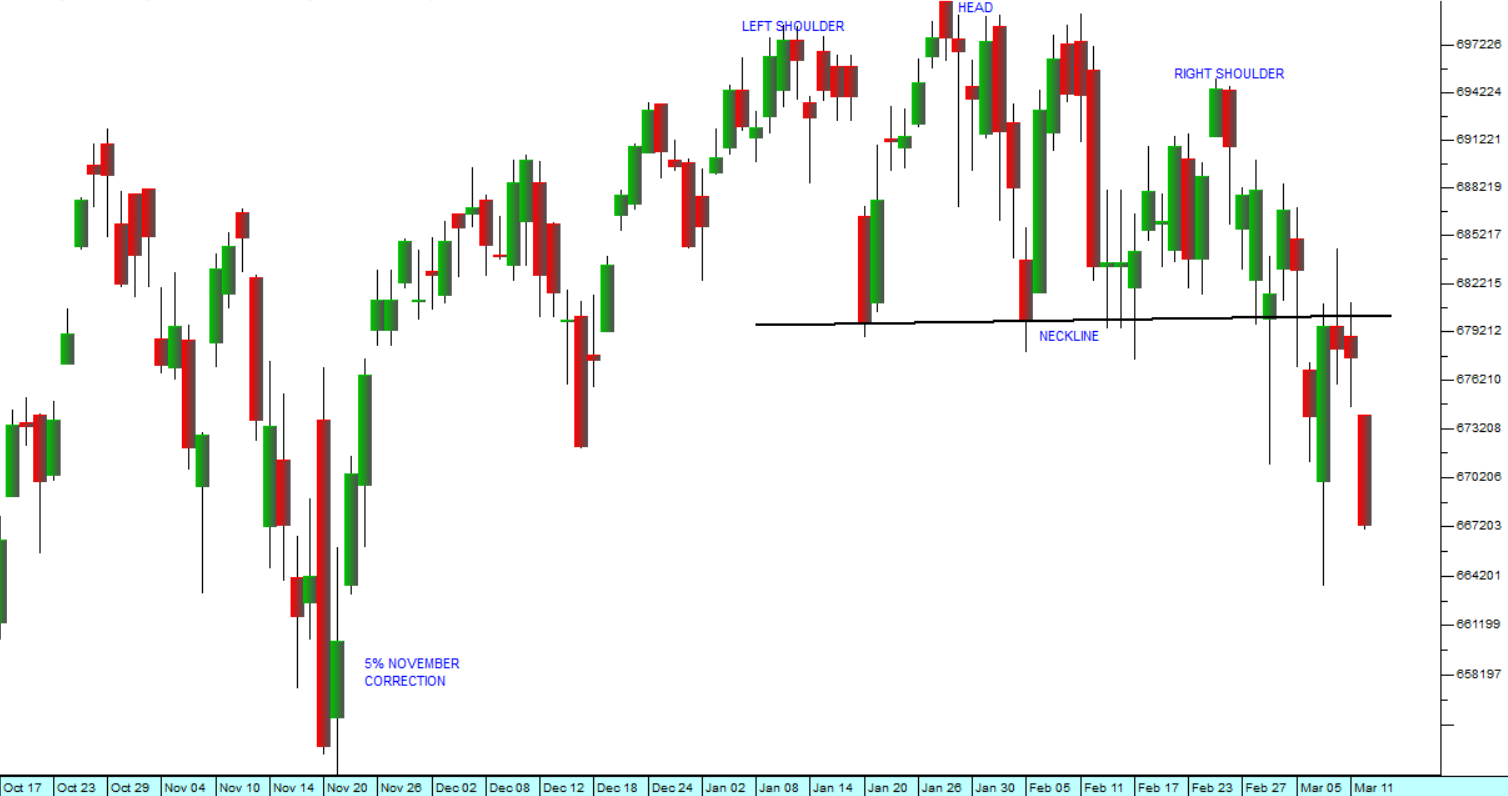
S&P500 Index : 17th of October 2025 - 13th of March 2026. Chart by ShareFriend Pro.

The chart shows the November correction and what some technicians are now suggesting is a head-and-shoulders formation. In our view, the formation is not particularly convincing, but after Friday’s move there can be no doubt that the index has broken strongly down.

Most of the problem comes from the jump in the oil price which has seen North Sea Brent rise to above $100. This is very good for Russia and Putin, while being very bad for Trump. The US Secretary for Defence, Pete Hegseth, seems to think that the problem is easily solvable, but we believe that it may be extremely difficult.    

Normally, about 20% of the world’s oil passes through the Strait of Hormuz. This narrow sea passage is relatively easy to attack and control, and it is Iran’s only strong pressure point in its war with Israel and America. Its navy and air force have now been systematically eliminated by strategic bombing. The new leader of Iran, Mojtaba Khamenei, has specifically said that he will not allow any ships to pass through and that he will use the rising oil price to put pressure on Trump.

The problem is that to open the Strait will require boots on the ground in Iran. The Israeli/US forces will have to clear a corridor at least 30km wide along the Iranian coast adjacent to the Strait to prevent the firing of missiles and drones against passing ships. They cannot do this from the air. Having boots on the ground means incurring casualties.

Trump probably began this war in order to draw attention away from his problems with the Epstein files. He has however landed himself with a new problem – the rising price of petrol in America. His approval ratings have fallen to an all-time low and the November mid-term elections are looming large. The price of petrol has risen by 20% since the start of the war. On the other hand, his tax cuts will begin to impact in April resulting in refund cheques being paid after the tax-filing season ends.

On Feb. 7, 2026, Chasity Verret Martinez won a special election to fill a vacant seat in the Louisiana House. Martinez is a Democrat who took 62% of the vote in a district that had given Donald Trump a 13-percentage-point victory in the 2024 presidential race. And her win came a week after Democrats seized a Texas Senate district that had supported Trump even more strongly.

While these results are not conclusive, they are a strong indication that the Republicans will lose their control of the House and may even lose the Senate in November. Trump knows that, if he loses both Houses, he could easily be looking at impeachment – so suddenly control over the shipping passing through the Strait of Hormuz becomes critical.

How should you as a private investor respond to this situation? Our advice is not to panic but to monitor your stop-loss levels closely and act on them when broken. We believe that the situation will be resolved and that some degree of normalcy will return sooner or later. When and if that happens, we expect stocks around the world to bounce.

The Iran Correction  (2026-03-09)

Trump’s decision to bomb Iran and kill the Supreme Leader of over 200 million Shia Moslems was taken without the consideration and approval of Congress and without the cooperation of other Western countries. It is the typical act of a dictator and has embroiled America in what looks like an…

Trump’s decision to bomb Iran and kill the Supreme Leader of over 200 million Shia Moslems was taken without the consideration and approval of Congress and without the cooperation of other Western countries. It is the typical act of a dictator and has embroiled America in what looks like an unplanned war situation. This may prove to be very difficult to conclude on any reasonable basis, and especially without a significant cost both in money and American lives.

Combined with other disturbing economic data, this has taken Wall Street out of the sideways pattern that it has been in since late last year and put it into a correction. The S&P500 index has so far fallen 3,4% from its all-time record high of 6978.6 on 27th January 2026. Consider the chart:

S&P500 Index: 4th of November 2025 - 6th of March 2026. Chart by ShareFriend Pro.

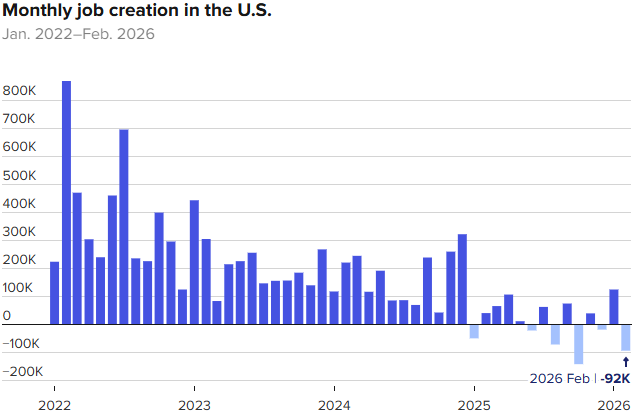
Part of the problem is the increasingly negative data coming out of the US economy, especially in the labour market. The most recent US jobs report showed that the US economy lost 92 000 jobs in February 2026.

Disturbingly, the steadily deteriorating monthly jobs numbers are an indication either that either the economy may be headed into recession or that the spread of artificial intelligence (AI) technologies is putting a large number of Americans out of work. Consider this chart published on Friday last week by CNBC:

Monthly job creation in the US: 2022 - March 2026. Available at:

https://www.cnbc.com/2026/03/06/february-2026-jobs-report.html

This shows a pattern of falling job creation going back to the beginning of 2022 and becoming steadily more negative in recent months. Combined with this, the unemployment rate has also been edging up and came in at 4,4% in February. This is somewhat higher than the unemployment rates below 4% which characterised the end of Joe Biden’s presidency, painting a concerning picture.

In our view, the productivity benefits of new technologies like AI should, in the medium term, more than compensate for the inevitable loss of jobs. In effect, the US economy is adjusting rapidly to a radically disruptive force which is reshaping the business environment and causing a sharp re-allocation of capital. Some businesses will benefit and others will disappear for ever.

In the longer term, once the dust settles, the economy should emerge stronger and that is why we believe that this is probably a correction rather than a new bear trend – but you will notice that what looks like a correction right now could develop into a head-and-shoulders formation if the record high of 6978.6 on the S&P is not broken when the market recovers.

At the moment, the positive news coming out of the tech sector is being off-set by the bad news on the political front and Trump’s war in Iran. If we are lucky, the war in Iran will be resolved on some basis - probably because he will probably back down in the face of increasing pressure both at home and abroad. If this happens in a relatively short time, the market will turn its attention back to the rapid progress of new technologies and hopefully recover to make a further new all-time record high in due course.

AngloGold Ashanti  (2026-02-23)

It is no secret that precious metals prices have been running. Most of the best-performing shares on the Winning Shares List (WSL) are mining companies with interests either in gold or platinum group metals (PGM). Gold in particular has dominated the investment world. The metal has risen 145% in US…

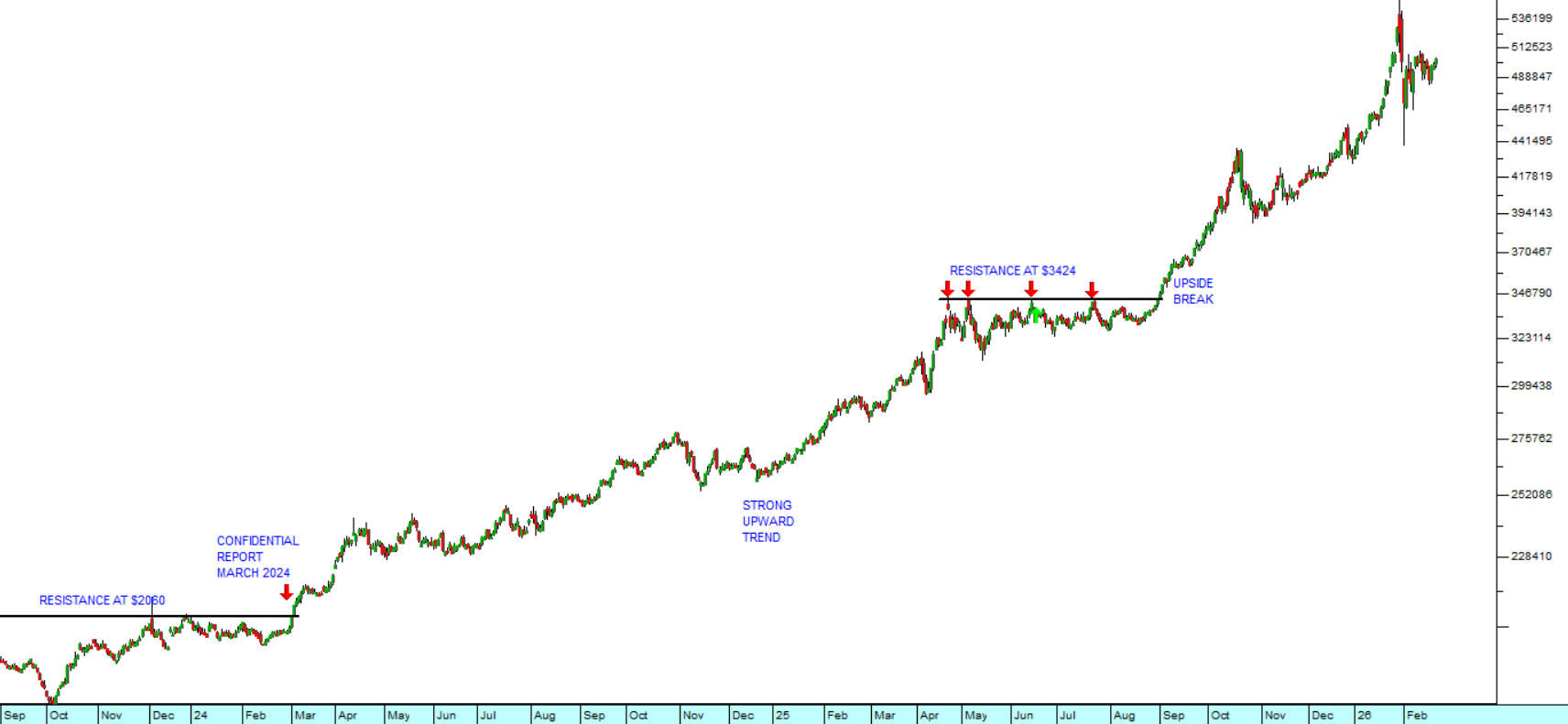
It is no secret that precious metals prices have been running. Most of the best-performing shares on the Winning Shares List (WSL) are mining companies with interests either in gold or platinum group metals (PGM). Gold in particular has dominated the investment world. The metal has risen 145% in US dollars since it broke up through resistance at $2060 at the beginning of March 2024, as reported in the Confidential Report of that month. Consider the chart:

Price of Gold in US dollars : September 2023 - 20th of February 2026. Chart by ShareFriend Pro.

As you can see here the break above resistance at $2060 sparked a strong upward trend. There was another period of resistance at $3424 in the middle of last year which was finally broken to the upside in early September. Gold may now, once again, be in for a period of consolidation, but the trend is clear.

The rising gold price is primarily due to central banks choosing to buy and hold gold as their most secure asset, rather than US Treasury Bills, despite the fact that gold offers no return. This is a testament to the rising levels of perceived geo-political risk in the world and gold’s ancient and undisputed status as the world’s most secure asset.  

AngloGold has been a great beneficiary of the rising gold price. In its latest financials for the year to 31st December 2025, the company reported a 16% increase in production combined with a 45% increase in the average gold price received. Costs were flat in real terms which generated a massive 186% increase in headline earnings.

The company's total cash costs increased 7% over the year to $1242 per ounce with all-in-sustaining costs (AISC) of $1709 – against a gold price of over $5000. This is an immensely profitable company. Total dividends paid for the year amounted to $1,8bn or 357c (US) per share – which is R57.19.

The company was originally formed to consolidate the gold interests of Anglo American in South Africa. Those interests included ERGO, Eastvaal, Southvaal, FreeGold, Elandsrand, Joel and Western Deep. Today, AngloGold owns no South African mines at all. It has 11 mining operations on 4 continents, and it has moved its head office to New York and its primary listing to the New York Stock Exchange (NYSE). Given that South Africa still has more than 5000 tons of proven underground gold reserves, this is a sad reflection of ANC’s hostile attitude towards the mining industry in this country over the past 30 years and what that has cost us.

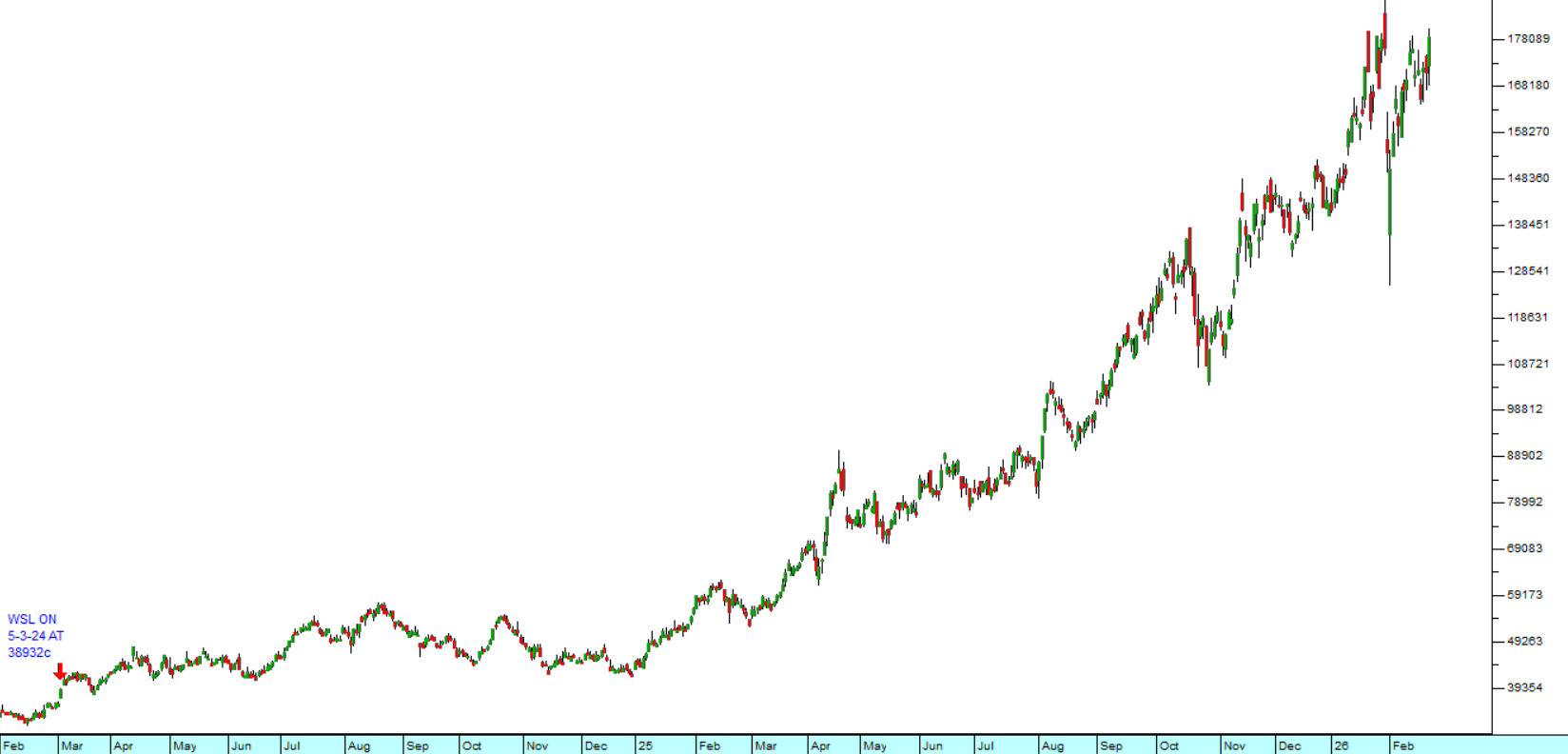
We added AngloGold to the WSL on 5th March 2024 at a price of 38932c – mainly because we could see that gold was breaking up through that key level at $2060. Since then the share has risen to 179102c – a gain of almost 340% in 718 days or 172,6% per annum. Consider the chart:

AngloGold Ashanti (ANG) : February 2024 - 20th of February 2026. Chart by ShareFriend Pro.

AngloGold is constantly adjusting its portfolio, adding exciting new gold prospects while divesting itself of non-performing assets. During 2025 it acquired Centamin which is proving to be a great addition. It also made three further acquisitions in Nevada. These acquisitions have increased the company’s mineral reserve to 36,5 million ounces – a 17% increase on 2024. This means that the company will be able to continue mining profitably for many years, especially considering its very low cost of extraction.

In our view, this share is speculative because it is dependent on the international price of gold over which it has no control. But it is geographically diversified and extremely well managed with relatively low costs and minimal debt. We believe that it will continue to perform well.

JSE Top 40

105,887.00 (-3.37%)

All Share

113,710.00 (-3.02%)

Financial 15

24,743.00 (-1.12%)

J200
J203
J212
Top Gainers
# Code Name Close (c) % move
1 VIS VISUAL 3 +50.00%
2 MTA METAIR 480 +14.01%
3 MCZ MC-MINING 355 +11.99%
Top Losers
# Code Name Close (c) % move
1 AII AIMIA 0 +0.00%
2 EPS EASTPLATS 441 -32.15%
3 MHB MAHUBE 532 -11.33%

Top Movers – Charts

Top Gainer: VIS
Top Loser: AII