Market View
J200 107,730.00 -0.58% J203 115,082.00 -0.67% J210 133,007.00 -0.49% J211 120,803.00 -1.49% J212 25,914.00 +0.05% J213 137,678.00 -0.71%
Winning Shares (Top 5)
Code Name Added Price Latest % Gain % Gain/Year
SNT SANTAM 2024-06-19 31059 41494 +33.60% +15.23%
OCT OCTODEC 2025-08-21 1100 1778 +61.64% +59.67%
IOC IOCO 2024-11-06 220 409 +85.91% +47.15%
CLI CLIENTELE 2026-05-05 1880 1971 +4.84% +32.12%
WVR WEAVER 2025-08-23 4399 4891 +11.18% +10.89%
Opinions (Top 5)
Code Name Date Action
APN ASPEN 2026-09-03 View

02-09-2026 Aspen (APN) is a pharmaceutical company which trades in 150 countries in a wide range of specialty and branded products aimed at a range of acute and chronic medical conditions. They have 25 manufacturing facilities on 15 sites. Their main product categories are thrombosis, anaesthetics, cytotoxics and nutritionals.

Pharmaceuticals generally are a defensive industry which does well even during a recession because people are compelled to buy chronic medications. However, a major factor in Aspen's case is the strength of the rand. In the longer term, the company expects that its interests in China will eventually be larger than its South African interests.

The company's business is now "heavily weighted" towards emerging markets. In its results for the year to 30th June 2026 the company reported revenue down 1% and headline earnings per share (HEPS) down 15%. The company said, "The divestment of the Aspen APAC business (“APAC Divestment”) for gross proceeds of R28 billion was a tangible demonstration of the Group unlocking the intrinsic value in the sum of its parts.

This together with stronger free cash flow generation, meant Aspen concluded FY 2026 with a substantially strengthened balance sheet". The company's P:E ratio of 23,02 is fairly demanding for this type of international, blue-chip, rand-hedge share. Technically, the share was in a long-term downward trend until 29-12-25 when it broke up through its downward trendline.

We added it to the Winning Shares List on 14th February 2026 at 12515c. It has since moved up to 14500c (2-9-26) and we believe it will continue to recover.

TFG TFG 2026-09-03 View

The Foschini Group (TFG) is an international retailer of 28 fashion brands. It has 4083 trading outlets in 32 countries around the world. It has a division in London and one in Australia, aside from its extensive presence in the South African market. One of the notable achievements of TFG is that it has managed to establish a successful business in Australia where many other retailers (like Woolworths) have failed.

TFG bought the Retail Apparel Group (RAG) in Australia for just over $300m in 2017. TFG has allowed the Australian management team virtual autonomy in the management of the business and has not attempted to manage it from South Africa. Over the long term, TFG has been a consistent performer in one of the most difficult industries in South Africa, with stiff competition from overseas brands and local clothing retailers.

We regard TFG as the best of the retail clothing companies and it is well diversified overseas which gives it a rand hedge element. Retail is normally very much impacted by the business cycle, but the TFG board has shown its ability to manage the business profitably in many difficult environments where others have failed.

In its results for the year to 31st March 2026 the company reported revenue up 7,2% and headline earnings per share (HEPS) down 33,5%. The company said, "Group performance was adversely affected by a weaker second half, as trading conditions deteriorated across all operating regions.

The impact of softer peak season demand and lower gross margins resulted in negative operating leverage". In a trading update for the 21 weeks to 22nd August 2026 the company reported sales up by 0,2% with online sales up 15,3%. The company said, "85 stores, which were no longer economically viable, were closed during the current period.

25 new stores were opened during the current period". This shows that sales at walk-in stores are shrinking while online sales are growing leading to store closures. From December 2024 TFG has been in a downward trend. We believe that this remains a very well-managed company which should be accumulated on weakness.

Wait for a break up through the 200-day moving average before investigating further. 

MTH MOTUS 2026-09-03 View

02-09-2026 Motus (MTH) was unbundled from Imperial (IPL) and separately listed on the JSE on 22-11-2018. It is a company that owns motor dealerships in South Africa, the UK and Australia. The company has four divisions - import and distribution, retail and rental, motor-related and financial services and aftermarket parts.

It imports and sells more than 80 000 vehicles per annum and runs 356 dealerships and 134 rental outlets for Tempest and Europcar. It offers vehicle finance and fleet management in South Africa with 730 000 clients. It retails parts and accessories for older vehicles through 720 franchised outlets.

Altogether it has a 20% share of the South African retail vehicle market, selling roughly 100 000 vehicles per annum. It is the importer of Hyundai, Kia, Mitsubishi and Renault. The CEO, Osman Arbee, said that the company plans to pay generous dividends because of its strong cash flows.

The company generates 65% of its turnover in South Africa and 93% of its operating profit. On 1st October 2021 the company announced that it had acquired FAI Automotive in the UK for R550m. In its results for the year to 30th June 2026 the company reported revenue up 1% and headline earnings per share (HEPS) up 15%.

The company said, "The Group’s passenger and commercial vehicle businesses, including the UK and Australia, sold more than 220 000 vehicles, an increase of 7%. New vehicle and pre-owned vehicle units grew by 11% and 3%, respectively, comprising 128 160 new units (2025: 115 910) and 92 790 pre-owned units (2025: 90 100)". Technically, the share made a double bottom in  May and June 2026 and now looks to be moving up.

It is now on a P:E of 5,96 - which makes it reasonably priced in our estimation. We see this as a very well-established company that is to some extent dependent on the state of the economy and the level of consumer spending. It is benefiting directly from the surge of Chinese and Indian vehicle imports into South Africa.

We think it will turn out to be a good investment, especially as the economy improves with the end of loadshedding and the new government of national unity (GNU). 

WHL WOOLIES 2026-09-03 View

The sad fall of the Woolworths share (WHL) price was occasioned by the decision of previous CEO, Ian Moir, and his board to buy David Jones in Australia for AU$2,1bn which has now had R12bn written off its original purchase price of R20bn in 2014. The only aspect sustaining the Woolworths group was its food sales.

Woollies announced on 14th January 2020 that they had appointed Roy Bagattini, from Levi Strauss, to replace Ian Moir as Group CEO with effect from 17th February 2020. Woolies fashion and clothing section was also not doing that well in a very difficult trading environment. In its results for the 52 weeks to 28th June 2026 the company reported turnover up 4,3% and headline earnings per share (HEPS) up 5,3%.

The company said, "Earnings per share growth was negatively impacted by the inclusion of non-cash impairments recognised in both periods, as well as the profit on sale of the Bourke Street property and the rental received on the property in the prior period. These impairments and profit on sale are adjusted for in calculating headline EPS ("HEPS"). Technically, the share is struggling to break above its long-term downward trendline.  As an investor you should wait for it to break up through that trendline before investigating further.

The current P:E is around 14,87 which we believe may still be a bit expensive.

CSB CASHBIL 2026-09-03 View

02-09-2026 Cashbuild (CSB) is the largest retailer in Southern Africa of building materials and related hardware, concentrating on the home improvements market. In the currently depressed economies of Southern Africa, most of the company's growth comes from opening new stores. Clearly, this is a share which is positioning itself for survival and to benefit from any general recovery in economic conditions in Southern Africa.

In its results for the year to 28th June 2026 the company reported revenue up 6% and headline earnings per share (HEPS) down 8%. The company said, "Cash and short-term funds increased by 4% to R2.0 billion. Inventory levels, including new stores, increased by 7% with stock days at similar levels to prior year at 97 days.

Net asset value per share is 7 784 cents (June 2025: 7 996 cents). During the period the Group opened 9 new stores and closed 11 underperforming stores". Technically, the share has been in a long downward trend and we advise waiting for it to break up through that downward trendline before investigating further.

It is now at 10864c (2-9-26), with a P:E of 11,32 and a dividend yield of 4,61%. Cashbuild is an extremely well-managed company and well-positioned to take advantage of any improvement in local economic conditions since the advent of the government of national unity (GNU), but it is in a tough and highly competitive industry that has been impacted by the sharp rise in fuel prices. 

Winning Share: SNT
Opinion: WHL
Harmony Takes Off  (2026-08-24)

The gold price has been in a persistent correction since its record high on 28th January 2026. It has been in what technical analysts call a descending flag formation which we have drawn you attention to on several occasions. As with any formation we are looking for the direction of the breakout…

The gold price has been in a persistent correction since its record high on 28th January 2026. It has been in what technical analysts call a descending flag formation which we have drawn you attention to on several occasions. As with any formation we are looking for the direction of the breakout from that formation to give a clear idea of the future trend. In the case of gold, we have always been confident that it would break to the upside – and that is what it did last week on 19th August 2026. Consider the chart:

Gold price in US dollars : August 2022 - 21st Of August 2026. Chart by ShareFriend Pro.

The chart shows the US dollar price of gold since August 2022. It broke up out of a long-term sideways pattern in March 2024, and we drew your attention to that in the Confidential Report at the time. The chart shows how the upward trend was paused in 2025 until the precious metal broke above resistance at $3424 and it shows the all-time record high of $5305 on 28th January 2026.

The flag formation has taken place between two parallel downward sloping trendlines, showing how gold lost about $1000 over 5 months then found support before breaking to the upside.

As a private investor you should be thinking about which shares would have enabled you to capitalise on gold’s amazing run – and one of the best was Harmony. Of course, gold shares are always going to be speculative and risky, but under the right circumstances they can provide an excellent long-term investment.

In the case of Harmony, the key, for us, was its purchase of the Mponeng gold mine for $200m in September 2020. This was a very brave, potentially dangerous acquisition and we waited for some time before recognising that they were making a success of it. Mponeng is the deepest mine in the world. It is currently mining at depths of around 3800 meters with plans to go deeper to 4200 meters. This means that it is operating 2 kilometres below sea level from the Highveld near Carletonville. At those depths the grade is excellent - around 11,27 grams per ton – more than double the average grade for South African gold mines. The problem is that mining at those extreme depths is expensive and potentially very dangerous. It is the very definition of a high-risk, high-return investment.

We added Harmony to the Winning Shares List (WSL) on 16th November 2023 at a price of 9920c per share. It reached an all-time high of 40841c on 28th January this year before falling back as gold corrected. Since 3rd August 2026 it has been moving up strongly again as gold recovered. Consider the chart:

Harmony (HAR) : August 2023 - 21st of August 2026. Chart by ShareFriend Pro.

Harmony published an excellent trading statement on Friday last week, predicting that its headline earnings per share (HEPS) would increase by between 90% and 105% in US dollars. 

Altogether, Harmony has risen by more than 250% since we added it to the WSL nearly 3 years ago and we believe it will continue to perform well – but it remains a commodity share and hence both volatile and risky.

A New Record High  (2026-08-16)

A couple of weeks ago we wrote an article about the sideways market that the S&P500 was in at the time. In that article we pointed out that while the market had been moving sideways for three months, the actual companies which the market represented had been continuing to grow and develop. We…

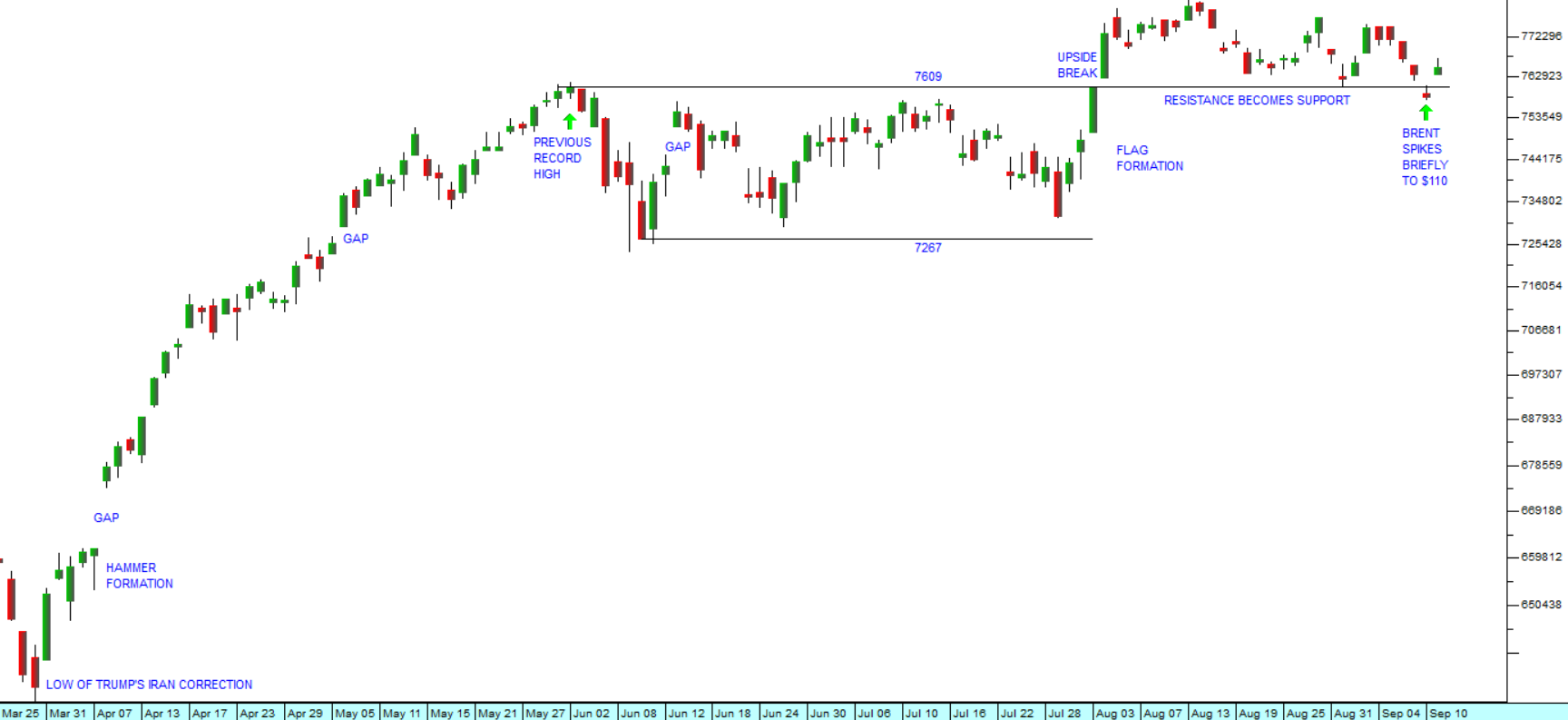
A couple of weeks ago we wrote an article about the sideways market that the S&P500 was in at the time. In that article we pointed out that while the market had been moving sideways for three months, the actual companies which the market represented had been continuing to grow and develop. We anticipated that the market would break to the upside out of that flag formation and that when it did it would have to catch up the growth of the previous three months. Consider the chart:

S&P500 Index :14th of May 2026 - 14th of August 2026. Chart by ShareFriend Pro.

The chart shows how the S&P was moving sideways between the previous record high of 7609 made on the 6th of June 2026 and the low of 7267 made on the 10th of June 2026. Then on the 4th of August 2026 the S&P broke strongly to the upside and made a series of new record highs – just as we expected.

From a fundamental perspective, lower-than-expected inflation and a slower level of job creation gave the market hope that the Federal Reserve Bank would not raise interest rates again at the next meeting of the monetary policy committee (MPC) on the 15th and the 16th September 2026. The consumer price index (CPI) fell to 3,4% in July 2026 from June’s figure of 3,5%. The drop gave investors hope that the worst of the effects of the Iran fuel price hike were behind and that inflation was again moving down.

The producer price inflation figure for the year to the 31st of July 2026 was also encouraging at 4,7% - significantly lower than June’s figure of 5,5% and reflecting the drop-off in the oil price. We believe that interest rates in America will probably remain unchanged until the end of this year.

The stalemate in Trump’s war and its impact on world oil prices appears to have stabilized with North Sea Brent Oil hovering roughly $15 per barrel above where it was before the war began. While developments in the war are still a factor, investors’ attention is back to focusing on the figures coming out of the companies which make up the S&P, especially the so-called Magnificent Seven.

In Q2 2026, Apple was the hero with earnings per share (EPS) up an impressive 29% year-on-year, followed by Microsoft’s 32% gain. Alphabet, Amazon, Meta, and Tesla delivered solid revenue, above forecast, but this was heavily counterbalanced by massive capital expenditure increases mainly for artificial intelligence infrastructure.

Nvidia is reporting its results for the second quarter in a few days’ time on the 26th of August 2026. Wall Street is anticipating another blowout quarter with analysts looking for exponential growth fuelled by the relentless demand for artificial intelligence infrastructure.

What is also clear to us is that Americans are expecting Trump and the Republicans to perform very badly in the coming November mid-term elections, almost certainly losing the House of Representatives and possibly even the Senate. If this happens, it will make Trump into a “lame dog” president, unable to pass any legislation against Democrat opposition. There is also now the clear possibility that he could be forced to resign as a result of increasingly poor health or because he is impeached.

Whatever happens it is clear that his influence over the stock market is declining rapidly. The market has lost interest in his interminable erratic announcements on Truth Social and is instead caught up in the excitement over the productivity benefits of new technologies.

We expect that the S&P will continue to climb to further new record highs and take all world markets up with it, including the JSE. 

Spur Corporation  (2026-08-11)

Everyone in South Africa knows the Spur chain of restaurants. It has been one of the strongest South African brands for decades. Over the years Spur has branched out into a variety of other well-known brands, built its own manufacturing base to supply raw materials to its restaurant chain and…

Everyone in South Africa knows the Spur chain of restaurants. It has been one of the strongest South African brands for decades. Over the years Spur has branched out into a variety of other well-known brands, built its own manufacturing base to supply raw materials to its restaurant chain and expanded internationally. More recently, it has been capitalising on the move towards online ordering of food with many of its restaurants now participating in what it describes as a “virtual kitchen”.

From an investment perspective, the business has the disadvantage of having a working capital element (stock and debtors) and a large staff throughout the country. These risks are substantially mitigated by the fact that most of its restaurants are owned and run by franchisees who are required to buy all their materials from Spur. An important factor is that at 31st December 2025, Spur had over R400m in the bank and almost no appreciable debt. This means that it is well-positioned to take advantage of any opportunities, while being insulated against external shocks.

Of course, the restaurant business is dependent on consumer spending. So, the company’s 753 restaurants need to be constantly patronised by people looking to eat a meal which they have bought rather than cooked themselves. A large proportion of this is sit-down meals in restaurants, but a growing percentage is take-away food ordered online and then delivered.

The restaurant business is based on the reality that everyone has to eat every day and that a good proportion of people will choose at least several times a month to get a ready-made meal even though it is more expensive. Their ability to do this is dependent on their available discretionary cash – and that depends on such things as the increase in real salary levels and the demands on their take-home pay like the cost of fuel and interest rates.

So, Spur’s business is generally aimed at higher income groups, and its success is a function of their perception of how well-off they are. When times are tight, they cut back on dining out – something which happened earlier this year when Trump decided to start a war with Iran resulting in a sharp increase in the cost of fuel and then later a 25 basis point hike in the level of interest rates.

In our view, the impact of the war in Iran is gradually subsiding. This can be seen in lower price of oil, the rands strength and the fact that the monetary policy committee (MPC) decided to keep interest rates on hold at its most recent meeting on 23rd July 2026. We believe that the oil price will continue to decline steadily over the coming months and years as the world economy adjusts to the new situation and moves more and more towards renewables. In other words, this external shock is really just a “bump in the road” for investors and hence probably represents a buying opportunity.

It their results for the six months to 31st December 2025 the company reported revenue up 8,5% and headline earnings per share (HEPS) up 13,6%. In a trading statement for the year to 30th June 2026 the company estimated that adjusted HEPS would increase by between 5% and 13%. The share trades on a dividend yield (DY) of 6,11% and a price:earnings ratio of 11,26. The DY, particularly is of interest to private investors. Any quality company on the JSE trading on a DY of 5% or more is worthy of your attention.

We first added Spur to the Winning Shares List (WSL) on 8th August 2023 at a price of 2488c. Since then, it has been in a steady upward trend paying good dividends which keep growing and maintaining its strong balance sheet. Consider the chart:

Spur (SUR) : June 2023 - 7th of August 2026. Chart by ShareFriend Pro.

We wrote an article about Spur shortly after we added it to the WSL on 16th October 2023 in which we said that we believed that it was “an excellent addition to any private investor’s portfolio”. 

We continue to believe in its long-term investment potential, and we also believe that consumer spending in South Africa will recover as the year progresses and the benefits of our relatively low inflation rate become more apparent.

JSE Top 40

107,730.00 (-0.58%)

All Share

115,082.00 (-0.67%)

Financial 15

25,914.00 (+0.05%)

J200
J203
J212
Top Gainers
# Code Name Close (c) % move
1 OAO OANDO 15 +25.00%
2 MKR MNTKRENEW 3230 +17.03%
3 SKA SHUKA 73 +15.87%
Top Losers
# Code Name Close (c) % move
1 GML GEMFIELDS 64 -13.51%
2 BAC AFBITCOIN 800 -12.95%
3 SLG SALUNGANO 95 -12.84%

Top Movers – Charts

Top Gainer: OAO
Top Loser: GML