Market View
J200 102,883.00 +0.26% J203 110,805.00 +0.31% J210 119,776.00 +0.91% J211 125,829.00 +0.11% J212 24,461.00 -0.14% J213 136,156.00 -0.08%
Winning Shares (Top 5)
Code Name Added Price Latest % Gain % Gain/Year
SUR SPURCORP 2023-08-08 2488 4011 +61.21% +23.30%
ADH ADVTECH 2023-08-14 1975 3863 +95.59% +36.61%
CGR CALGRO-M3 2023-08-15 356 443 +24.44% +9.37%
CAA CA-SALES 2023-08-25 775 1390 +79.35% +30.75%
CPI CAPITEC 2023-11-04 185496 410100 +121.08% +50.74%
Opinions (Top 5)
Code Name Date Action
GML GEMFIELDS 2026-03-25 View

The Gemfields Group (GML) (previously Palinghurst Group) is a mining group that has two major projects: (1) Kagem, the world's largest producer of emeralds (in Zambia) and rubies (at Montepuez in Mozambique); (2) Jupiter Mines, a South African producer of manganese.

The group is led by Brian Gilbertson, previously the CEO of BHP Billiton. Gilbertson identified that the semi-precious stones market was under-developed and offered an opportunity for consolidation and professional management - hence the Gemfield's operation. Jupiter was listed on the Australian Stock Exchange (ASX) in April of 2018 and in the process, Gemfields disposed of 60% of that company in line with its decision to cease being a diversified mining company and to focus purely on gemstones.

The share is fairly well-traded with approximately R,5m worth of shares changing hands on average every day. Like all commodity shares it is risky and its fortunes depend on the prices of emeralds and rubies on the international market - as well as the risks associated with mining in third-world countries.

It appears to have found a niche for itself where there is very limited competition, and it should do well as the world economy recovers. On 24th October 2022 the company announced that operations have resumed at MRM and key personnel had returned following an insurgent attack on a mine about 12km away on 20th October 2022.

On 7th August 2023 the company announced that it would construct a new processing plant that would triple its output from the Montepuez ruby mine. In its results for the six months to 30th June 2025 the company reported revenue of $64,2m, down from $121,4m in the previous period.

The company made a headline loss of 1,5c  per share compared with a profit of 0,6c in the previous year. The company said, "MRM experienced lower premium ruby output while Kagem Mining ("Kagem") suspended mining altogether at the end of 2024, with limited operations resuming only in May 2025.

The beginning of the year was also marred by civil unrest in Mozambique following the disputed general election and the surprise implementation of the 15% export duty on emeralds in Zambia, a matter since resolved." In an operational update to 31st December 2025 the company reported total auction revenues of $128,5m and net debt of $39,2m. In a trading statement for the year to 31st December 2025 the company estimated that it would make a headline loss of 1,3c (US) compared with a loss of 2,1c in the previous period.

The company said, "The well documented operational interruptions at both Montepuez Ruby Mining ("MRM") and the Kagem emerald mine ("Kagem") weighed on output and cash generation". This share tends to be volatile for a variety of reasons, but mostly because of the volatile nature of the product which it sells. Technically, the share has been falling since April 2023 and has yet to break above its long-term downward trendline.

We recommend waiting until that downward trendline is broken - which has not yet happened. On the 10th of August 2025 the company announced that it had sold Faberge for $50m.

NTC NETCARE 2026-03-25 View

The Netcare Group (NTC) operates hospitals and medical response teams throughout South Africa and Lesotho. It has fifty-nine hospitals, four of which are public/private partnerships, employs 22000 people in South Africa and has 10600 beds. Netcare 911 operates from seventy-nine sites and has over 1000 paramedics.

Healthcare is generally not impacted by the business cycle because consumers have to pay for their healthcare, even in a recession, but Netcare says it is being impacted by the competitive nature of medical aids which force them to take lower prices. On 23rd March 2021 Netcare received a letter from the Lesotho government cancelling its contract to run the Queen Mamohato Hospital in Maseru over a wildcat strike by nursing staff.

The vast majority of Netcare’s hospitals have full island capacity, allowing them to operate independently of the grid. In addition, all facilities are supported by Uninterrupted Power Supply (UPS) systems and a fleet of 200 backup diesel generators across the portfolio. In its results for the year to 30th September 2025 the company reported revenue up 4,5% and headline earnings per share (HEPS) up 18,3%.

The company said, "While volume growth remained modest, Netcare demonstrated effective cost management and implemented targeted efficiency initiatives. These efforts contributed to positive operating leverage and underpinned the Group’s solid results." In an update on the 5 months to 28th February 2026 the company reported, "Total normalised paid patient days grew by 0.8%(1) for the review period, comprising 0.5%1 in acute hospitals and 2.9% in mental health facilities".

Technically, the share was in a downward trend since its peak of 4300c in March 2015 until its bottom in March 2020 at around 1200c. A new upward trend began in May 2024 and while volatile appears to be gaining momentum. We need to see a break above resistance at 1713c which looks imminent.

On a P:E of 12,39 (24-3-26) the share looks like a good prospect.

RDF REDEFINE 2026-03-25 View

Redefine (RDF) is the second largest real estate investment trust in South Africa (after Growthpoint) with assets worth R72,9bn against a market capitalisation of R25,1bn. The company mainly holds industrial and office properties with investments in Poland, the UK and Australia. In our view, this is a massive REIT which has a large exposure to South African office space.

It is very much impacted by developments in the South African economy and by the local political risk and especially the elections. However, it is stable and well-managed and trading well below the book value of its assets. Redefine announced that it would look to acquire a controlling interest in the Polish property company, EPP.

In its results for the year to 31st August 2025 the company reported revenue up 3,3% and headline earnings per share (HEPS) up 11,1%. The company's loan-to-value (LTV) was 40,6% and its net asset value was up 3,6% at 816,45c per share. The company said, "The primary drivers of outperformance for Redefine have been portfolio quality and balance sheet strength." In an update on 24th February 2026 the company reported occupancy of 98,8% and loan-to-value (LTV) of between 39% and 41%.

In a pre-close update on 24th March 2026 the company reported that it would be focusing on "energy secure logistics hubs" which are less dependent on Eskom's supply. Technically, Redefine drifted down from the high of 1250c made in April 2015 to levels around 600c and then fell sharply to 159c with the advent of the COVID19 pandemic.

It has recovered strongly, especially in the last six months but has taken a hit with the Iran war. It trades at about than 74% of its NAV. To us the share still looks like good value to us, but its LTV is still a little on the high side.

ISB INSIMBI 2026-03-25 View

Insimbi (ISB) is a group which manufactures and supplies specialist products to the industrial sector. They source, buy, package and process ferrous and non-ferrous alloys, refractory and foundry materials, plastic blow-moulding and injection moulding. They recycle metal alloys and they provide technical support to users of their products.

In its results for the six months to 31st August 2025 the company reported revenue up 2% and a headline loss of 1,3c per share compared with a loss of 1,22c in the previous period The company's net asset value (NAV) fell by 17% to 170,74c per share. In a trading statement for the year to 28th February 2026 the company estimated that its headline loss would improve by at least 1,95c to around 4,55c compared with a loss of 6,5c in the previous period.

Technically, the share was in an upward trend until May 2023, but has been falling and moving sideways since then. In our view, this company will benefit directly from any recovery of the South African economy but it remains a risky commodity share. Its value traded has dropped off sharply to about R12000 per trading day on average which makes it impractical for a private investor.

It is also a commodity share which is risky.

MSP MAS 2026-03-25 View

MAS (MSP) is a real estate investment trust (REIT) which invests in office, commercial, logistics, retail, and hospitality properties in Europe and the UK. This REIT was started by Martin Slabbert and Victor Semionov who are well known for establishing NEPI - which merged with Rockcastle.

They are very highly regarded as European property experts. The company is involved in a program to "restructure and grow" its balance sheet. This was to be done by selling properties in Western Europe and buying income-generating properties with good growth potential in Central and Eastern Europe (CEE).

The company has tripled the size of its asset base since 2016. In its results for the six months to 31st December 2025 the company reported a net asset value (NAV) of 181 eurocents per share compared with 169c in the previous year. The company said, "MAS recorded earnings of EUR11.6million for the six months to 31 December 2025, compared with EUR76.1million for the six-month period to 31 December 2024.

On a per share basis, earnings amounted to 1.97 eurocents, compared with 12.01 eurocents per share in the comparable period". In our view, this is one of the better REIT's on the JSE and well-worth looking at if you want to buy a property stock in the rapidly expanding European property sector.

Obviously, it is a rand-hedge, and it is trading well below its net asset value (NAV). When and if the Ukraine crisis is resolved we see this share recovering rapidly. Like all JSE shares, it has taken a hit from the Iran war. Technically the share has been moving up since 2020. 

Winning Share: CGR
Opinion: MSP
Boots on the Ground  (2026-03-23)

The news from various sources that the US is preparing to send thousands of marines and large quantities of military hardware to the Middle East is unsettling markets around the world. Combined with Iran’s efforts to disable oil production in adjacent countries in the Persian Gulf, these 2 factors…

The news from various sources that the US is preparing to send thousands of marines and large quantities of military hardware to the Middle East is unsettling markets around the world. Combined with Iran’s efforts to disable oil production in adjacent countries in the Persian Gulf, these 2 factors have caused the S&P500 to fall 1,5% on Friday last week and brought it closer to a correction (generally accepted as 10% below the high point). 

The evidence is that Trump and America are getting ready to put boots on the ground in Iran with the idea of the protecting shipping passing through the Strait of Hormuz. The Iranian coastlines on the Persian Gulf and the Gulf of Oman will be very difficult to control and protect because they are overlooked by the Zagros mountains and the Central Iranian range. These mountains, which have many cave systems, will be ideal cover from which small groups of Iranian commandos can constantly harass the invaders in the coming months.  

In these troubled times the JSE Overall index has so far fallen 14,3% - twice as much as the 7,2% fall in the S&P500. This is as you would expect given that South Africa is a leading emerging market and our currency reflects the general worldwide shift towards risk-off. The imminent rise in our petrol price on 1st April could be as much as 25% or R5 per litre. This will push our inflation rate up and probably cause local interest rates to rise.

What is surprising in this scenario is that markets and especially Wall Street have not fallen further. This is because the tech companies in the US are still attracting enormous investor interest and there has been substantial “buying of the dips”. The general opinion of overseas analysts is that shares will bounce back from this correction before the end of this year.

Is this a reasonable assumption? In our view the short answer to the question is, “Yes”. Trump is well known for backing down and not sticking to anything when the pressure on him rises. In this case he is already coming under enormous pressure from both external sources and internally where his popularity has never been as low. With the mid-term elections due in November, he must be increasingly aware of the dire consequences of losing both the House and the Senate.  If he puts boots on the ground in Iran now, he will certainly still be getting a steady flow of body bags back from Iran by November. And we believe it is unlikely that his efforts will make the Strait of Hormuz safe for shipping. But he is Trump and therefore totally unpredictable.

In these troubled times, there are relatively few companies which are not touched in some way by what is happening in the Middle East, and especially by the rising oil price. Mobile Telephone Networks or MTN as it is known is one of those companies. It describes itself as a “...pan-African mobile operator with the strategic intent of leading digital solutions for Africa's progress”.

In its most recent results for the year to 31st December 2025 the company reported service revenue up 22,9% and data revenue up 37,7%. Fintech revenue rose 30% and the company reported a 5,6% increase in total customers to 307,2 million.

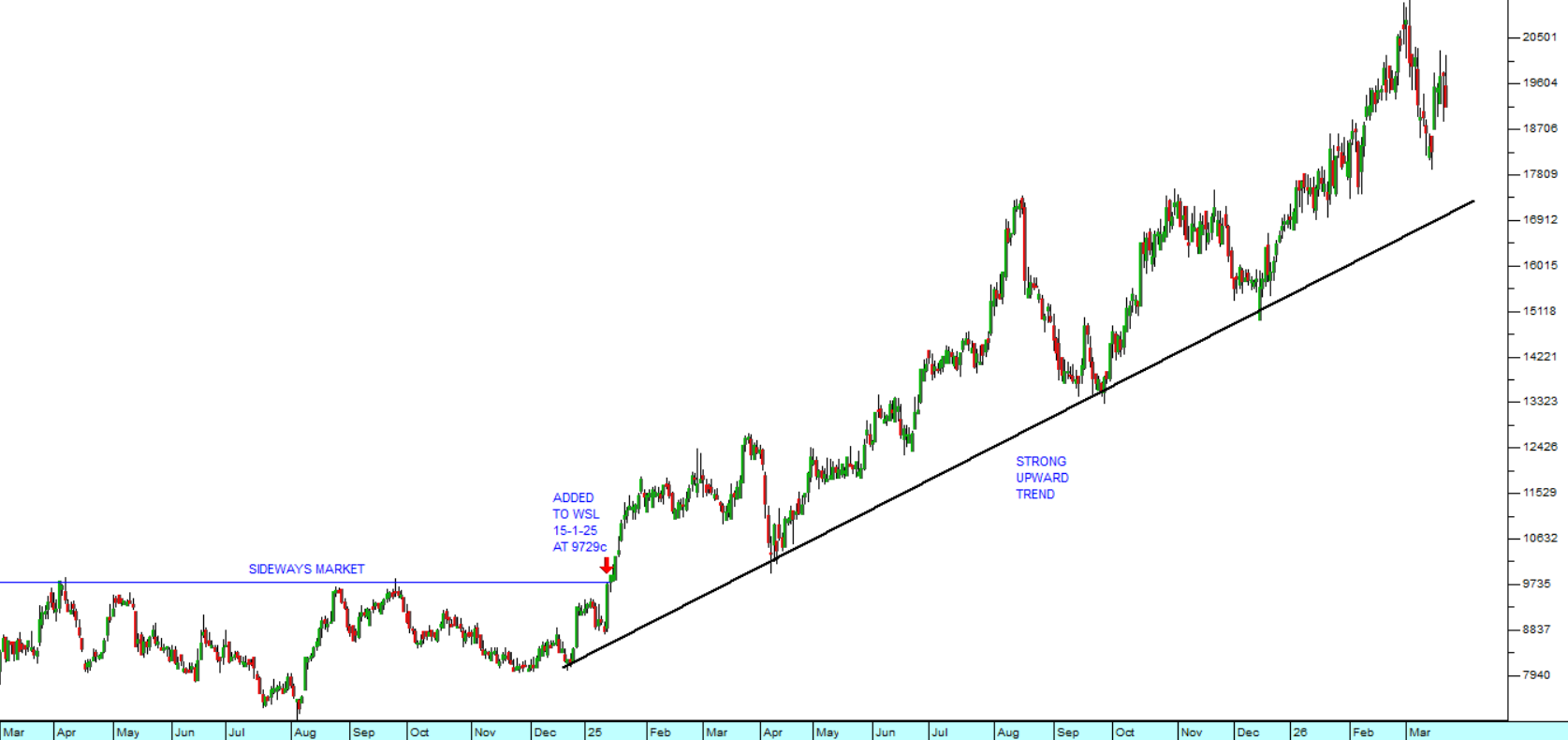
Technically, the share was in a sideways market from March 2024 until the beginning of 2025. It then entered a strong new upward trend. Consider the chart:

MTN (MTN) : March 2024 - 20th of March 2026. Chart by ShareFriend Pro.

We added MTN to the Winning Shares List (WSL) on 15th January 2025 at a price of 9729c. Since then, it has risen to 19155c – or about 88%. While it has certainly felt some of the fall-out from the Iran war, its business is in Africa which should be largely unaffected.

So, we see this sell-off on the JSE as a buying opportunity to pick up high-quality shares at bargain prices. MTN is one of those shares, but others include Clicks which has now fallen even further due Trump’s war, but which was already heavily oversold.

Buying shares at a time like this can be scary, but remember our maxim:

“If you don’t feel the risk, then you are probably not going to make any money”.

Your ultimate protection in all of this is, of course, as always, your stop-loss strategy.  
The Strait of Hormuz  (2026-03-16)

Are we teetering on the edge of a major bear trend? After Friday the 13th of March 2026's S&P500 close at 6632, Wall Street is now down 5% from its all-time record closing high of 6978.6 on the 27th of January 2026. This down-move is similar to the 5% correction which occurred in the first three…

Are we teetering on the edge of a major bear trend? After Friday the 13th of March 2026's S&P500 close at 6632, Wall Street is now down 5% from its all-time record closing high of 6978.6 on the 27th of January 2026. This down-move is similar to the 5% correction which occurred in the first three weeks of November last year and it is evident that there is still considerable bullish sentiment in Wall Street, just waiting for their moment to buy the dip .

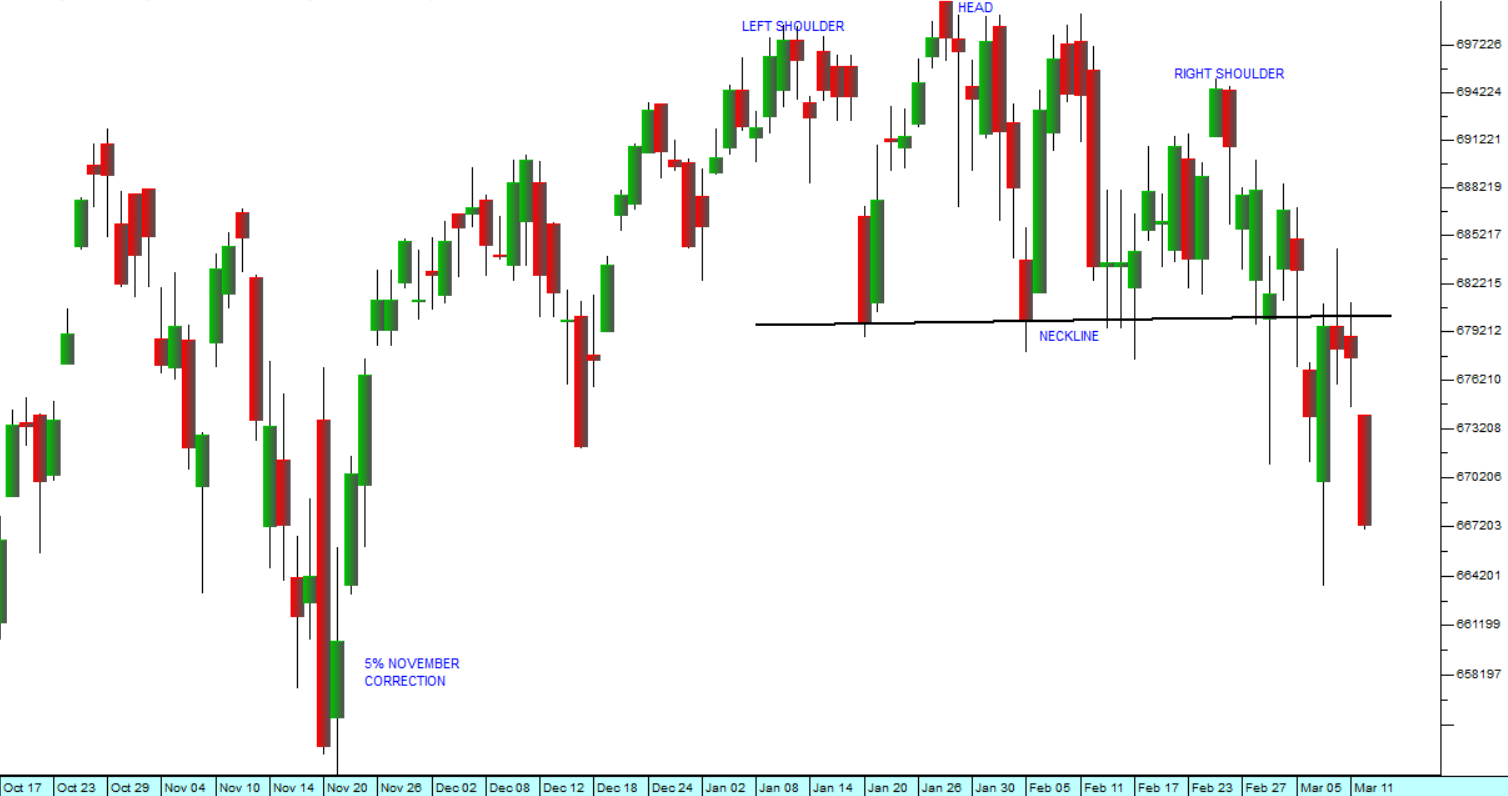
Into this mix, Oracle (ORCL) delivered strong Q3 FY2026 results on March 10, 2026, beating estimates with $17.2 billion in revenue, driven by a 243% surge in AI infrastructure demand. This demonstrates that the underlying strength of the AI boom in the US is still alive and well. If the war situation in Iran can be resolved, it is clear that the stock market will continue up to new record highs very quickly. Consider the chart:

S&P500 Index : 17th of October 2025 - 13th of March 2026. Chart by ShareFriend Pro.

The chart shows the November correction and what some technicians are now suggesting is a head-and-shoulders formation. In our view, the formation is not particularly convincing, but after Friday’s move there can be no doubt that the index has broken strongly down.

Most of the problem comes from the jump in the oil price which has seen North Sea Brent rise to above $100. This is very good for Russia and Putin, while being very bad for Trump. The US Secretary for Defence, Pete Hegseth, seems to think that the problem is easily solvable, but we believe that it may be extremely difficult.    

Normally, about 20% of the world’s oil passes through the Strait of Hormuz. This narrow sea passage is relatively easy to attack and control, and it is Iran’s only strong pressure point in its war with Israel and America. Its navy and air force have now been systematically eliminated by strategic bombing. The new leader of Iran, Mojtaba Khamenei, has specifically said that he will not allow any ships to pass through and that he will use the rising oil price to put pressure on Trump.

The problem is that to open the Strait will require boots on the ground in Iran. The Israeli/US forces will have to clear a corridor at least 30km wide along the Iranian coast adjacent to the Strait to prevent the firing of missiles and drones against passing ships. They cannot do this from the air. Having boots on the ground means incurring casualties.

Trump probably began this war in order to draw attention away from his problems with the Epstein files. He has however landed himself with a new problem – the rising price of petrol in America. His approval ratings have fallen to an all-time low and the November mid-term elections are looming large. The price of petrol has risen by 20% since the start of the war. On the other hand, his tax cuts will begin to impact in April resulting in refund cheques being paid after the tax-filing season ends.

On Feb. 7, 2026, Chasity Verret Martinez won a special election to fill a vacant seat in the Louisiana House. Martinez is a Democrat who took 62% of the vote in a district that had given Donald Trump a 13-percentage-point victory in the 2024 presidential race. And her win came a week after Democrats seized a Texas Senate district that had supported Trump even more strongly.

While these results are not conclusive, they are a strong indication that the Republicans will lose their control of the House and may even lose the Senate in November. Trump knows that, if he loses both Houses, he could easily be looking at impeachment – so suddenly control over the shipping passing through the Strait of Hormuz becomes critical.

How should you as a private investor respond to this situation? Our advice is not to panic but to monitor your stop-loss levels closely and act on them when broken. We believe that the situation will be resolved and that some degree of normalcy will return sooner or later. When and if that happens, we expect stocks around the world to bounce.

The Iran Correction  (2026-03-09)

Trump’s decision to bomb Iran and kill the Supreme Leader of over 200 million Shia Moslems was taken without the consideration and approval of Congress and without the cooperation of other Western countries. It is the typical act of a dictator and has embroiled America in what looks like an…

Trump’s decision to bomb Iran and kill the Supreme Leader of over 200 million Shia Moslems was taken without the consideration and approval of Congress and without the cooperation of other Western countries. It is the typical act of a dictator and has embroiled America in what looks like an unplanned war situation. This may prove to be very difficult to conclude on any reasonable basis, and especially without a significant cost both in money and American lives.

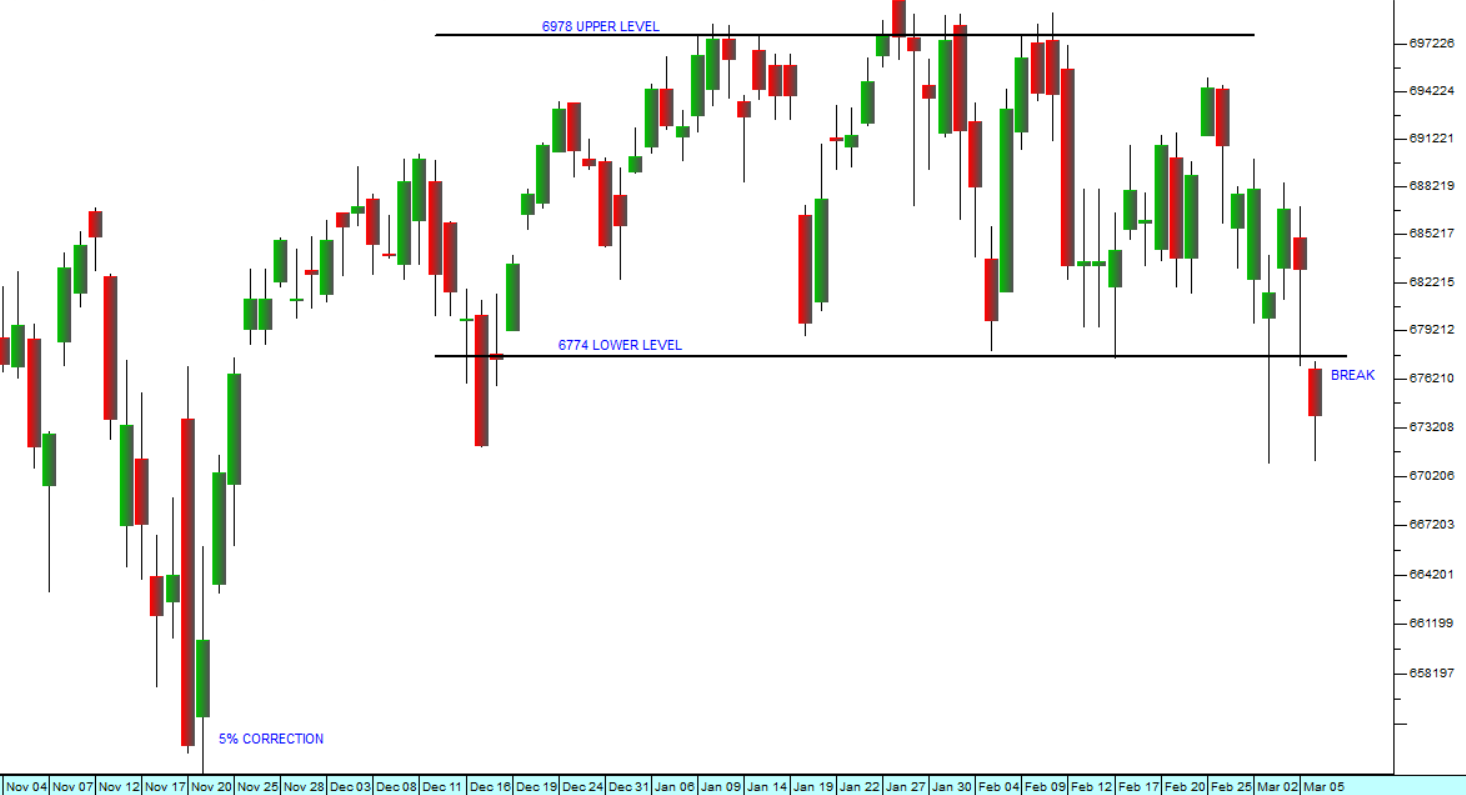
Combined with other disturbing economic data, this has taken Wall Street out of the sideways pattern that it has been in since late last year and put it into a correction. The S&P500 index has so far fallen 3,4% from its all-time record high of 6978.6 on 27th January 2026. Consider the chart:

S&P500 Index: 4th of November 2025 - 6th of March 2026. Chart by ShareFriend Pro.

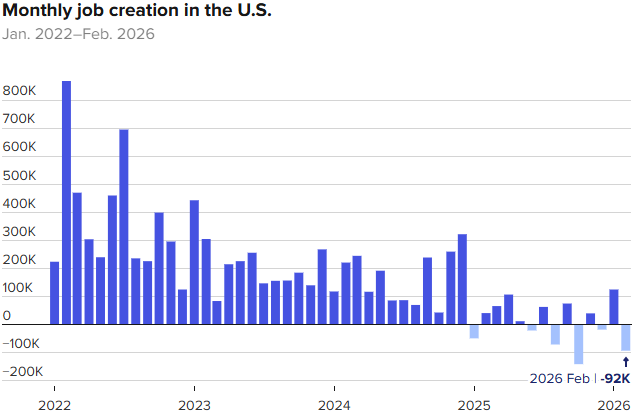
Part of the problem is the increasingly negative data coming out of the US economy, especially in the labour market. The most recent US jobs report showed that the US economy lost 92 000 jobs in February 2026.

Disturbingly, the steadily deteriorating monthly jobs numbers are an indication either that either the economy may be headed into recession or that the spread of artificial intelligence (AI) technologies is putting a large number of Americans out of work. Consider this chart published on Friday last week by CNBC:

Monthly job creation in the US: 2022 - March 2026. Available at:

https://www.cnbc.com/2026/03/06/february-2026-jobs-report.html

This shows a pattern of falling job creation going back to the beginning of 2022 and becoming steadily more negative in recent months. Combined with this, the unemployment rate has also been edging up and came in at 4,4% in February. This is somewhat higher than the unemployment rates below 4% which characterised the end of Joe Biden’s presidency, painting a concerning picture.

In our view, the productivity benefits of new technologies like AI should, in the medium term, more than compensate for the inevitable loss of jobs. In effect, the US economy is adjusting rapidly to a radically disruptive force which is reshaping the business environment and causing a sharp re-allocation of capital. Some businesses will benefit and others will disappear for ever.

In the longer term, once the dust settles, the economy should emerge stronger and that is why we believe that this is probably a correction rather than a new bear trend – but you will notice that what looks like a correction right now could develop into a head-and-shoulders formation if the record high of 6978.6 on the S&P is not broken when the market recovers.

At the moment, the positive news coming out of the tech sector is being off-set by the bad news on the political front and Trump’s war in Iran. If we are lucky, the war in Iran will be resolved on some basis - probably because he will probably back down in the face of increasing pressure both at home and abroad. If this happens in a relatively short time, the market will turn its attention back to the rapid progress of new technologies and hopefully recover to make a further new all-time record high in due course.

JSE Top 40

102,883.00 (+0.26%)

All Share

110,805.00 (+0.31%)

Financial 15

24,461.00 (-0.14%)

J200
J203
J212
Top Gainers
# Code Name Close (c) % move
1 CCC CILOCYBIN 83 +18.57%
2 ACT AFRO-C 79 +12.86%
3 PBT PBT-HOLD 700 +11.11%
Top Losers
# Code Name Close (c) % move
1 AII AIMIA 0 +0.00%
2 VIS VISUAL 3 -25.00%
3 BYI BYTES 5850 -15.38%

Top Movers – Charts

Top Gainer: CCC
Top Loser: AII