Market View
J200 110,516.00 -2.01% J203 118,540.00 -1.88% J210 134,506.00 -4.98% J211 131,019.00 -0.47% J212 25,932.00 -0.03% J213 142,690.00 -0.24%
Winning Shares (Top 5)
Code Name Added Price Latest % Gain % Gain/Year
SUR SPURCORP 2023-08-08 2488 3850 +54.74% +21.91%
ADH ADVTECH 2023-08-14 1975 3940 +99.49% +40.08%
CGR CALGRO-M3 2023-08-15 356 470 +32.02% +12.92%
CAA CA-SALES 2023-08-25 775 1485 +91.61% +37.36%
CPI CAPITEC 2023-11-04 185496 442318 +138.45% +61.33%
Opinions (Top 5)
Code Name Date Action
KAL KAL Group 2026-02-06 View

Previously, Kaap Agri, the KAL Group is an agricultural company owned 40,9% by Zeder, which is, in turn, 43,7% held by PSG. The company operates through over 190 retail outlets offering a wide range of products and services mainly to the farming community. Kaap Agri has seven divisions: (1) Pakmark offers a wide range of packaging materials for the local and export markets, especially to the fruit industry.

(2) Agrimark has over 70 stores in South Africa and Namibia offering a wide range of animal feeds, gardening equipment, tools, outdoor and camping equipment and pet accessories. (3) Liquormark offers a wide range of liquor products from beers to wines, spirits and mixers. (4) Kaap Agri Mechanisation offers farming machinery and equipment.

(5) Wesgraan offers grain handling and management services. (6) Expressmark supplies fuel, especially diesel, mainly to the farming community. It also has convenience stores. (7) The Fuel Company (TFC) aims to be the market leader in the independent fuel retail market in South Africa.

The group's product diversity has reduced its exposure to weather conditions in the agricultural sector, especially in the Western Cape, but it remains essentially a retail outlet which focuses on the agricultural sector and as such its results are impacted by the general level of consumer spending in South Africa and the state of the local economy as well agricultural conditions. On 4th October 2021 Kaap Agri announced that it had sold its 70,5% stake in TFC Properties for R446m.

On 19th January 2022 the company announced the acquisition of PEG Retail Holdings for R1,09bn. This acquisition increases the number of petrol stations which Kaap Agri has from 43 to 84. In its results for the year to 30th September 2025 the company reported revenue down 6,6% and headline earnings per share (HEPS) up 10,6%.

The company said, "The profit after tax of the Group amounted to R447 million (2024: R451 million) while the gross assets increased to R8 230 million (2024: R8 215 million)". Technically, the share broke down through its trendline on 6th January 2025 at 4952c and fell back to around to 3753c.

It has since been recovering but has just made it onto the Winning Shares List (WSL) on 9th October 2025 at a price of 4425c. In an update at the AGM, the company reported positive momentum in the Agrimark sector and an 8,7% increase in retail gross profit in the PEG sector. The debt/equity ratio was 34,3%.

We see it as a well-managed company that has exposure to South Africa's retail environment, loadshedding and also to the state of agriculture in this country. It has suffered with falling petrol prices recently. We recommend waiting for the share to begin a new upward trend before investigating further.

Issues surrounding expropriation of land without compensation have an impact on the company. However, with a P:E multiple of 7,89 these risks look to be fully discounted. 

HDC HUDACO 2026-02-06 View

Hudaco (HDC) is an importer and supplier of "...automotive, industrial and consumer products" mostly in Southern Africa. Its business has two sides (1) supplying automotive security, power tools, communications, and business supply products to the consumer market and (2) supplying mainly the mining and manufacturing industries with mechanical and electrical power transmissions, diesel engines, hydraulics and pneumatics, steel and thermoplastics, and fittings and bearings." The company has a very well-established business with 26 warehouses, 800 international suppliers and 140 branches.

Through this network they supply about 230 000 products. The company has been battling to export goods because of inefficiencies at South African ports, especially Durban. The group constantly makes bolt-on acquisitions to build and enhance its business. In its results for the year to 30th November 2025 the company reported revenue up 4,4% and headline earnings per share (HEPS) up 15,7%.

The company said, "We are delighted with the acquisitions of both Isotec and FloSolve and they have settled into the group well. Their results are included for seven and six months, respectively, this year, so their full impact will only be realised in 2026". Hudaco is an extremely well-managed company operating in a difficult economy.

As the economy improves, Hudaco's results will benefit directly. The share trades on a P:E of 9,75 and a dividend yield (DY) of 3,98% which looks cheap to us. In our view, this share should be bought on weakness and offers solid, long-term investment potential as the South African economy improves.

On 3rd June 2025 Hudaco announced the acquisition of Flosolve's trading assets and liabilities for R45m immediately and maximum of R125m depending on profitability over the next 3 years. This is a typical "bolt-on" acquisition which will add to Hudaco's existing markets and product range.

The latest results show that despite lower turnover the company was able to improve HEPS - this shows a significant improvement in efficiency.

ACL ARCMITTAL 2026-02-06 View

ArcelorMittal (ACL) is South Africa's largest steel producing company. It has survived where companies like Highveld Steel have disappeared. Arguably, ArcelorMittal felt the impact of the sub-prime crisis more than any other South African company and has fallen from its high of R260 in June 2008 to as low as 25c in August 2020.

Since then, it has rallied strongly and now trades at 1052c. It has had to deal with the collapse of the construction industry locally, which was a major consumer of steel, and the massive imports of cheap Chinese steel which were dumped onto our market. Those imports have slowed down somewhat, and ArcelorMittal was successful in getting certain tariffs in place to discourage imports.

We believe that this company came close to closure in July 2020 when the share price reached 25c. It has been rescued by the rising steel price combined with severe cost cutting. On 6th January 2025 the company announced that it had taken the decision to wind down and close its Longs steel division - leading to a sharp drop in the share price.

On 19th March 2025 the company announced that the government will provide funds to keep the long steel plant open by paying the wages at the plant for the next year. This has caused the share price to rise, but will probably not prevent the eventual closure of the plant in time. ACL said that in 2024 it paid R3,2bn to Eskom for electricity - up 14% on the previous year and that electricity costs had risen by more than 800% since 2007.

In its results for the year to 31st December 2025 the company reported revenue down 16% and a headline loss of R3,355bn. Borrowings increased to R6,48bn from R5,11bn the previous year. The company said, "Long steel business ("Longs Business") wound down into care and maintenance by the end of 2025 • Sales volumes down 12% to 2 million tonnes (crude steel production down 12% to 2,3 million tonnes), with the Flat steel business ("Flats Business") down 4% at 1,4 million tonnes (2024: 1,45 million tonnes) (crude steel production up 8% to 1,8 million tonnes on improved reliability)". In our view this is not a good investment because it is heavily dependent on government assistance and tariffs.

On 29th August 2025 the company announced that it would be winding down its long steel business because it had been unable to obtain government support. The share has been drifting sideways since September 2023. 

VAL VALTERRA 2026-02-06 View

Valterra, (VAL) was previously Anglo American Platinum, or Amplats, and is the second largest platinum producing company in the world (after Sibanye), producing a large portion of the world's platinum. VAL was one of the first platinum mining companies in South Africa to move away from expensive deep-level mining towards shallower, more mechanised mining.

The company has reduced the number of mines it is operating from 18 to 7 over 5 years, decreased overheads by 50% and its number of employees by 50%. This shift is now paying dividends. The Mogalakwena open-cast operation is a palladium-rich operation with costs in the lowest quartile in the platinum group metals (PGM) industry world-wide.

A new project at Mogalakwena will see platinum production up by 250 000 ounces and palladium production up by 270 000 ounces. The company also recently bought out Glencore's 40,2% stake in their joint venture Mototolo mine and the adjacent Der Brochen property for R1,5bn. Mototolo is a highly mechanised shallow mine which can be extended into Der Brochen without putting in new surface infrastructure.

The platinum price is plagued by an effective re-cycling industry which produces about 2 million ounces a year by recovering from old auto catalysts. We believe VAL is one of the best of the PGM shares on the JSE - but it remains a commodity share and thus volatile and unpredictable.

In its results for the six months to 30th June 2025 the company reported PGM sales volumes down 25% and refined PGM production down 18%. The rand basket price per PGM ounce was up 3% but revenue was down 19%. Headline earnings per share (HEPS) fell 81% and all-in sustaining costs were up 1%.

The company said, "Own-mined PGM production (expressed as 5E+Au metal-in-concentrate (M&C)) declined by 12% to 926,100 ounces, primarily due to the flooding at Amandelbult in February 2025 following heavy rains." In an update on the 3 months to 30th September 2025 the company reported refined PGM production down 5% and sales volumes down 9%. The company said, "We remain on track to deliver M&C production of 3.0-3.2 million ounces.

M&C production from our own operations is expected to be ~2.0 million PGM ounces and POC between ~1.0-1.2 million PGM ounces. Refined production and sales volumes guidance is expected at ~3.4 million PGM ounces due to sustained improvements in stability and reliability of the processing infrastructure." In a trading statement for the year to 31st December 2025, the company estimated that HEPS would increase by between 85% and 105%.

In an update on the 3 months to 31st December 2025 the company reported PGM production up 1% and sales volumes up 4%. Technically, the share was moving sideways from September 2023, mainly due to the challenges faced by the industry including loadshedding and falling PGM prices, but is now responding to rising PGM prices and moving into an upward trend.

We added it to the Winning Shares List (WSL) on 2nd July 2025 at 83183c and it has since gone up to 140978c. On 20th March 2025 the company announced that it will be changing its name to Valterra Platinum from Amplats with the same ISIN code (AMS) with effect from 30th May 2025. The listing on the LSE happened on Monday 2nd June 2025.

SOL SASOL 2026-02-06 View

Sasol (SOL) is a massive international chemicals and energy company which has its roots in the oil-from-coal technology developed during the apartheid era in South Africa. About 50% of the company's profits are directly linked to the oil price. It has two main growth areas - its 50% stake in an ethane cracker plant in Louisiana, America, known as "Lake Charles Chemical Project" (LCCP), and its development of gas resources in Mozambique.

Sasol was awarded two new licences in Mozambique to explore for gas in an onshore development of approximately three thousand square kilometres. This could significantly add to its existing gas projects in the Rovuma province. One area of concern for Sasol is that it is the biggest producer of greenhouse gases in South Africa and on the JSE.

It is listed as one of the 100 fossil-fuel companies world-wide that contribute to more than 70% of Greenhouse gases. The company remains under international pressure to deal with its carbon emissions effectively. After the impact of COVID-19, the share made a dramatic recovery which was been brought to an end by the decline in commodity prices, especially oil.  The company is planning to close some international operations to reduce costs.

On 25th May 2025 the company announced a settlement in its dispute with Transnet in terms of which Transnet will pay it R4,3bn. In a trading statement for the six months to 31st December 2025 the company estimated that HEPS would decrease by between 29% and 40%. The company said, "The decrease in earnings for the period was mainly driven by a 17% decline in the average Rand per barrel Brent crude oil price and a 3% decrease in the average US$ per ton chemicals basket price".

Technically, the share has recently (on 25th May 2025) broken up through its long-term downward trendline on 20th May 2025 at a price of 7950c and has now moved up to 11035c. It is in a volatile new upward trend which was interrupted on Friday 16th January 2026 when Morgan Stanley downgraded the company to "underweight" according to the Business Day (19/1/26).

There are better commodity shares on the JSE.

Winning Share: CAA
Opinion: VAL
Clicks Oversold  (2026-01-26)

Technical analysis is the study of investor perceptions as they are reflected in the price and volume patterns of a security. It is also true that shares move in cycles which take them from being overbought to being oversold and back again. This is especially true of the blue chip shares which are…

Technical analysis is the study of investor perceptions as they are reflected in the price and volume patterns of a security. It is also true that shares move in cycles which take them from being overbought to being oversold and back again. This is especially true of the blue chip shares which are heavily traded and patronised by the big institutions (pension funds, unit trusts and insurance companies).  The fund managers who manage the institutional portfolios account for about 90% of all trades on the JSE.

In our opinion, Clicks (CLS) is a high-quality share which should be part of every private investor’s portfolio. The problem is that it is generally very popular with the big institutions who are always buying it, which tends to make it very expensive – most of the time. But there are occasions when it goes out of fashion with the fund managers for some reason and at those moments it can represent excellent value and a great buying opportunity. In our opinion, right now is just such a moment.

A few days ago on 22nd January 2026, Clicks published a trading update for the 20 weeks up to 11th January 2026. In that update it said that group turnover was up 7,4% and that pharmacy sales had gained 9%. They also commented that they had record Black Friday sales and robust customer demand for their Christmas gift range.

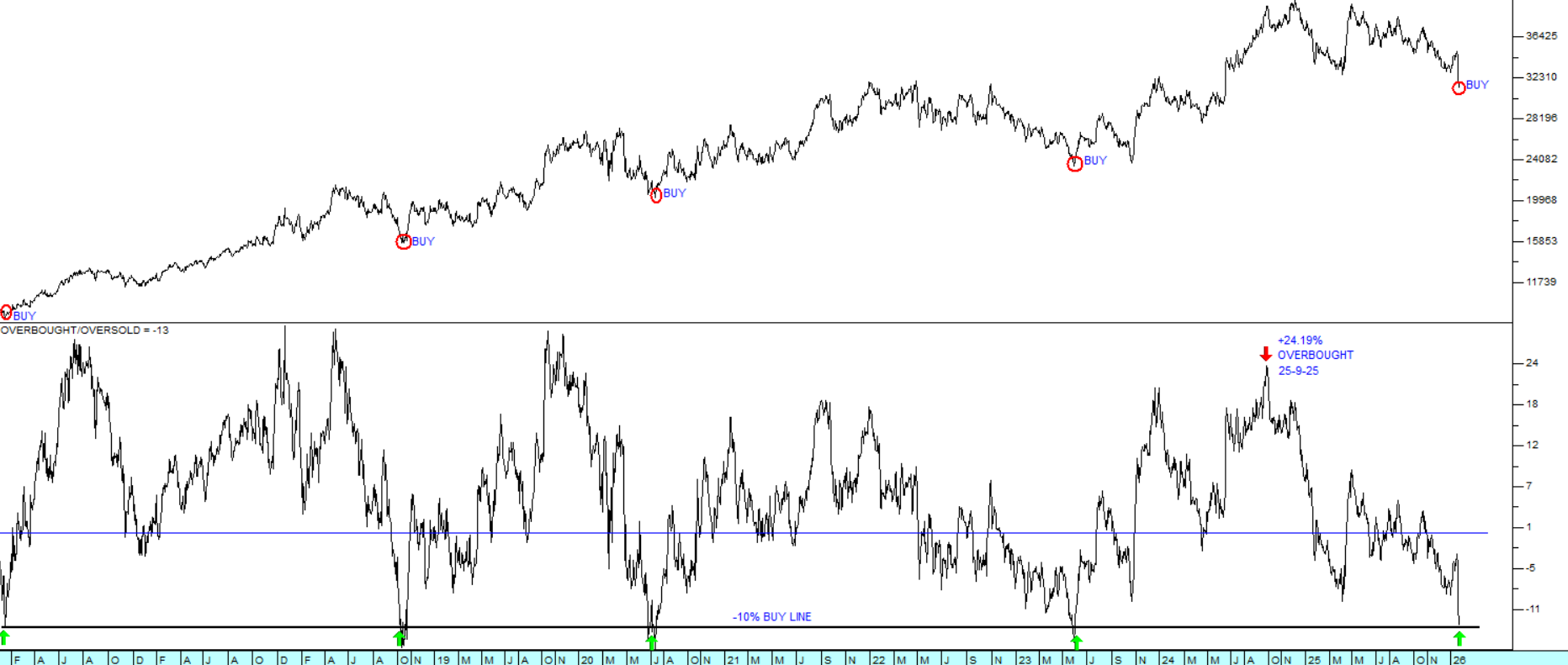
Consider the diagram below.

Clicks (CSL) : February 2016 - 23rd of January 2026. Chart by ShareFriend Pro.

The top chart in the diagram below shows the share price of Clicks over the last ten years. The lower chart shows the 200-day overbought/oversold (OB/OS) of Clicks over the same period.

On the OB/OS I have drawn in a -10% buy line and you can see that over the ten-year period there have been just 5 occasions (the green arrows) on which the OB/OS has fallen below -10%. Then considering the top chart you can see that, on each of those occasions, Clicks represented an excellent buying opportunity (the red circles).

On Friday last week, the Clicks OB/OS ended the week at –10,64%. And you will observe that historically it generally does not spend a great deal of time below that minus 10% buy line. Inevitably, the fund managers become aware that it is heavily over-sold and begin buying it, driving the price up again.

Of course, the fact that Clicks is heavily oversold right now does not guarantee that it will not fall further and you should always maintain a stop-loss strategy. But, if you are buying, it does give you a good indication of your probability of being right. In my estimation, the share has spent about 2% of its time over the last ten years below that -10% buy line. That means that your statistical probability of being wrong in buying it at that level is therefore extremely low.

And you will have one great satisfaction – you are not buying it at +24% - but somebody did! Otherwise, the chart would not have gone there.  It is amazing to consider that, less than 4 months ago on 25th September 2025, there were institutional fund managers buying Clicks at an OB/OS level of over +24% (the red arrow). If you buy now at -10,64%, you are certainly doing a lot better than them!

The Collapse of Choppies  (2026-01-19)

The fall in the Choppies share price from 795c on 2nd January 2026 to last Friday’s close at 290c is a great example of the volatility of markets, especially in shares which are relatively thinly traded. It demonstrates the importance of investor sentiment and the potential for popular shares to…

The fall in the Choppies share price from 795c on 2nd January 2026 to last Friday’s close at 290c is a great example of the volatility of markets, especially in shares which are relatively thinly traded. It demonstrates the importance of investor sentiment and the potential for popular shares to rapidly become over-priced once they attract the investing public’s imagination.

Choppies represents an unusual investment opportunity on the JSE, because it is a supermarket chain which is apparently highly successful in Africa outside of South Africa. This made it unique and a potential take-over prospect on the JSE. Most of the larger grocery retailers like Shoprite and Pick ‘n Pay have made an effort to establish themselves in other African countries with varying degrees of success. Those markets tend to be characterised by high levels of inflation and political instability. Choppies, on the other hand, was demonstrably successful in the rest of Africa, but found the South African market too competitive.

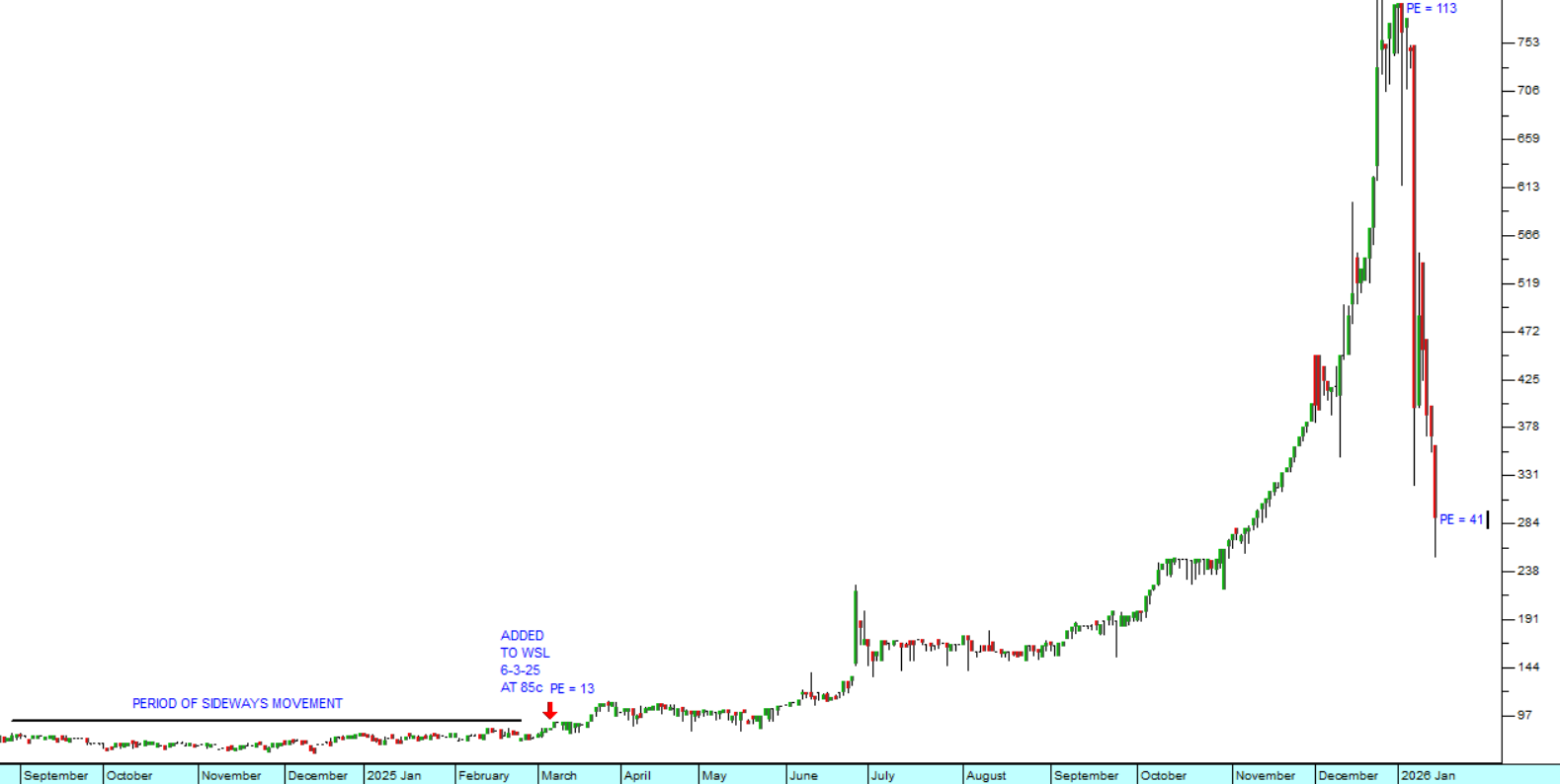
This made the Choppies story unique. We first recognised Choppies potential when it broke up out of an extended period of sideways movement in March last year. We added it to the Winning Shares List (WSL) on 6th March 2025 at a price of 85c and its performance was nothing short of meteoric. Eventually, by the beginning of 2026 it was trading on a price:earnings ratio (PE) of over 100. Consider the chart:

Choppies (CHP) : September 2024  - 16th of January 2026. Chart by ShareFriend Pro.

The chart shows the extraordinary climb in Choppies share price last year and then its subsequent collapse in 2026.

So, what happened? The answer to this question is that we really do not know. There have been no explanations or even comment given by the company itself in Stock Exchange News Service (SENS). There is some speculation that there was an offer from one of the other South African supermarket giants that was then abandoned, but again the company itself has said nothing.

In our view, the Choppies business proposition gained momentum leading up to the publication of its financials on 22nd September 2025 causing its share price to run up too quickly – accompanied by rising volumes. Investors felt that the company had suddenly caught the attention of institutional investors.

On 8th January 2026, probably a single investor decided to take profits and gave a market order to his broker to sell a million shares “at best”. The investor concerned was almost certainly a beneficiary of the Choppies “Long-term Investment Scheme” (LTI) and a member of the company’s senior management. The trade demonstrated his ignorance of the share market because he dumped a huge amount of shares into a relatively thinly traded market in a single day. A more experienced investor would have dribbled the shares into the market over a number of days thus giving time for the market to adjust. The problem is that 89% of the shares in issue are held by just two investors – which means that the “free float” is relatively small.  

So, how should you have handled this situation as a private investor? The answer is to strictly apply your stop-loss strategy. On the day after the share fell (Friday 9th January 2026) you should have sold out your holding on stop-loss. You would have got prices of at least 400c per share. If you bought the shares when we put them on the WSL on 6th March 2025, you would still more than quadrupled your initial investment. The lesson is never ignore your stop-loss.

And what should you do now? Well, when a share falls heavily like this, we always advise applying a 65-day exponential moving average (MA) and then waiting for the price to break up through that MA. There may still be some bad news which has not come out so you don’t want to buy prematurely. Wait for the share to settle down at these lower levels and then buy when it begins to move up again.

Notably, Choppies, at its current price (290c), is now on a P:E of 41 – which is far more attractive than its peak of over 113, but still very fully priced when compared to other grocery retailers on the JSE. Shoprite is on a PE 19.6 of and Spar is at 18,41.  

Thoughts on 2026  (2026-01-12)

At the start of a new year, we always give our view of what we think is to come. Since our last article, published on 22nd December 2025, there have been some notable developments in the international arena which are potentially important for South African investors. (1) As expected, the rand has…

At the start of a new year, we always give our view of what we think is to come. Since our last article, published on 22nd December 2025, there have been some notable developments in the international arena which are potentially important for South African investors.

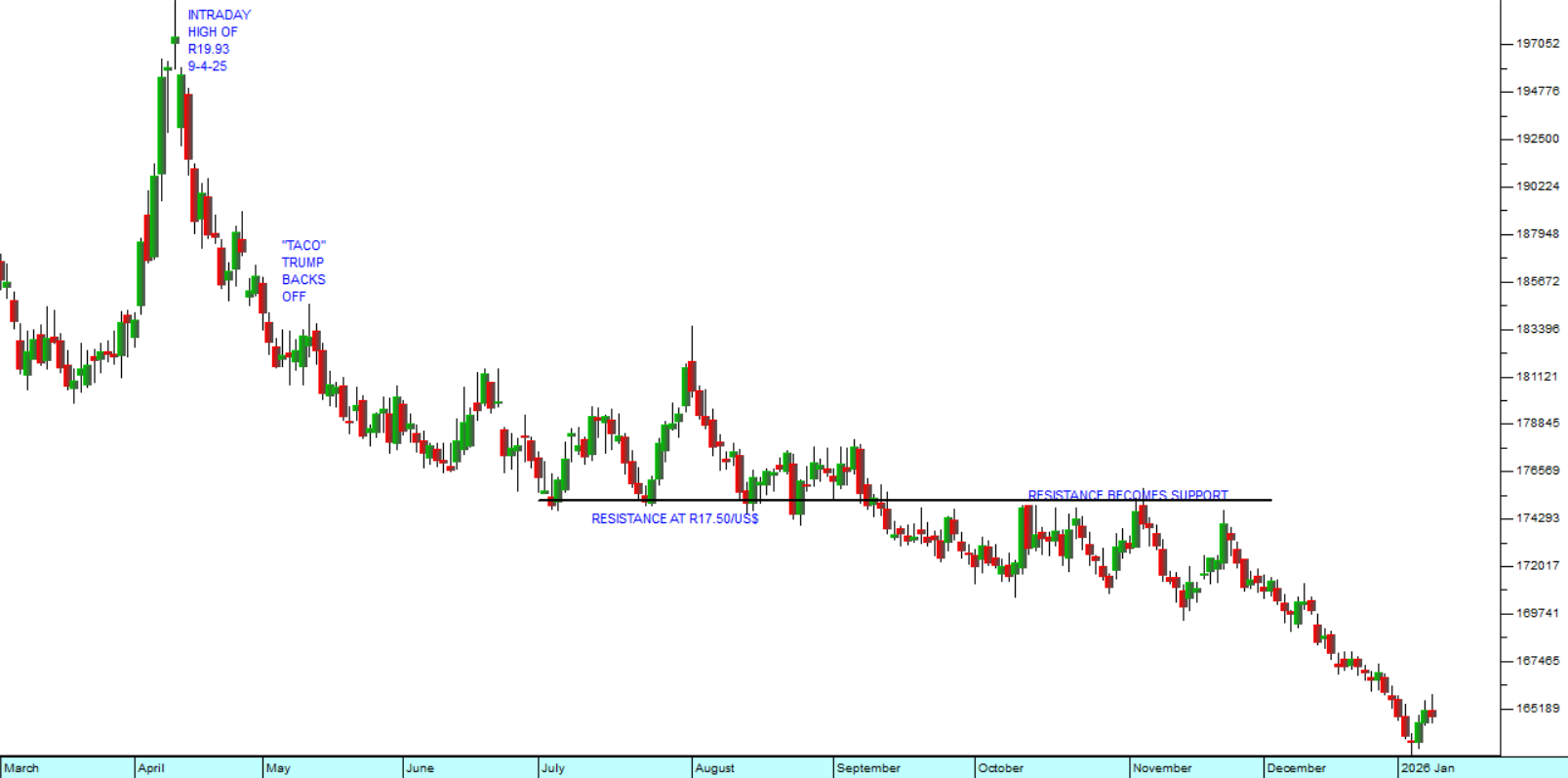
(1) As expected, the rand has strengthened further, continuing the trend of the last nine months and breaking convincingly below R16.50 to the US dollar. What is notable is that the rand has also strengthened against other hard currencies, like the euro and the British pound. We have long considered the rand to be under-valued and we expect it to continue strengthen, especially against the US dollar which has itself been weakening against other hard currencies. Consider the chart:

South African rand/US dollar : March 2025 - 9th of December 2026. Chart by ShareFriend Pro.

The rand broke below the key R17.50 level in September and then that level became a support level. But now it has moved down to R16.50 and looks set to stabilise at that level. The strengthening currency reflects a growing local and internation optimism about South Africa’s future.

(2) Gold and platinum continue to perform well bolstering South Africa’s economy and providing jobs for thousands of miners. Gold reached a new all-time record high on Friday last week closing above $4500 for the first time ever. I bought my first Krugerrand for R600 in 1985 and last week that same coin was worth a new record high value of R75 000. We reiterate our view that, because of the political risk in this country, South Africans should hold 10% of their total wealth in Krugerrands. Gold may correct from these levels on profit-taking, but the long-term trend will continue to be up – so make sure you have some of these internationally accepted, highly transportable assets in your portfolio.

(3) The unexpected invasion of Venezuela and the capture of Maduro marks a new direction for the Trump administration. The attack was executed with surgical precision and, while it sets a dangerous precedent, it has definitely boosted Trump’s dictatorial confidence. One effect is that he has suddenly become less afraid of Putin and has been willing to put in motion various measures which are good for Ukraine and bad for Russia. The first was capturing two oil tankers in Putin’s “shadow Fleet” and the second approving a Bill which will result in tariffs of up to 500% on any country which buys oil from Russia.

At the same time, the Ukrainians have been very effective in their management of the drone war, increasing their production of drones dramatically and innovating new technologies which have given them a definite edge over Russia. This can be seen in their recent use of a land drone, packed with 12 anti-tank mines, to completely wipe out an entire Russian stronghold.

We never expected the war in Ukraine to last as long as it has, mainly because we thought that, with Europe and America’s backing, Ukraine ultimately had far more resources at its disposal than Russia. We still believe firmly in Ukraine’s superiority, but this year we expect that advantage to finally force Putin to the negotiating table.  The Russian economy is crumbling under sanctions; the Urals oil price has collapsed and Russia’s performance on the battlefield has been abysmal.  

(4) The South African economy is definitely improving. There is, of course, still a great deal of room for further improvement and we remain light years away from being a first world country – but our economy is in far better shape than most third world or emerging market countries, especially most of those in Africa to the North and many of those in South America and Asia. The improvements can be traced back to the monetary discipline exercised by the Reserve Bank which has brought our inflation rate close to or even better than many first world countries. Low inflation has increased the level of real take-home pay and that, in turn, is impacting consumer spending. We expect the economy to continue improving this year, provided that there are no material external shocks. The Municipal elections towards the end of the year should be significant in consolidating our new direction.

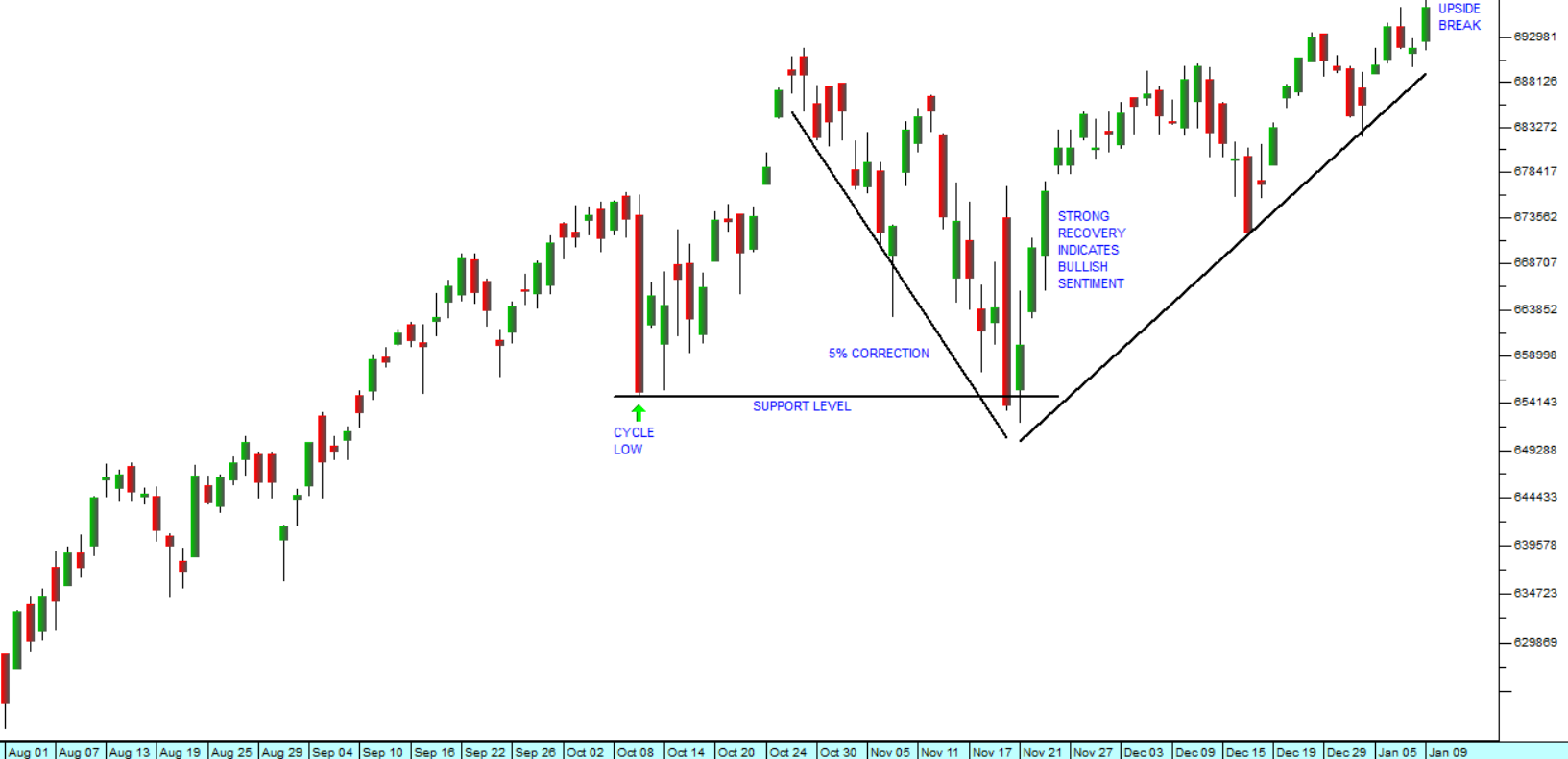
(5) The Great Bull Market, which began in March 2009, remains intact, with the S&P500 closing on Friday last week at another new all-time record high. The productivity impact of AI and the steady move towards solar and other alternative power sources is raising the performance and prospects of S&P500 companies. Consider the chart:

S&P500 Index : 1st August 2025 - 9th of January 2026. Chart by ShareFriend Pro.

The stage is set for another strong year featuring rising profits stimulated by further advances in technology and lower oil prices.

As a private investor you should be close to fully invested in this market. Just make sure that you maintain a strict stop-loss strategy. Remember, being successful in the share market is not so much about making money as it is about not losing it.    

JSE Top 40

110,516.00 (-2.01%)

All Share

118,540.00 (-1.88%)

Financial 15

25,932.00 (-0.03%)

J200
J203
J212
Top Gainers
# Code Name Close (c) % move
1 XII NUMERAL 30 +50.00%
2 MMP MARSHALL 3100 +10.71%
3 QFH QUANTUM 1050 +10.53%
Top Losers
# Code Name Close (c) % move
1 OAO OANDO 19 -38.71%
2 LAB LABAT 6 -14.29%
3 ISO ASPI 9088 -13.83%

Top Movers – Charts

Top Gainer: XII
Top Loser: OAO