Market View
J200 103,152.00 -0.65% J203 110,826.00 -0.66% J210 123,858.00 -0.53% J211 118,117.00 -0.40% J212 25,218.00 -0.93% J213 134,252.00 -0.67%
Winning Shares (Top 5)
Code Name Added Price Latest % Gain % Gain/Year
WVR WEAVER 2025-08-23 4399 4901 +11.41% +10.47%
QLT QUILTER 2023-11-21 2154 3878 +80.04% +28.12%
FSR FIRSTRND 2025-08-01 7746 9193 +18.68% +16.23%
PPC PPC 2026-01-22 579 793 +36.96% +54.84%
MRF MERAFE 2026-06-02 128 136 +6.25% +19.84%
Opinions (Top 5)
Code Name Date Action
GML GEMFIELDS 2026-09-28 View

The Gemfields Group (GML) (previously Palinghurst Group) is a mining group that has two major projects: (1) Kagem, the world's largest producer of emeralds (in Zambia) and rubies (at Montepuez in Mozambique); (2) Jupiter Mines, a South African producer of manganese.

The group is led by Brian Gilbertson, previously the CEO of BHP Billiton. Gilbertson identified that the semi-precious stones market was under-developed and offered an opportunity for consolidation and professional management - hence the Gemfield's operation. Jupiter was listed on the Australian Stock Exchange (ASX) in April of 2018 and in the process, Gemfields disposed of 60% of that company in line with its decision to cease being a diversified mining company and to focus purely on gemstones.

Like all commodity shares it is risky and its fortunes depend on the prices of emeralds and rubies on the international market - as well as the risks associated with mining in third-world countries. It appears to have found a niche for itself where there is very limited competition, and it should do well as the world economy recovers.  The company made an attributable loss of $39m compared with a loss of $82,1m in the previous year.

In an operational update for the year to 30th June 2026 the company reported revenue of $102,9m compared with $60m in the comparable period. The company said, "MRM continued to experience weak premium grade ruby recovery, at 0.025 carats per tonne in the six-months to 30 June 2026".

In a trading statement for the six months to 30th June 2026 the company estimated that HEPS would be 0,6c (US) compared with a loss of 1,5c in the previous period. This share tends to be volatile for a variety of reasons, but mostly because of the volatile nature of the product which it sells.

Technically, the share has been falling since April 2023 and has yet to break above its long-term downward trendline. We recommend waiting until that downward trendline is broken - which has not yet happened. On the 10th of August 2025 the company announced that it had sold Faberge for $50m.

On 30th June 2026 the company announced that Sean Gilbertson would retire as CEO with effect from 15th July 2026 and would be replaced by David Lovett (currently CFO).

GLN GLENCORE 2026-09-28 View

Glencore (GLN) describes itself as, "...one of the world’s largest global diversified natural resource companies and a major producer and marketer of more than 90 commodities." The group's operations comprise around 150 mining and metallurgical sites, oil production assets and agricultural facilities. With a strong footprint in both established and emerging regions for natural resources, Glencore's industrial and marketing activities are supported by a global network of more than 90 offices located in over 50 countries.

So, this is a massive, diversified mining house which markets its products all over the world and is involved in almost every mineable commodity that exists. This means that it is far less volatile and risky than other less diverse mining houses. Since the commodity cycle turned at the start of 2016, one of the greatest beneficiaries has been Glencore, particularly because of the fact that it owned the world's richest source of cobalt in the Democratic Republic of Congo (DRC).

Cobalt is the metal used in the batteries which will be needed by the world's shift to electric motor vehicles. The problem is that the government in the DRC is in the process of declaring cobalt to be a "strategic mineral" - which means much higher tax. In its results for the six months to 30th June 2026 the company reported revenue up 49% and earnings per share (EPS) of 37c (US) compared with a loss of 0.05c in the previous period.

The company said, "H1 2026 was characterised by the significant repricing of energy and closely related markets and risks, following escalation of the Middle East (ME) conflict". We added this share to the Winning Shares List (WSL) on 30th September 2025 at a price of 7983c. It has since moved up to 12560c (5-8-26).

Glencore is confident that Eskom will reduce its electricity by as much as 54% to make it competitive with Chinese imports. Technically, the share has been in an upward trend since April 2025 which we expect to continue, but is dependent on the prices of the commodities which it produces, especially copper.

Glencore announced on 25th September 2026 that it would commence a secondary listing on the Australian Stock Exchange (ASX) on 14th October 2026. 

TEX TEXTON 2026-09-28 View

Texton (TEX) is a small real estate investment trust (REIT). The company owns forty-eight retail, industrial and office properties, 55,4% of which are in South Africa and the balance in the UK. After reaching a high of 1235c in March of 2015, the share fell steadily to a low of 78c on 29th October 2020.

This fall was exacerbated by the recent revelation that the company's share price has triggered a "default event" in terms of which the Public Investment Corporation (PIC) has decided to "put" its shareholding of 51,9m shares on Texton. The current CEO, Marius Muller is the 5th CEO in 5 years.

On 26th September 2020, in this opinion, we pointed out that it was trading at a fraction of its net asset value of over 580c. Then, suddenly, on Thursday 29th October 2020, 28,3m shares changed hands at 78c in four deals - and then on Friday 30th October 2020, the company made a public announcement of a mandatory offer at 120c - and the share jumped 47% to close at 115c.

Obviously, the Thursday trade was a highly profitable insider trade which netted a profit of over R10m - and it was clearly visible in the volume chart. So, it is always worth watching the volume traded especially in small companies with limited volumes traded. In its financials for the year to 30th June 2026 the company reported revenue up 1,83% and headline earnings per share (HEPS) of 9,2c compared with 0,61c in the previous period.

The company said, "In South Africa, greater political stability, fewer power outages and lower inflation supported business confidence and office demand, and property values increased on the back of capital investment and sustained underlying earnings". Technically, the share has been trending up and sideways since its low in October 2020, but it remains thinly traded. In our view, there are better property shares available on the JSE.

PPR PUTPROP 2026-09-24 View

24-09-2026   Putprop (PPR) is a property company which was spun out of Putco (the bus company) and separately listed on the JSE in July 1988. The company owns 16 properties in industrial, retail and office with a gross lettable area (GLA) of 97601 square meters and a value of R1095m.

In its results for the year to 30th June 2026 the company reported rentals and recoveries of R138,1m slightly lower than the previous period and headline earnings per share (HEPS) of 67,1c - up from 60,86c in the previous period. The company's net asset value (NAV) fell to 1500c per share from 1777c.

From a private investor's perspective, the main problem with this share is that it is relatively thinly traded with many days on which there are no trades at all. It is clearly not a share that the institutional investors are interested in. We believe that there are better counters in the property sector.

EPE ETHOSCAP 2026-09-24 View

17-09-2026   Ethos Capital Partners (EPE) is a private equity fund (PEF), incorporated in Mauritius, which invests into unlisted companies for long-term capital appreciation on behalf of its investors. Like most investment holding companies, Ethos trades at a significant discount to its net asset value (NAV).

Fifty-six percent of their assets are in South Africa and 39% in the rest of Africa. It has stakes in Tymebank, Ster Kinekor and Brait. The risk in this company appears to be minimal since it does not invest a significant proportion of its funds in any one investment and its investments have performed well in the circumstances.

It does not pay dividends, so the investor has to look for a capital gain. In its results for the year to 30th June 2026 the company reported net asset value (NAV) down 34% to 562c per share. The company said, "The Initial Public Offering (“IPO”) of the Optasia business on the JSE, with partial sell down proceeds of R360 million".

EPE is well-traded with an average of over R800 000 worth of shares changing hands on average every day. The share has been falling since its high in November 2025, but it may now have found support at around 450c. In our opinion this share, although volatile, should turn out to be a good investment at current levels - depending on the progress of the current trend in world markets.

The separate and successful listing of Optasia on 4th November 2025 resulted in short-lived a jump in the share price. 

Winning Share: FSR
Opinion: GLN
Using AI  (2026-09-21)

Artificial Intelligence (AI) has been sweeping the world over the past year affecting almost every field of human endeavour. The investment world is no exception. Today the private investor, through AI, has access to a range of analysis which is totally unprecedented and lightning fast. For example…

Artificial Intelligence (AI) has been sweeping the world over the past year affecting almost every field of human endeavour. The investment world is no exception. Today the private investor, through AI, has access to a range of analysis which is totally unprecedented and lightning fast. For example, if you pose the following to Google's Gemini:

“Using a price:earnings growth ratio (PEG), with historical earnings figures over the past 10 years, compare Clicks and Dischem on the JSE for relative value at their current prices”.

A few seconds later, you will receive the following answer:

Based on a 10-year historical valuation framework using the Price/Earnings-to-Growth (PEG) metric, Clicks Group Limited (CLS) offers significantly better relative value than Dis-Chem Pharmacies Limited (DCP), with Clicks holding a PEG ratio of 1,07 compared to Dis-Chem's elevated PEG ratio of 4,92. While both healthcare retailers have faced growth pressures over the past year, Clicks’ consistent long-term earnings growth profile maps to a far more sustainable valuation at current market prices.

It then goes on to say:

To understand the core drivers behind these valuation gaps, we normalize the current trailing Price-to-Earnings (P/E) ratios against their respective multi-year historical Compound Annual Growth Rates (CAGR) in Headline Earnings Per Share (HEPS).

Clicks Group (CLS) — Steady Compounder

  • Robust Growth Track Record: Over the past decade, Clicks Group has compounded its diluted HEPS at an impressive 13,5% per annum, alongside a dividend growth rate of 14,2%.
  • Defensive Cost Efficiencies: Its massive retail presence (~1,000 stores) gives it exceptional operating leverage. At a current P/E of 14,45x, the market has compressed Clicks' historical premium rating (which typically sat closer to 30x), creating a much safer entry point where the earnings growth rate almost directly mirrors its multiple.

Dis-Chem Pharmacies (DCP) — Growth Disruption

  • Earnings Volatility: While Dis-Chem Pharmacies initially listed with immense growth premium expectations in 2016, its long-term financial delivery has slowed down. For instance, its FY2026 annual performance saw a sharp 17,3% drop in HEPS to 113,7 cents due to significant operational and macroeconomic pressures.
  • Depressed Growth Base: Compounding its HEPS from its first full year post-listing (74,7 cents in FY2017) to FY2026 yields a long-term compound growth rate of only 4,78%. A P/E multiple of 23,53x is highly mismatched against this lower single-digit structural growth pace, heavily inflating its PEG ratio.

Risk Guardrails & Framework

Peter Lynch’s traditional benchmark dictates that a PEG ratio near 1,0 indicates a stock is fairly priced relative to its growth, while any metric significantly exceeding 2,0 alerts investors to potential overvaluation relative to realized history. For long-term portfolios, Clicks presents a structurally sound baseline where you are paying a reasonable price for a stable, high-return business framework, whereas Dis-Chem requires aggressive operational margin expansions (such as its automated staffing framework 2.0 initiatives) to justify its present multiple.

This analysis shows that Clicks is cheap at current prices, while Dischem is probably over-priced. Of course, you could have come to the same conclusion if you had done the work yourself, but that would be extremely laborious and time-consuming. For many months now we have been watching Clicks closely. Its price has virtually halved since the middle of last year. And when the price of a blue chip share like Clicks halves, it is always worth investigating.

Of course, before you know to ask such a question you would need to have a basic understanding of how the PEG ratio works or even that there is such a thing as the PEG ratio. Even with the advantage of AI, you need to know enough to be able to ask the right questions – but AI can help you with that too.

We are not suggesting that you let AI make your investment decisions, but we are suggesting that when you find an investment idea it can be a very powerful tool for analysis.

And we do believe that Clicks offers significant value at current levels. Certainly, we believe that it is far better value than Dischem. That is why we asked AI the question in the first place.

Muddy Waters  (2026-09-14)

It has become difficult to keep up with all the news coming out of America. Trump’s erratic behaviour is combining with other factors to make the systematic risk picture complicated and unpredictable. On the one hand, there have been some excellent results coming out of the S&P500 companies riding…

It has become difficult to keep up with all the news coming out of America. Trump’s erratic behaviour is combining with other factors to make the systematic risk picture complicated and unpredictable. On the one hand, there have been some excellent results coming out of the S&P500 companies riding the wave of AI.

AI Boom Lifts S&P 500 Earnings 32% as 86% of Companies Beat Estimates | Business | CryptoRank.io

Wall Street investors now expect that the earnings of the S&P500 companies will be roughly 32% higher than they were a year ago as second quarter earnings dramatically exceed analysts’ expectations. 86% of S&P500 companies have now reported earnings above forecast. Alphabet reported second-quarter earnings that included a $98 billion gain, while Amazon recorded $53.4 billion in non-operating pre-tax income, primarily related to its Anthropic investments. Nvidia’s revenue in the second quarter was $96,2bn – more than double the same quarter last year.  

On the negative side, the price of North Sea Brent oil spiked up to nearly $110 per barrel last week, but has now fallen back to just below $100. This decline to $100 comes because of new hopes for peace negotiations such as planned meetings between Gulf and Iranian foreign ministers. These hopes helped ease immediate fears of a total, prolonged blockage of the Strait of Hormuz. At the same time, oil producers in the Persian Gulf shifted shipments to alternative pipeline capacities and non-Middle Eastern regions (like the US, Canada, and Ghana) which increased output to bridge supply gaps. Finally, major international bodies, including the International Energy Agency indicated that there was slowing consumption and a broader economic slowdown, and notably reduced oil demand from major importers like China driven partly by the transition to electric vehicles.

In the middle of all this, on Tuesday and Wednesday this week the US Federal Reserve Bank’s monetary policy committee will be meeting to decide on the future course of interest rates, and they will be focusing on these figures.

https://coinpaper.com/35641/stock-market-today-sp-500-nasdaq-jump-1-as-oil-falls-despite-hot-cpi

The US inflation rate for August 2026 came in at 3,4% for the year to the 31st August 2026. This was the same rate as July and shows broad increases across both goods and services with the price of gasoline being the major contributor. In the month itself, inflation was 0,4% because of a 3,9% increase in the price of gasoline.

Following hotter-than-expected August inflation data, market metrics and prediction venues show a massive shift toward monetary tightening. The CME Fedwatch Tool suggests that the probability of a 25 basis point hike in  interest rates is now between 84% and 87% while Polymarket says there is an 81% probability. A hike in interest rates will add to the misery of consumers in America already facing an average price across the country of $4.30 per gallon of petrol.

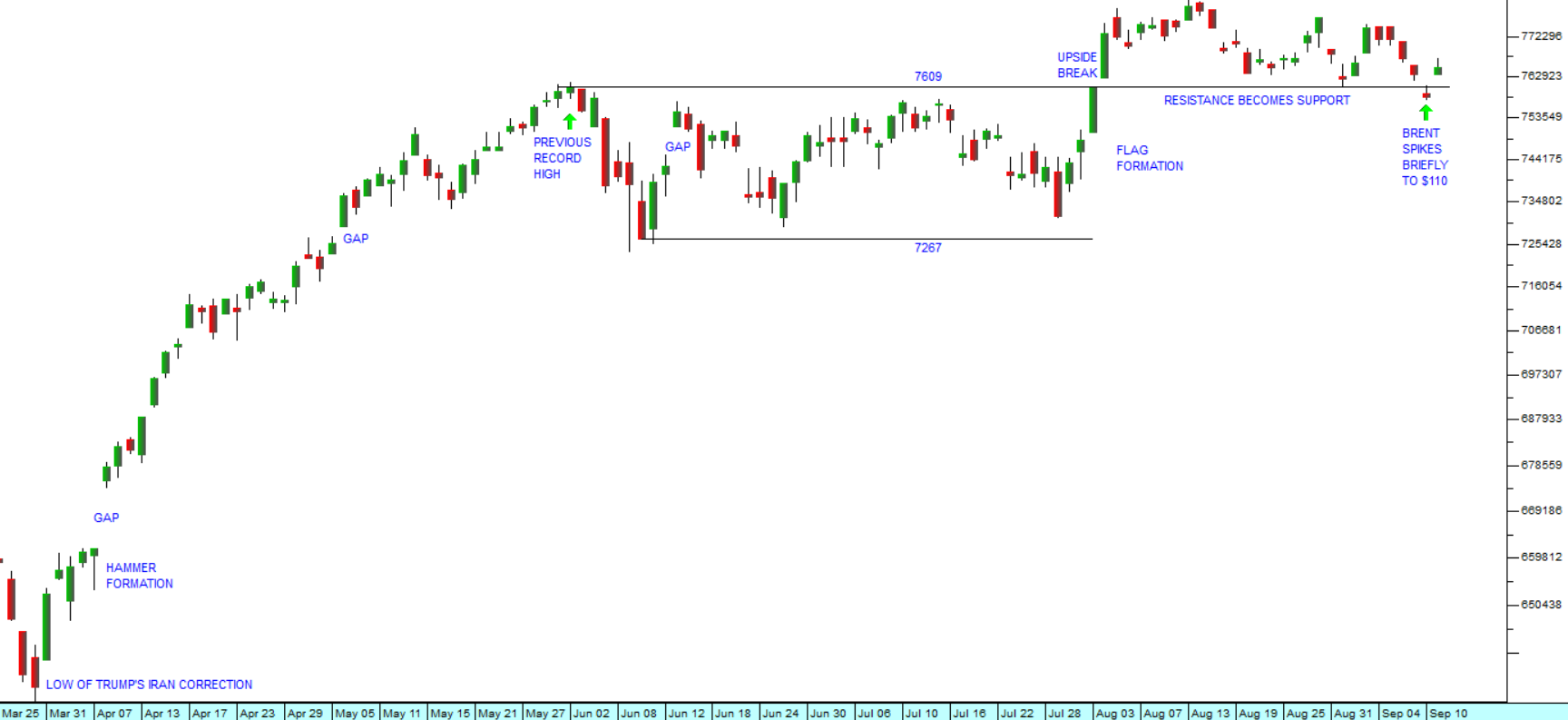
The S&P500 index has been trying to discount all these disparate forces and is basically moving sideways since it broke above the key support/resistance level at 7609. Consider the chart:

S&P500 Index : 25th March 2026 - 11th of September 2026. Chart by ShareFriend Pro.

There can be little doubt about the bullish sentiment which underlies the extended sideways market in the S&P. The news coming from big tech companies appears to be slowly overcoming the bad news coming out of the Middle East. The unexpected spike in the oil price to $110 was short-lived, but it did unnerve the market for a day. That was quickly rectified the next day.

And in the background is the looming mid-term election in America, which is increasingly focusing the Trump camp’s attention, resulting in some radical moves on his part like promising to pay every adult American $5000 if the Republicans win both the House and the Senate. The cost of this is a further $1,23 trillion to be added to the budget deficit already above $40 trillion. He also said that after the elections the petrol price will drop back to $2 per gallon – and anyone who believes that is not following what is happening on the ground.

Trump approval rating hits new low over Labor Day weekend

The Focaldata/Financial Times poll released on September 6, 2026, found that only 32% of Americans now approve of Trump's job performance. Trump's approval rating dropped three points from the previous month, the lowest since the poll series began in May. Critically, his approval among Republicans fell to 72%, a two‑point decline and a new low for that group. The poll was conducted from August 28 to September 2 with 2,178 U.S. adults surveyed. Only 17% of respondents approved of Trump's handling of inflation and the cost of living, while 69% disapproved.

In our view, the Republicans will almost certainly lose the House and the Senate race is now a “toss-up”. If he loses both, we can expect impeachment proceedings to commence promptly.

The S&P500 and markets around the world will ultimately be drawn higher by the AI driven boom in American and elsewhere. We expect new record highs on all indexes in due course.

The Currency  (2026-09-07)

Perhaps the best way to measure the progress of South Africa as a country is to look at our currency – especially against the so-called hard currencies of the Western World. Its strength or weakness gives a very good overall picture of how the country is doing economically, politically and in terms…

Perhaps the best way to measure the progress of South Africa as a country is to look at our currency – especially against the so-called hard currencies of the Western World. Its strength or weakness gives a very good overall picture of how the country is doing economically, politically and in terms of its image with overseas investors.

As an emerging economy, South Africa is not regarded as a poor country, but rather as one which is striving to become first world. For overseas investors this typically means a country and a currency which offers high risk and high potential return. Whereas a 10-year US Treasury Bill can offer the international investor a return of 4,8%, a South African 10-year government bond offers around 8,8% - that is 4% better, if the investor is prepared to take the risk of investing here.

We have a number of advantages over other emerging markets. Perhaps most importantly, we have relatively low inflation. In fact, due to the tireless efforts of Lesetja Kganyago, Governor of the Reserve Bank, our inflation rate is very comparable to many First World countries – and certainly far better than many of the other emerging economies. For example, Turkey’s inflation rate is 31,5%, Argentina is at 33,8% Egypt is at 14,9% and Columbia is at 6%.

We are generally grouped among those less risky emerging economies with lower inflation rates like Brazil (4,6%), India (4,4%), Mexico (3,4%), Indonesia (2,9%), and South Korea (2,8%). These are very comparable to the inflation rates of First World economies like Europe (3,3%), the United Kingdom (2,9%) and America (3,4%).

Approximately $19bn worth of rands are traded in our currency market every day on average. This makes it a highly liquid and very free currency exchange. Overseas investors can quickly take or sell large positions in what is a strong and well-organised market. This has tended to mean that the rand has become a proxy for all emerging economies. When international sentiment is risk-on they pile into our currency and government bonds. When it is risk-off, as it was when Trump began his war with Iran, they sell out quickly.

But overall, for at least the past 17 months the rand has been steadily appreciating against most first world currencies. In our view, this is related to the stabilising impact of the government of national unity (GNU) and the fact that the ANC is no longer in complete control. This together with the various initiatives set in motion by President Ramaphosa have meant that the economic environment has been steadily improving since April 2025.

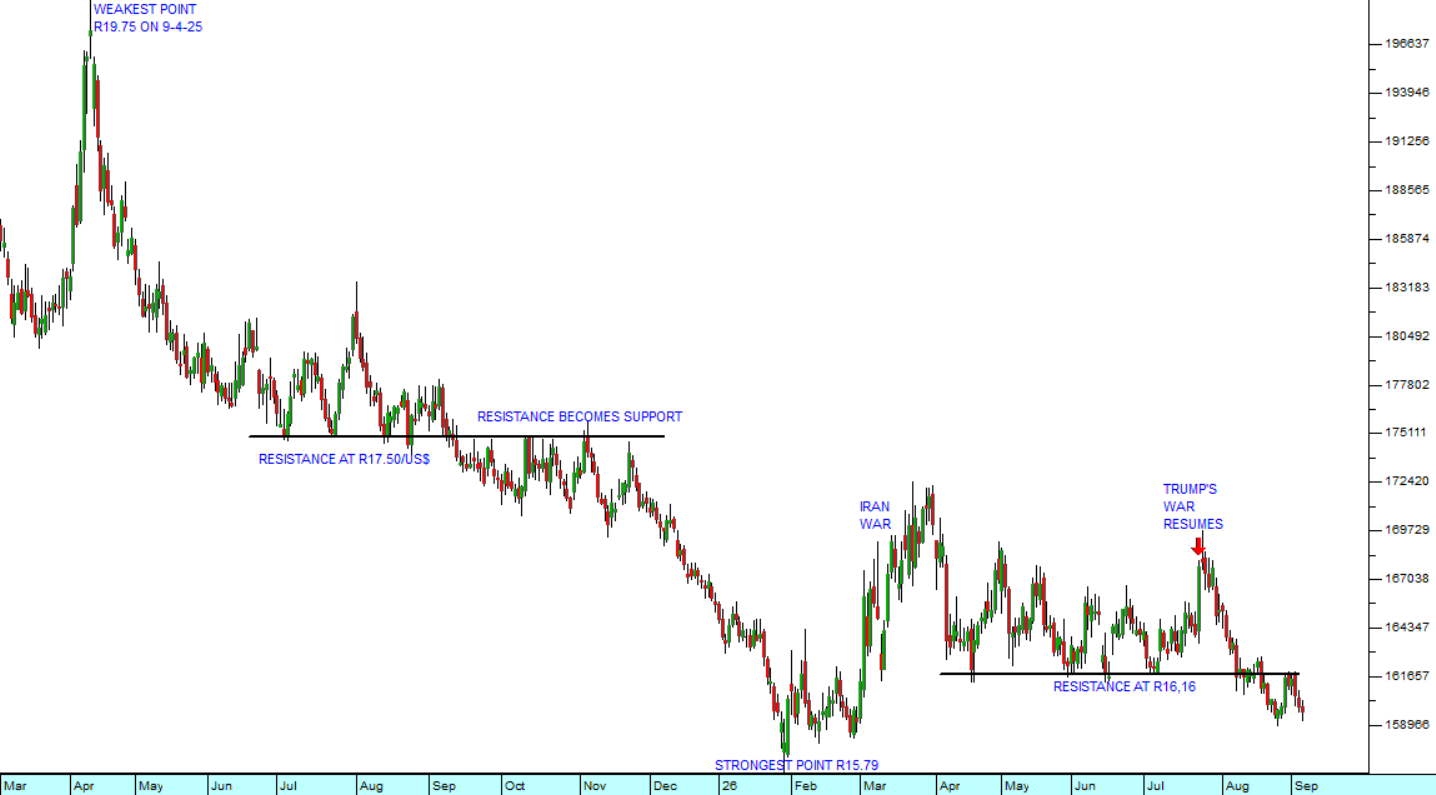
On 10th April 2025 one euro would have cost you R21,90 and today it costs R18,53. On the same day, one British pound would have cost you R25,34 whereas today it costs only R21,56 and of course over the same time period the US dollar has fallen from being worth R19,75 to being worth R15,96. Consider the chart:

South African rand/US dollar : March 2025 - 4th of September 2026. Chart by ShareFriend Pro.

What is significant about this chart is that it clearly shows the steady improvement in international sentiment towards South Africa. The massive, well-informed international investors of the world are betting on our country and putting their money here instead of elsewhere. That is a significant vote of confidence and one which many South Africans caught up in the cut and thrust of daily life here do not appreciate.

In our view, the rand is about to break below its previous cycle low of R15.79 to the US$ made on 29th January 2026. The outcome of the municipal elections on 3rd November 2026 will have a significant impact. If the ANC loses further ground and the DA gains ground (which is what we believe will happen) then you can expect the rand to appreciate further.

A stronger rand is good for everyone in South Africa. It means lower fuel prices, lower inflation, lower interest rates, more stability and a better future for everyone involved in the economy. It is the most telling and reliable indicator of our progress as a nation.

JSE Top 40

103,152.00 (-0.65%)

All Share

110,826.00 (-0.66%)

Financial 15

25,218.00 (-0.93%)

J200
J203
J212
Top Gainers
# Code Name Close (c) % move
1 AME AME 6631 +25.00%
2 MKR MNTKRENEW 4695 +20.20%
3 GPL GRANPRADE 180 +11.80%
Top Losers
# Code Name Close (c) % move
1 XII NUMERAL 11 -63.33%
2 MTU MANTENGU 20 -9.09%
3 SNV SANTOVA 741 -8.86%

Top Movers – Charts

Top Gainer: AME
Top Loser: XII