Market View
J200 103,420.00 -1.15% J203 111,275.00 -1.05% J210 115,887.00 -4.35% J211 128,372.00 +0.78% J212 24,948.00 +0.41% J213 139,500.00 +0.61%
Winning Shares (Top 5)
Code Name Added Price Latest % Gain % Gain/Year
GFI GFIELDS 2025-02-04 32915 60570 +84.02% +63.10%
CHP CHOPPIES 2025-03-06 85 167 +96.47% +77.22%
PPE PURPLE 2025-04-16 120 175 +45.83% +40.31%
MTN MTN-GROUP 2025-01-15 9729 21174 +117.64% +84.86%
IVT INVICTA 2024-07-09 2875 3630 +26.26% +13.77%
Opinions (Top 5)
Code Name Date Action
TFG TFG 2026-06-08 View

The Foschini Group (TFG) is an international retailer of 28 fashion brands. It has 4083 trading outlets in 32 countries around the world. It has a division in London and one in Australia, aside from its extensive presence in the South African market. One of the notable achievements of TFG is that it has managed to establish a successful business in Australia where many other retailers (like Woolworths) have failed.

TFG bought the Retail Apparel Group (RAG) in Australia for just over $300m in 2017. TFG has allowed the Australian management team virtual autonomy in the management of the business and has not attempted to manage it from South Africa. Over the long term, TFG has been a consistent performer in one of the most difficult industries in South Africa, with stiff competition from overseas brands and local clothing retailers.

We regard TFG as the best of the retail clothing companies and it is well diversified overseas which gives it a rand hedge element. Retail is normally very much impacted by the business cycle, but the TFG board has shown its ability to manage the business profitably in many difficult environments where others have failed.

In its results for the year to 31st March 2026 the company reported revenue up 7,2% and headline earnings per share (HEPS) down 33,5%. The company said, "Group performance was adversely affected by a weaker second half, as trading conditions deteriorated across all operating regions.

The impact of softer peak season demand and lower gross margins resulted in negative operating leverage". From December 2024 TFG has been in a downward trend. We believe that this remains a very well-managed company which should be accumulated on weakness. Wait for a break up through the 200-day moving average before investigating further. 

MRP MR-PRICE 2026-06-08 View

Mr. Price (MRP) is a retailer of clothing, household goods and sportswear through shop fronts and online in Africa and Australia. Unlike most retailers, Mr. Price receives most of its sales in cash, but there is a growing credit element. Mr. Price has a reputation for being cheaper than other stores.

This was a definite advantage during COVID-19 as consumers tried to stretch the buying power of their income. In our view, this is a good share doing extremely well in a very difficult industry, especially in the current economic environment in South Africa. There is little doubt that Mr. Price has grown its market share at the expense of other clothing retailers during the COVID-19 period.

On 15th March 2021, the company announced the acquisition of Yuppiechef, a primarily online retail kitchenware business for an undisclosed amount. In its results for the 52 weeks to 28th March 2026 the company reported revenue up 4,2% and headline earnings per share (HEPS) up 8%.

The company said, "The group's retail sales growth of 4.3% (FY2025: 7.8%) was higher than the Retailers' Liaison Committee (RLC) growth of 4.0% (FY2025: 5.0%). The group expanded its annual gross profit (GP) margin by 70bps to 41.2%, despite the retail sector being highly promotional". Technically, the share has been drifting down since its peak in December 2024 and has definitely become "oversold".

We regard it as good value at the current level. In our view, this is a very high quality share that should be accumulated on weakness. On a P:E of 11,83 it is beginning to look really cheap. On 17th March 2026 the company announced that its deal to acquire 100% of the Pegasus Group (NKD) had become unconditional. 

OMU OMUTUAL 2026-06-05 View

Old Mutual (OMU) is a premium African financial services group that offers a broad spectrum of financial solutions to retail and corporate customers across key market segments in seventeen countries. Old Mutual's primary operations are in South Africa and the rest of Africa, and it has niche businesses in Latin America and Asia.

This company is what is left after Quilter, Brightsphere and most of Nedbank, were unbundled from the original Old Mutual Plc which was listed on the London Stock Exchange. Some estimates indicate that Old Mutual is about 30% below the company's embedded value. Currently, the company has about R1,one trillion under management.

A large part of its loss in the period was the R8bn write-down in its investment in Nedbank which is now recovering. The company unbundled 62m Nedbank shares into the hands of shareholders worth about R10,4bn in the ratio of 1,32 Nedbank shares for every one hundred Old Mutual shares held.

Obviously, insurers like OMU are vulnerable to the impact of the pandemic and the company announced a R2bn increase in its provisions in this regard. In its results for the year to 31st December 2025 the company reported net asset value (NAV) up 2% and life APE sales up 3%. Headline earnings rose by 24% and gross written premiums were 3% higher.

The company said, "Net underwriting margin of Old Mutual Insure increased by 60 basis points to 6.8% supported by the continued operational turnaround and disciplined underwriting. In the second half, underwriting margin was impacted by a once-off exceptional provision related to a third-party cell in Old Mutual Alternative Risk Transfer Insure.

Adjusting for this, net underwriting margin would have been 8.3%". In an operating update for the 3 months to 31st March 2026 the company reported Life APE sales up 28% and gross written premiums up 1%. The company said, "Strong Life APE sales growth of 28%. Excluding a large risk deal in Old Mutual Corporate, Life APE sales was up by 15%, indicating sales momentum across most clusters.

Strong recovery in the value of new business margin to 1.6%" On a PE of 6,37 and a dividend yield (DY) of 5,79%, we see still this blue-chip, share as relatively cheap now, especially after the sell-off this year resulting from the Iran war. Technically, the share was moving sideways from March 2020, but now looks to be entering a new downward trend since February 2026.

Certainly, it is not expensive at current prices.

SEB SEBATA 2026-06-05 View

Sebata (SEB) is an investment holding company with four divisions - software solutions, water technologies, ICT support services and consulting. Their software solutions division consists of Sebata which offers IT services to municipalities and public entities, Freshmark which provides IT solutions to fresh produce providers, and Rdata which offers an accounting package for the public sector.

Water technologies consists of Utility Systems, electronic water control and pre-payment devices, and Amanzi Meters which supplies water meters to the residential market. ICT support services consists of Turrito Networks, which provides telecommunications and managed solutions to the SME and corporate market, and Dial-a-Nerd, which provides IT support to SMMEs and professionals.

The Consulting division consists of Utility Management Services, which assists municipalities with meter reading and debt management, and Mubesko Africa, which consults to local government supplying draft policies and long-term financial planning. Its market, which consisted primarily of municipalities, is renowned for being badly managed and for failing to pay their debts.

In its results for the six months to 30th September 2024 the company reported revenue of R83,75m and a headline loss of 0,13c compared with a loss of 9,91c in the previous period. In an update for the 3 months to 31st December 2025 the company estimated that its FY2025 results would be published by early January 2026 and the results for the 6 months to 30th September 2025 would follow in a few weeks.

In a trading statement for the year to 31st March 2026 the company estimated that HEPS would be between 90,66c and 110,66 compared with a loss of 102,2c in the previous year. The share was suspended on the JSE on 1st October 2025 and remains suspended. In a quarterly progress report Sebata advised that FY2025 results would be released by no later than the 17th of April 2026.

NCS NICTUS 2026-06-05 View

Nictus (NCS) is a furniture and electrical appliance retailer with three stores in South Africa. It also sells short-term insurance through Corporate Guarantee. In its financials for the six months to 30th September 2025 the company reported headline earnings per share (HEPS) of 41,04c compared with 26,51c in the previous period.

The company said, "The retail industry, specifically for high-value durable goods, has been negatively affected by the fact that consumers remain under pressure due to the struggling local economy with persistent and increasing levels of sustained unemployment." In a trading statement for the year to 31st March 2026 the company estimated that HEPS would increase by between 74,28% and 94,28%. The enduring problem with this company is that its shares are far too thinly traded to be practical for private investors.

Winning Share: MTN
Opinion: NCS
Market Catching its Breath  (2026-06-08)

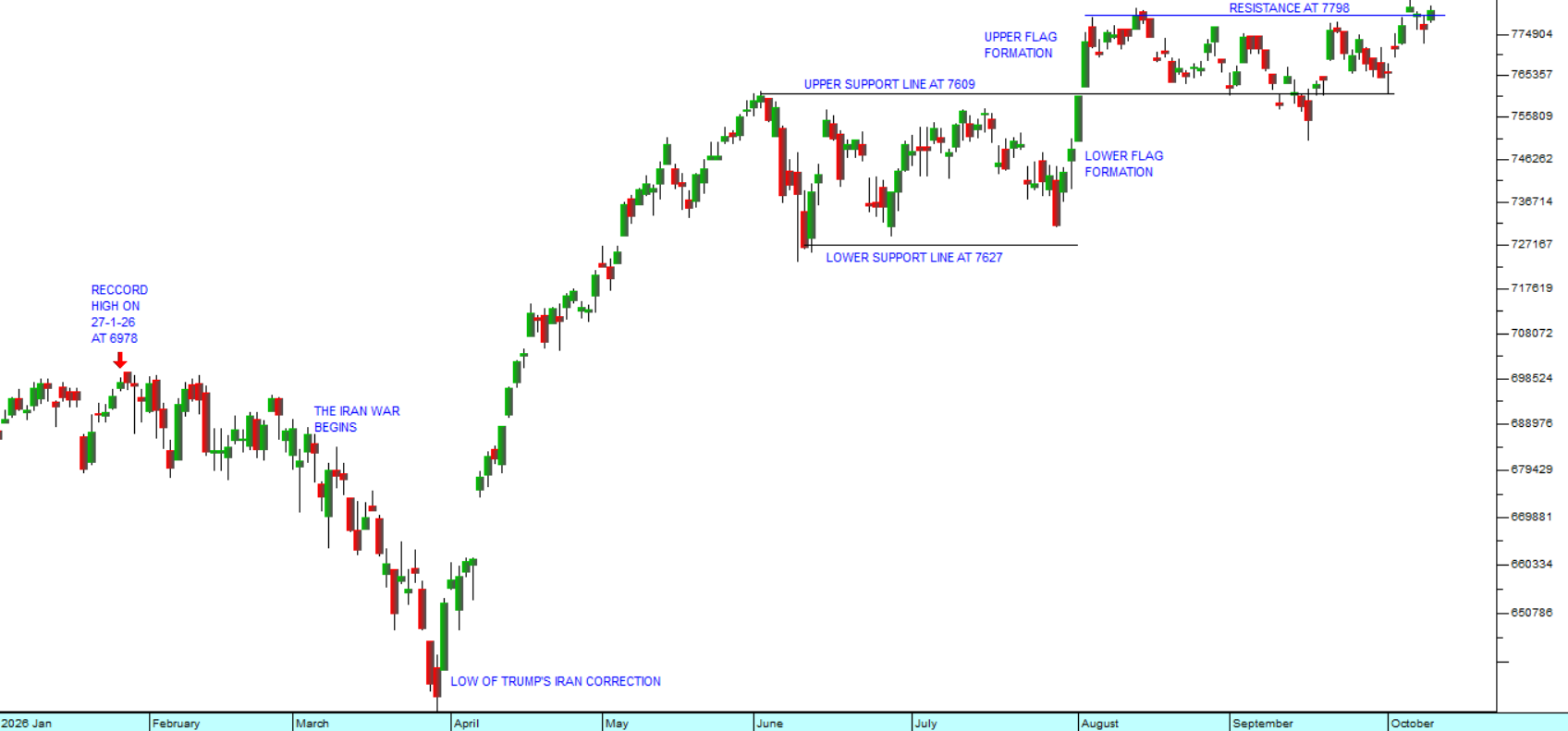
Experienced investors know that when a market has run hard for a while, as it has for the last two months, some sort of correction is more-or-less inevitable. We suggested in the recent Confidential Report that right now you should be looking for that correction – and then on Friday the 5th of June…

Experienced investors know that when a market has run hard for a while, as it has for the last two months, some sort of correction is more-or-less inevitable. We suggested in the recent Confidential Report that right now you should be looking for that correction – and then on Friday the 5th of June 2026, the S&P500, which was teetering after having made a new record high (7609.78) fell by an impressive 2,64%. Consider the chart:

S&P500 Index : 21st of January 2026 - 5th of June 2026. Chart by ShareFriend Pro.

The anatomy of a correction is that the positive news in the market reaches a point where it has been heavily over-discounted and shares begin to look seriously vulnerable and over-priced. Profit taking then sets in and the market falls back to more reasonable levels. This is a natural and normal pattern - even healthy - which reflects the interaction of the two great human emotions which dominate the market – fear and greed.

The fundamentals of a share can indicate what profits are likely to flow from owning it, while the technicals show the thrust of investor sentiment towards or away from it. When it comes to analysis, there are two kinds of people in the market – those that say they will not buy a share unless they can see the “real” value (the fundamentalists) – and those who say that the real value does not matter. What matters is what people think the real value is (the technicians). In other words, the reality and the perception of that reality.

And markets, like wildfires, can sometimes create their own energy. They can reach a point where they get carried up or down by the mere fact of their own momentum. In the longer term, the positivism or bullishness which is driving this market up today is beginning to become a self-fulfilling prophecy. Some investors are now coming into the market, not because they have done their homework and can see the earning potential of the shares that they want to buy, but rather because they are confident that in a few weeks’ or months’ time, someone with even less knowledge than them will buy the same shares back from them at a higher price.

When this begin to happen, the share’s price tends to lose touch with its underlying fundamentals and become over-priced. The fundamentals may be very good – but the important question is, “Are they good enough to justify the current price?” In 1998, during the dot-com boom, the blue sky potential of the nascent internet boom seemed immense – just as the potential of AI seems immense to us today. But, markets went too far, bid shares up too high, and inevitably fell back to more reasonable levels. However that did not mean that the potential of the internet was suddenly gone – far from it. The internet’s potential was only just beginning to be understood. It was just that markets had become too excited and lost sight of their underlying fundamentals.

We pointed out in our article of 18 May 2026 that the S&P 500 chart is becoming exponential. The blue sky potential of shares is now the dominant factor in investors’ assessments, with the focus shifting to possible future profits rather than established track records. Investors are concentrating on forward, rather than historical, P:E ratios. It is sobering to realise that all three of the enormous new listings coming to Wall Street this year—SpaceX, OpenAI, and Anthropic—are still unprofitable..

In our view, the current correction on Wall Street, and hence on markets around the world including the JSE, is more than likely temporary. After a period of selling, the downward trend will almost certainly give way to bullish investors seeking to buy the dip. Since there is no obvious fundamental factor driving this downward trend we see it as almost completely technical – and therefore temporary and healthy. The market is literally catching its breath.

What is interesting is that the JSE Overall index made its record high on 27th February 2026, at 128456, and has been basically trending down since then. It is apparent that local investors never really believed much in Wall Street’s strong recovery from Trump’s Iran war correction. We have found that often the JSE is a leading indicator of what happens on Wall Street.

Southern Sun Hotels  (2026-05-25)

The Hotel business was probably the worst hit of all sectors during the pandemic in 2020. With the travel restrictions and the various difficulties aimed at preventing the spread of the disease, many business people simply elected to stay at home and conduct meetings on Zoom or Skype. Conventions of…

The Hotel business was probably the worst hit of all sectors during the pandemic in 2020. With the travel restrictions and the various difficulties aimed at preventing the spread of the disease, many business people simply elected to stay at home and conduct meetings on Zoom or Skype. Conventions of various sorts which are major business for hotels also stopped almost completely. Gradually, over the proceeding years the situation has steadily improved, and occupancy rates have climbed back.

From an investor’s viewpoint, the hotel industry offers a very secure and relatively unexciting investment. It has a substantial investment in land and buildings and it has a large staff contingent. In normal times, it can be expected to grow steadily as the economy grows. It remains sensitive to political risk and economic external shocks.

Southern Sun Hotels (SSU) was spun out of Tsogo Sun (TSG) and separately listed on 12th June 2019 – immediately before COVID-19. The share opened at 400c and quickly rose to 460c. It was always expected to be a solid well-traded institutional counter. As the pandemic gained momentum, the share collapsed, eventually reaching an intra-day low of 102c on 23rd March 2020.

At that point it was trading well below its net asset value (NAV), clearly under-priced given its huge property asset base and potential. Slowly, as investors began to realise that the pandemic was past its worst levels and that a vaccine would be produced, they looked around for bargains in the market and SSU was an obvious candidate. Consider the chart:

Southern Sun Hotels (SSU) : January 2020 - 22nd May 2026. Chart by ShareFriend Pro.

You can see here the impact of the pandemic on the newly-listed SSU. At the time we always said that COVID would result in a V-bottom and therefore a buying opportunity precisely because it was a black swan event and its effects would not last. In our article published on 13th March 2020 we said, “...my expectation is that we will see a “V-bottom” in the chart...” SSU (together with many blue chip shares) moved sideways at its worst level for about year and then began to recover.

Then in February 2022, Russia invaded Ukraine and the share price collapsed again – but this time not as badly as during COVID, which was by that time already fully discounted. The subsequent recovery was slow and steady. We finally added the share to the Winning Shares List (WSL) on 17th May 2024 at a price of 555c, but a more adventurous investor might easily have bought it much earlier and at lower levels.

The chart also shows the impact of Trump’s tariffs which initially caused a significant sell-off and, more recently this year, his war with Iran. Both of these events offered private investors further solid buying opportunities, especially for a relatively low-risk share like SSU.

In its results for the year to 31st March 2026 the company reported income up 9% and headline earnings per share (HEPS) up 20%. The company said, "Trading momentum increased in the second half of the year, with broad-based improvements across all regions underpinned by major international conferences and events including the G20 in Gauteng and improved transient demand in South Africa."

Since we added the share to the WSL it has risen 80% in two years. We believe it will continue to perform well as the economic reforms of the government of national unity (GNU) begin to eliminate or at least reduce some of the absurdities in the South African economy. The November municipal elections at the end of this year are likely to increase and consolidate the DA’s grip on the GNU making this effect more pronounced.

Exponential Bull Trend  (2026-05-18)

The current bull trend, in our opinion, began in 2009 from the low point on the S&P500 index of 676 reached on 9th March of that year. It has now been going on for over 17 years – making it the longest bull trend in the history of Wall Street by far. On Thursday, May 14, 2026, the S&P 500 closed at…

The current bull trend, in our opinion, began in 2009 from the low point on the S&P500 index of 676 reached on 9th March of that year. It has now been going on for over 17 years – making it the longest bull trend in the history of Wall Street by far.

On Thursday, May 14, 2026, the S&P 500 closed at a new all-time record high of 7,501 and the Dow Jones Industrial index went back above 50 000. This means the market has gone up 11-fold over the past 17 years. The question which investors have to ask themselves is, “How much further up can it go?” – and nobody really knows the answer to that question.

The historical price:earnings ratio (P:E) of the S&P500 is now just under 32 – which is well above its average level, but this does not necessarily mean that it cannot go higher. The fundamentals driving the 500 shares which make up the index are a direct function of their perceived future earnings and their potential to increase those earnings even further.

This in turn is a function of the on-going impact of new technologies like AI, and humanoid robotics on productivity levels. The problem is that during a protracted bull trend like this one, markets tend to become over-enthusiastic about that future potential, to the point where they begin to create their own momentum. Then share prices can begin to lose touch with the underlying profitability of the companies which they represent – and Wall Street is certainly moving in that direction.

A similar situation arose in the 1920’s when the new technologies of the motor car and the telephone began to become ubiquitous. These technologies impacted the profitability of all companies big and small giving rise to the “Roaring Twenties”. As Wikipedia puts it, “...the decade was characterized by economic prosperity, rapid social and cultural change, and a mood of exuberant optimism.

The problem is that investors tend to push share prices up so high that their potential to produce concomitant profits becomes irrelevant to investors. In other words, the investors get carried away in the excitement and bid shares up to absurd and unsustainable levels. Eventually a “bigger fool” point is reached where investors buy a share, not because of its earnings potential, but because a bigger fool will buy it back from them in a few weeks for even more money. The inevitable result is a 1929-style crash.

So, we need to ask, “Is Wall Street at a similar position now?” We believe it is getting there, but not yet. The new technologies are certainly impacting profitability across the board but the upward trend has not yet become crazy. It is still linked to future profits. So, we believe that Wall Street is still at a relatively early stage in this process and that the bull trend will continue for quite a while, getting steadily more and more excessive.

Our view is that the profitability gains flowing from AI are only just beginning. We are expecting far greater gains in the future. In our view America and the world is at much the same point that it was at, say, in 1923 or thereabouts, just when the Roaring Twenties were just getting going.

Sometimes it is useful to step back from the immediate excitement of the latest all-time record highs to look at the big picture. Consider the following chart which shows the progress of the S&P500 index since the start of this great bull trend 17 years ago:

S&P500 Index : November 2008 - 15th of May 2026. Chart by ShareFriend Pro.

The chart shows the progress of the S&P500 index since March 2009. You can see there the low point of 676 followed by a very gentle upward slope until about 2016. Thereafter, the gradient increased, but not very much and it was interrupted by the COVID-19 pandemic in 2020. Bear in mind that we regard COVID-19 as an aberration, not directly related to the stock market from a technical point of view. After that came the war in Ukraine which held the market back for a time, but since then the market has been accelerating despite Trump’s two interventions. What you can see from this chart is that the market is definitely becoming exponential. It is going up faster and faster. The move from 7000 on the S&P to 8000 is definitely quicker than the move from 6000 to 7000. The chart is rising almost vertically now.

And we can only imagine where the S&P500 would be now if the Brent oil price was still at around $70 per barrel instead of close to $110. Trump’s war in the Middle East has had the effect of temporarily cooling markets, but it has been insufficient to dampen the tidal wave of investor enthusiasm for the “blue sky” potential of AI and related technologies.

It is always fun to participate in the final stages of a great bull market, but you must be aware that nothing goes up forever. Your best protection against the coming bear, whenever it happens, is to maintain a strict stop-loss strategy on all your share investments. Remember, it is acceptable to widen your stop-loss percentages when your investments are strongly in-the-money, but you can never lose sight of the fact that at some unpredictable date in the future the market will come down – so it is important to have a clear strategy that locks in your profits.  

JSE Top 40

103,420.00 (-1.15%)

All Share

111,275.00 (-1.05%)

Financial 15

24,948.00 (+0.41%)

J200
J203
J212
Top Gainers
# Code Name Close (c) % move
1 PMV PRIMESERV 324 +15.71%
2 MRP MR-PRICE 17200 +14.67%
3 CHP CHOPPIES 167 +11.33%
Top Losers
# Code Name Close (c) % move
1 SDL SOUTH-PD 1351 -13.40%
2 VAL VALTERRA 118366 -8.47%
3 ZED ZEDER 113 -8.13%

Top Movers – Charts

Top Gainer: PMV
Top Loser: SDL