Market View
J200 108,761.00 -1.73% J203 116,257.00 -1.62% J210 133,837.00 -3.82% J211 123,073.00 -0.36% J212 26,042.00 -0.65% J213 139,283.00 -0.48%
Winning Shares (Top 5)
Code Name Added Price Latest % Gain % Gain/Year
BTI BATS 2024-07-19 60060 90281 +50.32% +23.76%
KST PSG-FIN 2024-05-23 1610 3210 +99.38% +43.70%
MTN MTN-GROUP 2025-01-15 9729 18900 +94.26% +58.02%
TBS TIGBRANDS 2023-12-01 18295 26870 +46.87% +17.04%
CLI CLIENTELE 2026-05-05 1880 1971 +4.84% +32.12%
Opinions (Top 5)
Code Name Date Action
OMU OMUTUAL 2026-09-01 View

31-08-2026 Old Mutual (OMU) is a premium African financial services group that offers a broad spectrum of financial solutions to retail and corporate customers across key market segments in seventeen countries. Old Mutual's primary operations are in South Africa and the rest of Africa, and it has niche businesses in Latin America and Asia.

This company is what is left after Quilter, Brightsphere and most of Nedbank, were unbundled from the original Old Mutual Plc which was listed on the London Stock Exchange. Some estimates indicate that Old Mutual is about 30% below the company's embedded value. Currently, the company has about R1,one trillion under management.

A large part of its loss in the period was the R8bn write-down in its investment in Nedbank which is now recovering. The company unbundled 62m Nedbank shares into the hands of shareholders worth about R10,4bn in the ratio of 1,32 Nedbank shares for every one hundred Old Mutual shares held.

Obviously, insurers like OMU are vulnerable to the impact of the pandemic and the company announced a R2bn increase in its provisions in this regard. In its results for the year to 31st December 2025 the company reported net asset value (NAV) up 2% and life APE sales up 3%. Headline earnings rose by 24% and gross written premiums were 3% higher.

The company said, "Net underwriting margin of Old Mutual Insure increased by 60 basis points to 6.8% supported by the continued operational turnaround and disciplined underwriting. In the second half, underwriting margin was impacted by a once-off exceptional provision related to a third-party cell in Old Mutual Alternative Risk Transfer Insure.

Adjusting for this, net underwriting margin would have been 8.3%". In an operating update on the six months to 30th June 2026 the company reported life annual premium equivalent sales up 21% and gross flows up 21%. Gross written premiums increased by 3% and the value of new business was up 32%.

On a PE of 6,47 and a dividend yield (DY) of 5,71%, we still seel this blue-chip share as relatively cheap now, especially after the sell-off this year resulting from the Iran war. Technically, the share was moving sideways from March 2020, but now looks to be entering a new downward trend since February 2026.

Certainly, it is not expensive at current prices.

BVT BIDVEST 2026-09-01 View

31-08-2026 Bidvest (BVT) is a highly diversified South African company with dozens of subsidiaries. Its most notable investments are 66% of Bidvest Namibia which also owns a large property portfolio rented out to various Bidvest companies and 56.13% of Adcock Ingram. Its subsidiaries are organised into 6 divisions - Services, Freight, Automotive, Office, Print & Commercial Products, Financial Services and Electrical.

The directors of each operating company are allowed considerable autonomy within this structure provided they produce good returns. This is the opposite of most listed companies, which aim to retain their focus on a single area of business and constantly sell off or close down "non-core" businesses.

Diversification of this sort has the benefit that it reduces risk. When one division is performing badly, the others are performing well. The company is also constantly making new acquisitions. The acquisition of PHS, UK's largest cleaning service was well timed coming immediately before the huge increase in demand for cleaning that followed COVID-19.

The company's investment in alternative energy sources is seen as a potential profit generator. On 3rd July 2024 the company announced that it will be looking for a buyer for Bidvest Bank and FinGlobal. At the same time it announced that acquisition of Citron Hygiene LP. In its results for the year to 30th June 2026 the company reported revenue up 3% and headline earnings per share (HEPS) from continuing operations up 6%.

The company said, "Cash generated from operations and free cash generated excelled with increases of 16.9% (+R2.5 billion to R17.2 billion) and 26.9% (+R2.6 billion to R12.5 billion), respectively. This, together with strong treasury management, culminated in a gearing ratio of 1.9x (FY2025: 2.2x) without the planned capital recycling proceeds".

Bidvest now trades on a P:E of 11,97 - and we believe it still represents good value at these levels. Technically the share has been falling since October 2025, but we believe it represents good value at current levels and, although volatile, is now in a new upward trend. On 12th December 2024 Bidvest announced that it had sold Bidvest Bank for R2,8bn. 

BEL BELL 2026-09-01 View

31-08-2026 Bell (BEL) is a manufacturer and distributor of heavy equipment, earth-moving equipment to the mining construction, agriculture, and waste management industries. As such, it has been directly impacted by the slow-down in construction since 2008 and collapse of the mining industry.

Bell's articulated dump trucks are exported world-wide from South Africa and Germany. Bell also has dealerships for a number of other global manufacturers, giving it a product range of over 120 products. Roughly 60% of its business comes from outside South Africa. The company employs 3200 people of whom 88,6% are in South Africa.

The CEO of Bell, Gary Bell has indicated to Business Day that the company would consider delisting with 1A Bell making an offer to minorities (but he did not disclose at what price). Some of those minority shareholders are now saying that the board has a fiduciary duty to put the company up for sale to the highest bidder.

In its results for the year to 31st December 2025 the company reported revenue down 5% and headline earnings per share (HEPS) down 11%. In July 2024 the share rose sharply on a proposed buyout by the controlling family, but shareholders rejected their offer. Since then the share has been drifting down.

In a trading statement for the six months to 30th June 2026 the company estimated that HEPS will fall by between 67% and 76%. We do not see this as a great investment for private investors. On 4th March 2026 Bell announced that they had concluded a "collaboration" with CNH Industrial to supply construction equipment branded motor graders.

On 11th June 2026 the company announced that the CEO, Ashley Bell, has resigned with effect from 31st August 2026. He will be replaced by Izak van Niekerk.    

AEL ALTRON-A 2026-09-01 View

31-08-2026 Allied Electronics Corp, or Altron (AEL), is an information and communications technology company which was started by Bill Venter in 1965. It has recently been re-focusing on its core business and has sold its 80% stake in Powertech and its 100% subsidiary, Altech UEC (a developer of set-top boxes).

Powertech was also sold to a BEE consortium. Altron is in the process of selling CBI Telecom Cables. Altron operates in six African countries as well as the UK and Australia. The company said it had "...secured key wins in both the public and the private sector...", including the Gauteng Broad Band Network phase 2 contract and FNB's data and analytics contract.

Netstar won the eThekwini 3-year contract for vehicle tracking for 7000 vehicles. Bytes, in the UK, which has now been unbundled and separately listed both in the UK and in an inward listing on the JSE, won a 5-year contract for Windows 10 from the NHS (UK). Altech aims to re-structure its debt to reduce its interest bill and has resumed paying dividends.

They acquired Phoenix Software in the UK for R698m. On 17th December 2020, the company announced the successful listing of its subsidiary Bytes Technology on the London Stock Exchange (LSE) at a price of GBP2.70. In its results for the year to 28th February 2026 the company reported revenue up 1% and headline earnings per share (HEPS) up 34%.

The company said it had an, "Ungeared balance sheet supported by strong cash generation, with cash generated from operations of R1.9 billion and closing cash balance of more than R1 billion". In an operational update for the six months to 31st August 2026 the company reported, "Group EBITDA and operating profit increased by low-to-mid-teen percentages, underpinned by continued operational discipline and operating leverage, enabling the conversion of revenue growth into stronger earnings growth".

The company has no debt on its balance sheet. Technically, the share has been in a strong rising trend, but was moving sideways from January 2025. A new upward trend began in May 2026 with the publication of its results. The results caused the share price to jump. We expect the upward trend to continue now.

RNG RANGOLD 2026-09-01 View

Rangold (RNG) is a mining exploration company. It has a strong asset base which is mostly now in cash. It is being used to pursue legal claims and may be applied to investment opportunities. Since Brett Kebble died, the company has been going after various entities against which it has a legal claim.

In early 2011 the company paid a dividend of 90c as a result of a British court order against Paul Main which was forced to repay GBP4m. In July 2014, the company was able to pay out a dividend to shareholders of 225c as a result of a R150m settlement with auditors PWC. There are still a variety of legal matters outstanding which could result in further settlements of around R3bn.

In its results for the six months to 30th June 2026 the company reported a headline loss of 10,54c per share and net asset value (NAV) down 29,27% to 45,44c per share. The share is thinly traded and has been drifting down on thin volumes for many years. Since June 2026 the share has popped up to 380c, but it remains to be seen if this can be sustained.

It has an average of R107 000 rands worth of shares traded each day which does make it practical for a small investment.

Winning Share: TBS
Opinion: OMU
Harmony Takes Off  (2026-08-24)

The gold price has been in a persistent correction since its record high on 28th January 2026. It has been in what technical analysts call a descending flag formation which we have drawn you attention to on several occasions. As with any formation we are looking for the direction of the breakout…

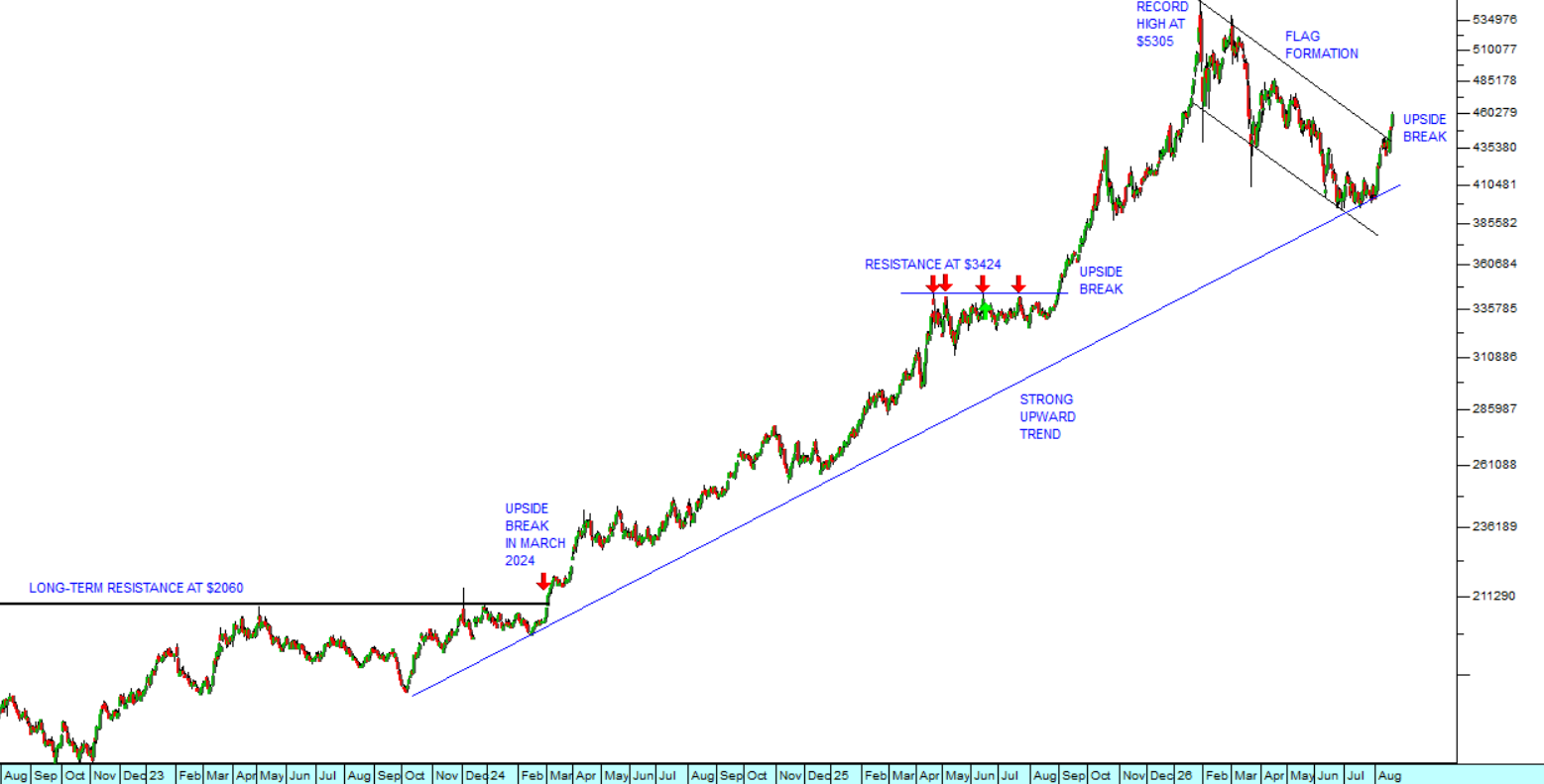
The gold price has been in a persistent correction since its record high on 28th January 2026. It has been in what technical analysts call a descending flag formation which we have drawn you attention to on several occasions. As with any formation we are looking for the direction of the breakout from that formation to give a clear idea of the future trend. In the case of gold, we have always been confident that it would break to the upside – and that is what it did last week on 19th August 2026. Consider the chart:
Gold price in US dollars : August 2022 - 21st Of August 2026. Chart by ShareFriend Pro.

The chart shows the US dollar price of gold since August 2022. It broke up out of a long-term sideways pattern in March 2024, and we drew your attention to that in the Confidential Report at the time. The chart shows how the upward trend was paused in 2025 until the precious metal broke above resistance at $3424 and it shows the all-time record high of $5305 on 28th January 2026.

The flag formation has taken place between two parallel downward sloping trendlines, showing how gold lost about $1000 over 5 months then found support before breaking to the upside.

As a private investor you should be thinking about which shares would have enabled you to capitalise on gold’s amazing run – and one of the best was Harmony. Of course, gold shares are always going to be speculative and risky, but under the right circumstances they can provide an excellent long-term investment.

In the case of Harmony, the key, for us, was its purchase of the Mponeng gold mine for $200m in September 2020. This was a very brave, potentially dangerous acquisition and we waited for some time before recognising that they were making a success of it. Mponeng is the deepest mine in the world. It is currently mining at depths of around 3800 meters with plans to go deeper to 4200 meters. This means that it is operating 2 kilometres below sea level from the Highveld near Carletonville. At those depths the grade is excellent - around 11,27 grams per ton – more than double the average grade for South African gold mines. The problem is that mining at those extreme depths is expensive and potentially very dangerous. It is the very definition of a high-risk, high-return investment.

We added Harmony to the Winning Shares List (WSL) on 16th November 2023 at a price of 9920c per share. It reached an all-time high of 40841c on 28th January this year before falling back as gold corrected. Since 3rd August 2026 it has been moving up strongly again as gold recovered. Consider the chart:
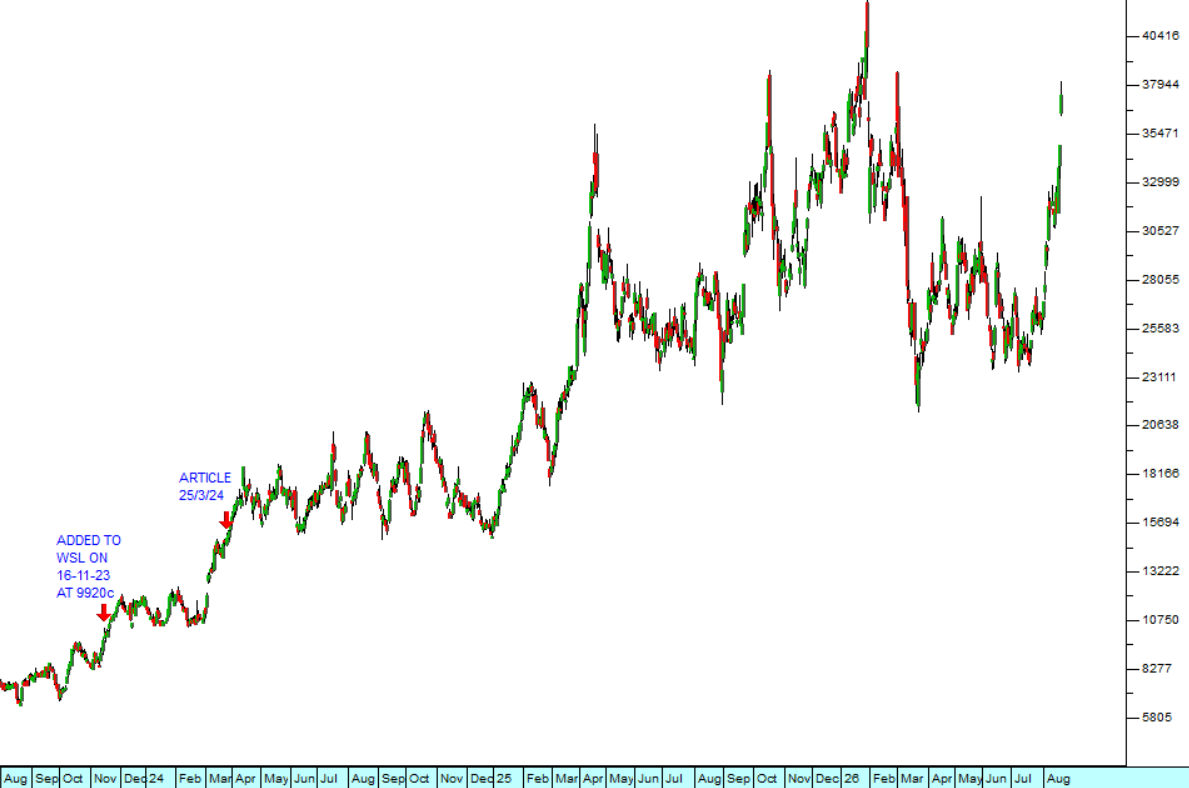
Harmony (HAR) : August 2023 - 21st of August 2026. Chart by ShareFriend Pro.

Harmony published an excellent trading statement on Friday last week, predicting that its headline earnings per share (HEPS) would increase by between 90% and 105% in US dollars. 

Altogether, Harmony has risen by more than 250% since we added it to the WSL nearly 3 years ago and we believe it will continue to perform well – but it remains a commodity share and hence both volatile and risky.
A New Record High  (2026-08-16)

A couple of weeks ago we wrote an article about the sideways market that the S&P500 was in at the time. In that article we pointed out that while the market had been moving sideways for three months, the actual companies which the market represented had been continuing to grow and develop. We…

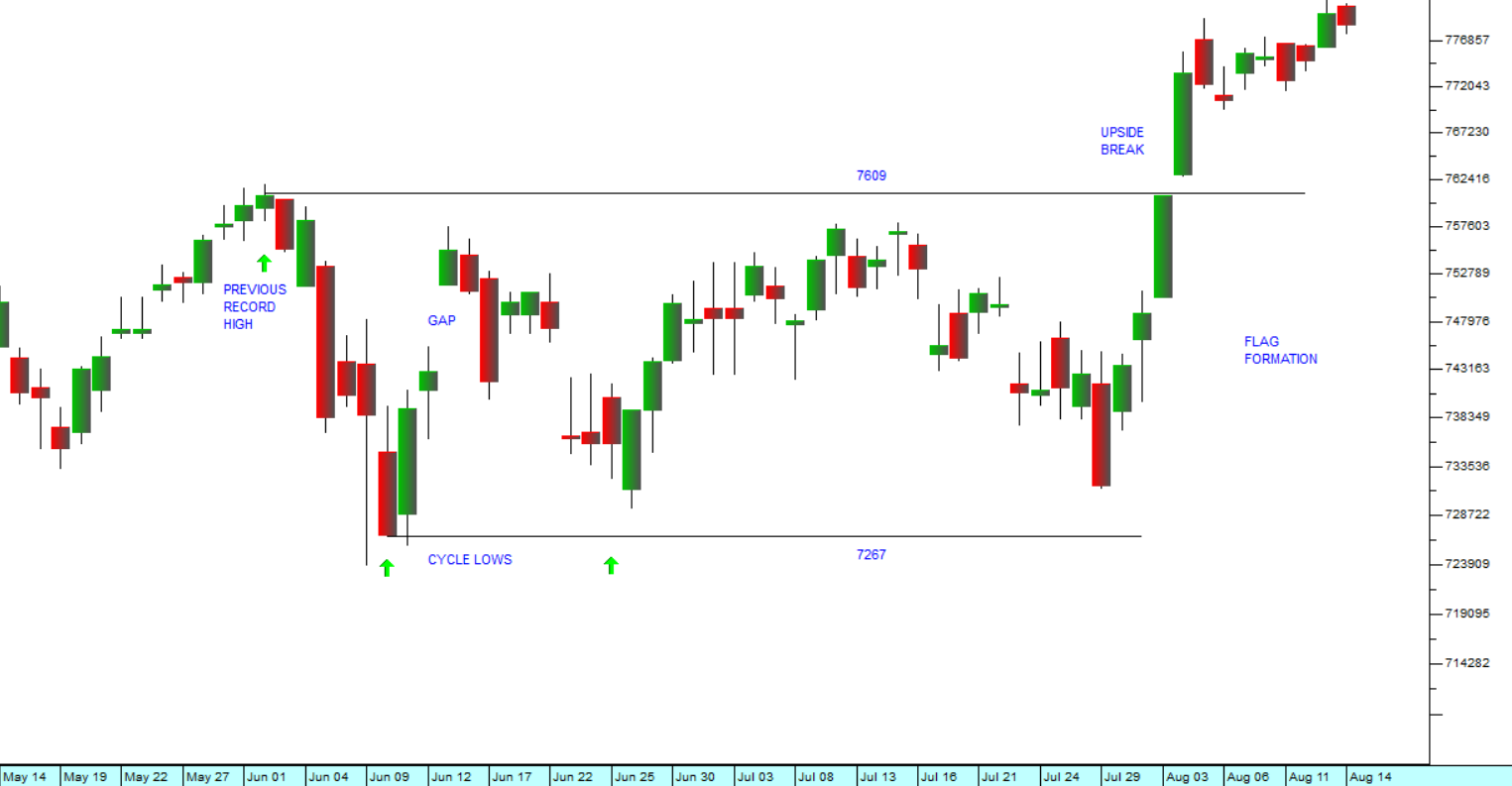
A couple of weeks ago we wrote an article about the sideways market that the S&P500 was in at the time. In that article we pointed out that while the market had been moving sideways for three months, the actual companies which the market represented had been continuing to grow and develop. We anticipated that the market would break to the upside out of that flag formation and that when it did it would have to catch up the growth of the previous three months. Consider the chart:

S&P500 Index :14th of May 2026 - 14th of August 2026. Chart by ShareFriend Pro.

The chart shows how the S&P was moving sideways between the previous record high of 7609 made on the 6th of June 2026 and the low of 7267 made on the 10th of June 2026. Then on the 4th of August 2026 the S&P broke strongly to the upside and made a series of new record highs – just as we expected.

From a fundamental perspective, lower-than-expected inflation and a slower level of job creation gave the market hope that the Federal Reserve Bank would not raise interest rates again at the next meeting of the monetary policy committee (MPC) on the 15th and the 16th September 2026. The consumer price index (CPI) fell to 3,4% in July 2026 from June’s figure of 3,5%. The drop gave investors hope that the worst of the effects of the Iran fuel price hike were behind and that inflation was again moving down.

The producer price inflation figure for the year to the 31st of July 2026 was also encouraging at 4,7% - significantly lower than June’s figure of 5,5% and reflecting the drop-off in the oil price. We believe that interest rates in America will probably remain unchanged until the end of this year.

The stalemate in Trump’s war and its impact on world oil prices appears to have stabilized with North Sea Brent Oil hovering roughly $15 per barrel above where it was before the war began. While developments in the war are still a factor, investors’ attention is back to focusing on the figures coming out of the companies which make up the S&P, especially the so-called Magnificent Seven.

In Q2 2026, Apple was the hero with earnings per share (EPS) up an impressive 29% year-on-year, followed by Microsoft’s 32% gain. Alphabet, Amazon, Meta, and Tesla delivered solid revenue, above forecast, but this was heavily counterbalanced by massive capital expenditure increases mainly for artificial intelligence infrastructure.

Nvidia is reporting its results for the second quarter in a few days’ time on the 26th of August 2026. Wall Street is anticipating another blowout quarter with analysts looking for exponential growth fuelled by the relentless demand for artificial intelligence infrastructure.

What is also clear to us is that Americans are expecting Trump and the Republicans to perform very badly in the coming November mid-term elections, almost certainly losing the House of Representatives and possibly even the Senate. If this happens, it will make Trump into a “lame dog” president, unable to pass any legislation against Democrat opposition. There is also now the clear possibility that he could be forced to resign as a result of increasingly poor health or because he is impeached.

Whatever happens it is clear that his influence over the stock market is declining rapidly. The market has lost interest in his interminable erratic announcements on Truth Social and is instead caught up in the excitement over the productivity benefits of new technologies.

We expect that the S&P will continue to climb to further new record highs and take all world markets up with it, including the JSE. 

Spur Corporation  (2026-08-11)

Everyone in South Africa knows the Spur chain of restaurants. It has been one of the strongest South African brands for decades. Over the years Spur has branched out into a variety of other well-known brands, built its own manufacturing base to supply raw materials to its restaurant chain and…

Everyone in South Africa knows the Spur chain of restaurants. It has been one of the strongest South African brands for decades. Over the years Spur has branched out into a variety of other well-known brands, built its own manufacturing base to supply raw materials to its restaurant chain and expanded internationally. More recently, it has been capitalising on the move towards online ordering of food with many of its restaurants now participating in what it describes as a “virtual kitchen”.

From an investment perspective, the business has the disadvantage of having a working capital element (stock and debtors) and a large staff throughout the country. These risks are substantially mitigated by the fact that most of its restaurants are owned and run by franchisees who are required to buy all their materials from Spur. An important factor is that at 31st December 2025, Spur had over R400m in the bank and almost no appreciable debt. This means that it is well-positioned to take advantage of any opportunities, while being insulated against external shocks.

Of course, the restaurant business is dependent on consumer spending. So, the company’s 753 restaurants need to be constantly patronised by people looking to eat a meal which they have bought rather than cooked themselves. A large proportion of this is sit-down meals in restaurants, but a growing percentage is take-away food ordered online and then delivered.

The restaurant business is based on the reality that everyone has to eat every day and that a good proportion of people will choose at least several times a month to get a ready-made meal even though it is more expensive. Their ability to do this is dependent on their available discretionary cash – and that depends on such things as the increase in real salary levels and the demands on their take-home pay like the cost of fuel and interest rates.

So, Spur’s business is generally aimed at higher income groups, and its success is a function of their perception of how well-off they are. When times are tight, they cut back on dining out – something which happened earlier this year when Trump decided to start a war with Iran resulting in a sharp increase in the cost of fuel and then later a 25 basis point hike in the level of interest rates.

In our view, the impact of the war in Iran is gradually subsiding. This can be seen in lower price of oil, the rands strength and the fact that the monetary policy committee (MPC) decided to keep interest rates on hold at its most recent meeting on 23rd July 2026. We believe that the oil price will continue to decline steadily over the coming months and years as the world economy adjusts to the new situation and moves more and more towards renewables. In other words, this external shock is really just a “bump in the road” for investors and hence probably represents a buying opportunity.

It their results for the six months to 31st December 2025 the company reported revenue up 8,5% and headline earnings per share (HEPS) up 13,6%. In a trading statement for the year to 30th June 2026 the company estimated that adjusted HEPS would increase by between 5% and 13%. The share trades on a dividend yield (DY) of 6,11% and a price:earnings ratio of 11,26. The DY, particularly is of interest to private investors. Any quality company on the JSE trading on a DY of 5% or more is worthy of your attention.

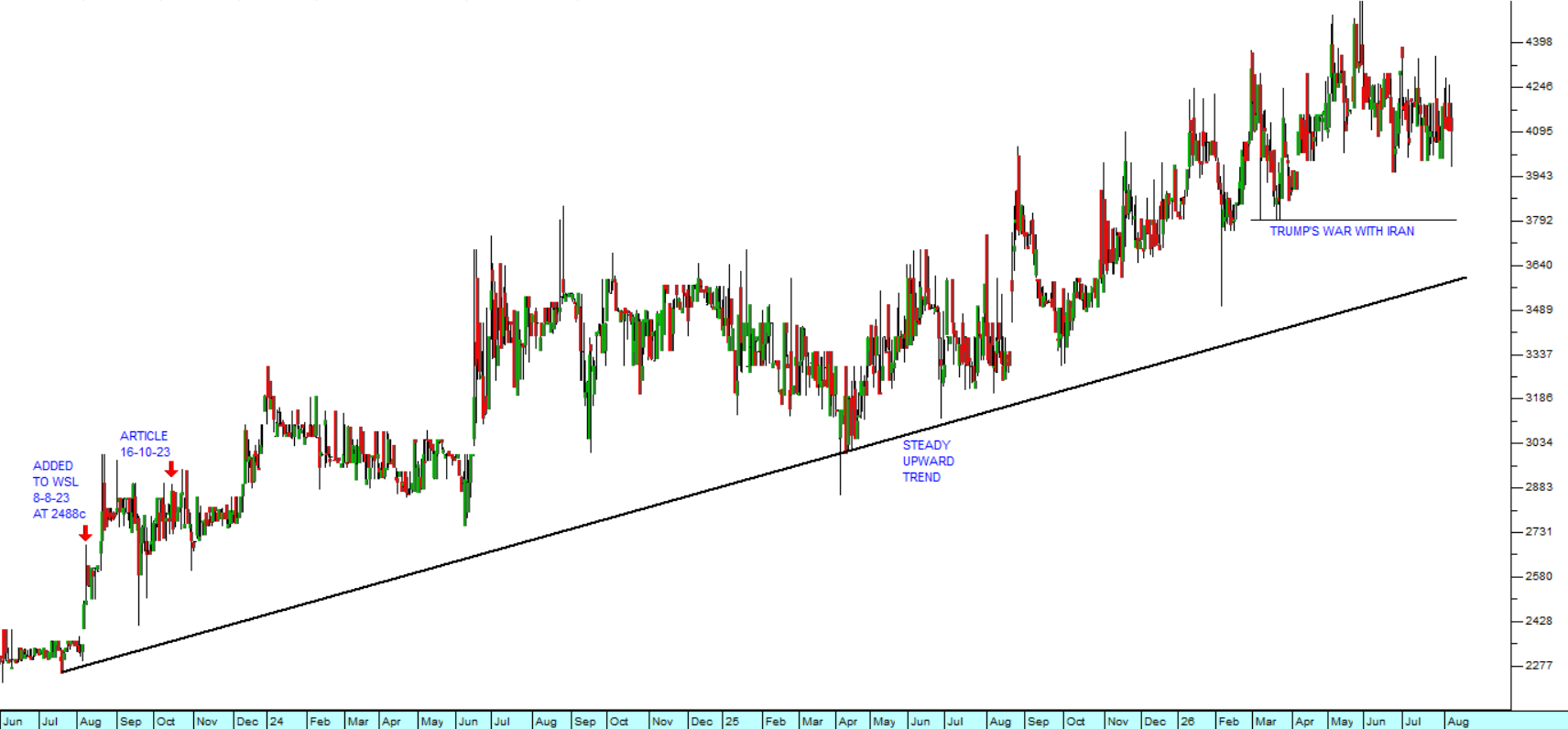
We first added Spur to the Winning Shares List (WSL) on 8th August 2023 at a price of 2488c. Since then, it has been in a steady upward trend paying good dividends which keep growing and maintaining its strong balance sheet. Consider the chart:

Spur (SUR) : June 2023 - 7th of August 2026. Chart by ShareFriend Pro.

We wrote an article about Spur shortly after we added it to the WSL on 16th October 2023 in which we said that we believed that it was “an excellent addition to any private investor’s portfolio”. 

We continue to believe in its long-term investment potential, and we also believe that consumer spending in South Africa will recover as the year progresses and the benefits of our relatively low inflation rate become more apparent.

JSE Top 40

108,761.00 (-1.73%)

All Share

116,257.00 (-1.62%)

Financial 15

26,042.00 (-0.65%)

J200
J203
J212
Top Gainers
# Code Name Close (c) % move
1 MCZ MC-MINING 309 +27.69%
2 GML GEMFIELDS 73 +15.87%
3 SLG SALUNGANO 110 +10.00%
Top Losers
# Code Name Close (c) % move
1 ISB INSIMBI 86 -12.24%
2 CNP CANALPLUS 5210 -9.64%
3 TEX TEXTON 280 -8.79%

Top Movers – Charts

Top Gainer: MCZ
Top Loser: ISB